News Analysis
China on Sept. 9 marked a half century since the death of Mao Zedong, founder of the communist regime, while the country still grapples with his grim legacy.
Some young Chinese people have embraced Mao even as current Chinese Communist Party (CCP) leader Xi Jinping adopts Mao’s methods to tighten control over Chinese society, which analysts who spoke to The Epoch Times saw as a sad choice.
Mao died on Sept. 9, 1976, at age 82. His death hastened the end of the Cultural Revolution, a violent mass movement he launched in 1966, which caused millions of deaths.
The Cultural Revolution was the CCP’s systemic eradication of religions, traditional Chinese values and culture, as well as modern democratic ideals, while removing Mao’s political rivals within the Party. “Killing the Christians, Taoists, Buddhists, and popular folk groups solved the problem of religions. Mass murders during the Cultural Revolution established, culturally and politically, the CCP’s absolute leadership,” according to The Epoch Times’ 2004 editorial “Nine Commentaries on the Communist Party.”
Between 1949 and 1976, under the rule of Mao, the CCP caused tens of millions of unnatural deaths through political campaigns, forced labor, and historic famines, while hundreds of millions of Chinese lived in poverty.
Related Stories


“Since 1949, more than half of China’s population has suffered persecution by the CCP, including an estimated 80 million who died from unnatural causes. This number exceeds the total number of deaths in both world wars combined,” noted “Nine Commentaries on the Communist Party.”
In renowned China historian Frank Dikötter’s book “The Tragedy of Liberation,” the total civilian death toll across the first eight years of CCP rule (1949–1957) is estimated at more than 5 million unnatural deaths, driven by mass terror campaigns, land reform, and political purges.
The Great Leap Forward (1958 to 1962)—an economic and social campaign led by Mao and the CCP aimed at rapidly catching up and surpassing the United States and the UK—devastated Chinese agricultural production through forced collectivization, severe labor diversion, and flawed central planning that triggered the catastrophic Great Chinese Famine. It’s estimated that it caused about 40 million unnatural deaths and reduced births from 1959 to 1961. It’s “likely to be the world’s greatest famine in this century,” according to the 1994 book series “Historical Records of the People’s Republic of China.”
Following Mao’s death in 1976, the Gang of Four, which included Mao’s wife, were officially blamed by the CCP for the Cultural Revolution and put on trial to shield Mao from direct political blame.
In the “Resolution on Certain Questions in the History of Our Party Since the Founding of the People’s Republic of China” passed in 1981, the CCP officially evaluated the legacy of Mao, which is “seven parts achievement and three parts error,” preventing further criticism of Mao while preserving Mao’s cult of personality as the symbol of the communist regime.
“All totalitarian regimes share the characteristics of cult of personality and dictatorial leadership,” Feng Chongyi, associate professor of China studies at the University of Technology Sydney, said of the worship of Mao in China.
“Whether they appear in a right-wing guise—like Hitler in Nazi Germany—or a left-wing one—such as Stalin in the Soviet Union, Mao Zedong in China, Castro in Cuba, or Ceausescu in Romania—a whole host of communist states fall into this same category,” he told The Epoch Times.
Sheng Xue, a Canada-based writer and rights activist, told The Epoch Times that she believes that the CCP cannot truly denounce Mao. “If the CCP wants to hold Mao Zedong accountable for all the crimes he committed, it is equivalent to admitting that the CCP should be reclassified as a criminal group and a terrorist group since the founding of the party.”
She said that the official CCP narrative—attributing the failures of the Mao era to the excessive concentration of power and the cult of personality—completely sidesteps the real issue. “The crux of the matter lies in the system of tyranny established upon communist ideology,” she said.
Feng also said that once Mao is stripped of his status and thoroughly repudiated, the CCP’s foundations will become unstable. “This will undermine its legitimacy and lead to the loss of power. The conclusion that Mao was ‘70 percent right and 30 percent wrong’ is utterly absurd—it is worlds apart from historical truth.”

Photos from the Cultural Revolution. Public Domain
Xi Resorts to Mao’s Methods
Chinese state media outlets simultaneously published articles extolling Mao on Sept. 9.
Xi’s father, former Vice Premier Xi Zhongxun, was purged and brutally persecuted during the Cultural Revolution, while the family home was ransacked. The teenage Xi was labeled a “reactionary student,” and subjected to interrogation and coercive political study. At age 15, Xi was sent away from Beijing to the remote village of Liangjiahe in Shaanxi Province to work in a farm under the name of receiving “re-education” from peasants.
“Today, Xi Jinping is not merely emulating Mao but aiming to surpass him. The two most critical foundations of his ideology and values are Mao Zedong and the Cultural Revolution,” Sheng said.
“Mao could be considered a leader of the Third World—spanning Asia, Africa, and Latin America. Now, Xi wants to be a leader for the entire world,” she said. “That is why, immediately upon taking office, Xi introduced the concept of a ‘community with a shared future for mankind.’”

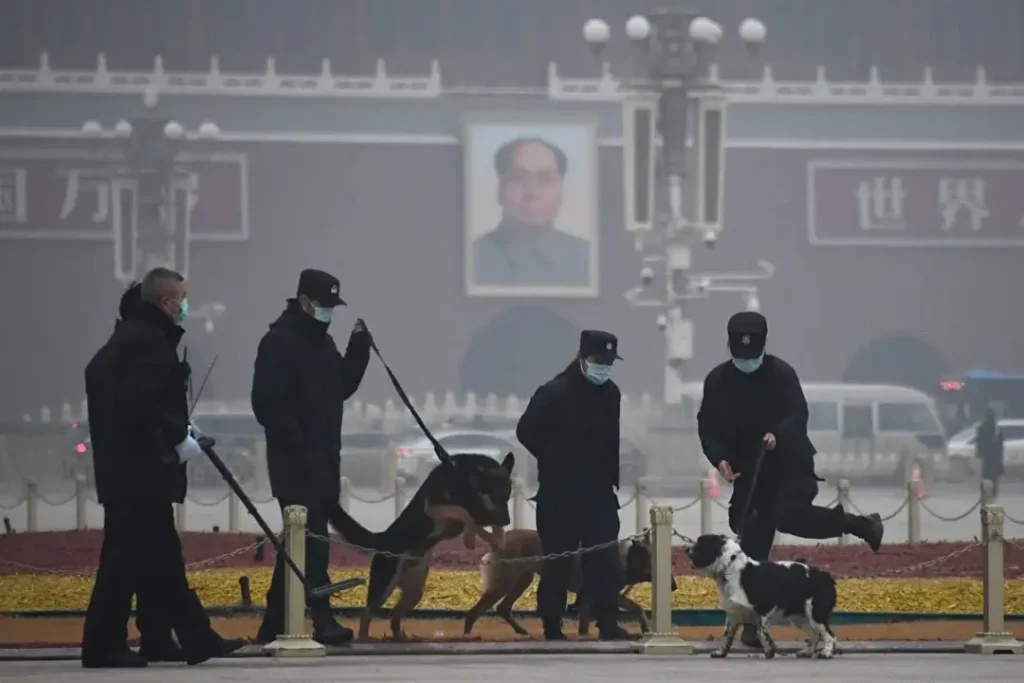
Police patrol Tiananmen Square before the opening session of the Chinese People’s Political Consultative Conference in Beijing on March 4, 2025. Vincent Thian/AP Photo
Following the CCP’s launch of “Reform and Opening Up,” the market economy and external ideas flowed into China, sparking an awakening across society, Feng said. “Although civil society hasn’t been established, widespread and close ties with the outside world were re-established, posing a challenge to the CCP.”
“What Xi Jinping is doing now represents the hardline faction within the Party,” he said. “In an effort to safeguard their hold on power, he is reverting to the Maoist model—a move that runs counter to historical trends as well as the interests and will of the Chinese people.”
In fact, the Cultural Revolution has never really ended, as its ideology has persisted through the entire structure of the CCP’s totalitarian tyranny and its instruments of oppression, Sheng said. “The CCP’s ‘Reform and Opening Up’ was a sham from the start. Its sole purpose was to loosen economic constraints on the people so they could generate wealth—wealth that is, in large part, used to bolster the state power of the CCP.”
Frustrated Youth Look Back to Mao
Following the Chinese regime’s national flag-raising ceremony at Beijing’s Tiananmen Square, a long queue formed to visit Mao’s Mausoleum, including both elderly people and young people of the post-1990 and post-2000 generations, while students’ memorial activities were held in Shanghai, Mao’s old residence, according to state media outlet Jiefang Daily.
Hundreds of Mao fans began gathering on Sept. 8 at the Mao Zedong Bronze Statue Square in Shaoshan, Hunan Province, Mao’s birthplace. Some held portraits of Mao and red flags or banners bearing pro-Mao slogans, others dressed as Red Guards in the Cultural Revolution, and some traveled to Shaoshan from other provinces, according to multiple Chinese language media reports.
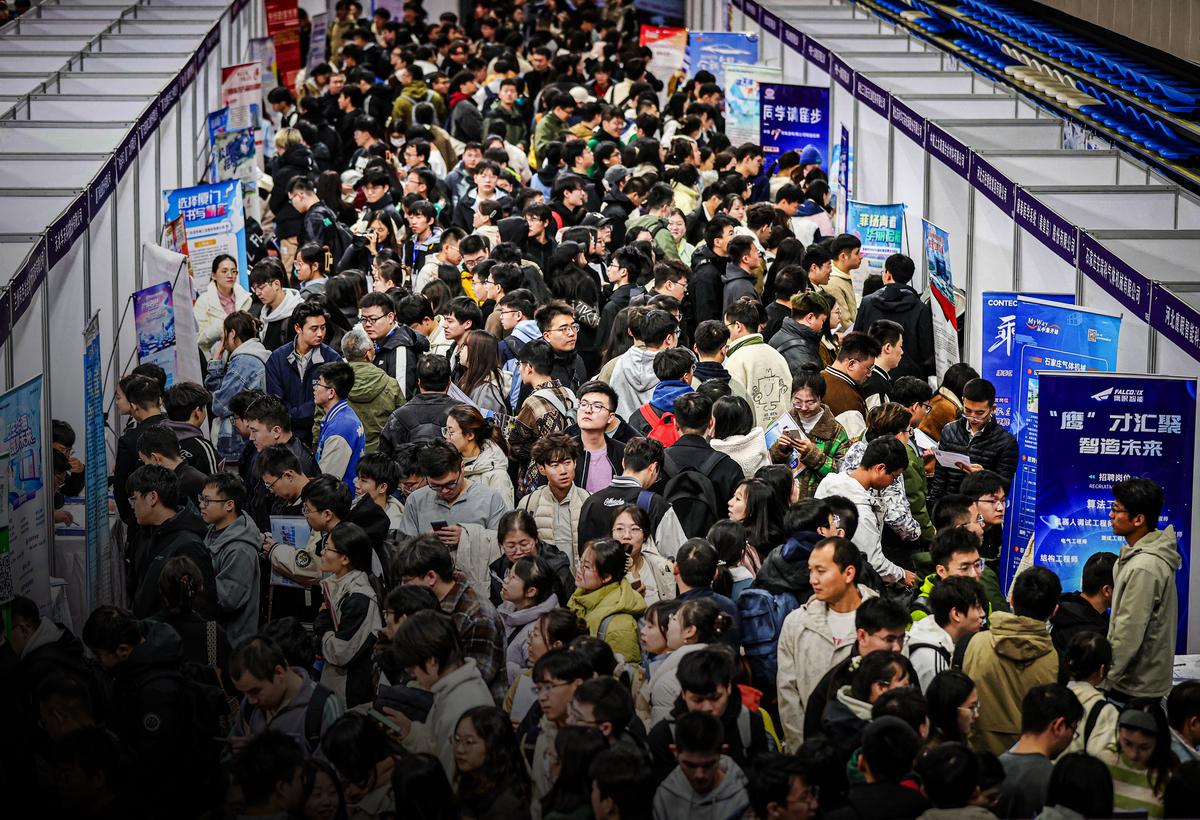
People attend a job fair in Shenyang, Liaoning Province, China, on Oct. 22, 2024. China’s National Bureau of Statistics reported that the urban unemployment rate for youth aged 16 to 24, excluding students, fluctuated between 13.2 percent and 18.8 percent from December 2023 to March 2025. STR/AFP via Getty Images
Amid the current political turmoil, economic downturn, and falling employment rates, young people see absolutely no hope for the future, Sheng said, and “the point of reference they look back to is, sadly, the Mao era.”
Under the state-run system of the Mao era, the authorities largely controlled the allocation of food, clothing, housing, and daily necessities of urban residents, resulting in a relatively equal distribution of poverty—a situation that some now look back on with nostalgia given today’s vast class disparities, Sheng said. “The Chinese people lack the ability to move forward [under the CCP’s rule], so the only outlet now is to look backward. This is precisely a situation brought about by Xi Jinping.”
Sheng warned, “Many people travel to Mao Zedong’s hometown to pay homage. It is a deeply distressing phenomenon.” She said that Mao was one of the most heinous figures in human history. “His rule resulted in the greatest scale and highest number of human casualties ever recorded. Yet, he remains worshiped and admired by many. Of course, in a totalitarian environment, the vast majority of people’s thinking is confined by the boundaries set by the CCP.”
Feng said that young Chinese people’s use of Mao to criticize the contemporary China ruled by the CCP is a sad choice.
“Many protests in China have been suppressed. The CCP makes full use of the internet, the social credit system, and various digital tools to control Chinese people,” he said. “Being unable to mount effective resistance, people turn to Mao—using Mao Zedong’s own words to criticize the current leadership of Xi Jinping.”
Tang Bing and Luo Ya contributed to this report.