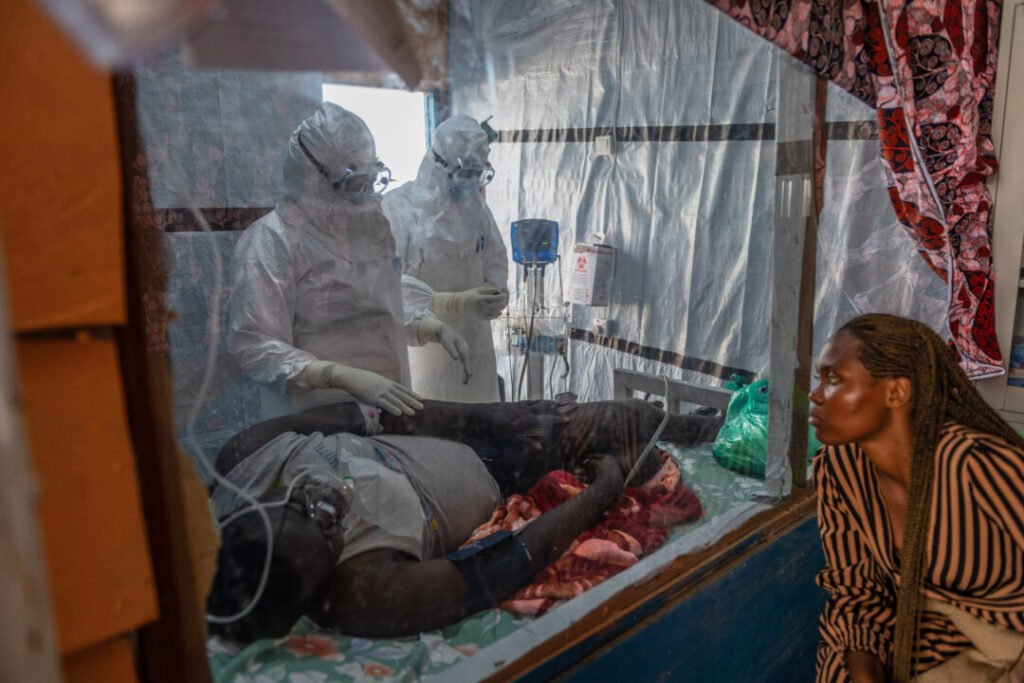
The number of Ebola cases in Congo has exceeded 7,000, with the infection now detected in a new province.
In total, 7,022 confirmed cases have been reported as of Thursday, according to a Sept. 11 report from the Congo government.
The total number of confirmed deaths stands at 3,398, with the case fatality rate at 48.4 percent. A total of 1,671 people have recovered. Most infections, 5,538 cases, have been reported in Ituri province. North Kivu and Haut-Uele are other provinces significantly impacted by the infections.
A new province, Sud Ubangi, reported its first Ebola case, with the person dying from the disease. The individual was a 23-year-old man who left South Kivu province on July 10.
Out of the total 167 health zones in Congo, 62 are affected by Ebola infections. Province-wise, seven provinces have been impacted.
According to the report, care quality remains partially below standards, with limited capacity to treat patients.
Related Stories


In Ituri province, treatment centers are overcrowded in some areas. In Haut-Uele, one treatment center lacks sanitary facilities, while another lacks permanent access to water and electricity.
In Tshopo province, patient care has been negatively affected by a lack of safe blood and technical issues. In Bas-Uele, the report said, there is a lack of treatment centers and ambulances.
According to the World Health Organization (WHO), the Ebola outbreak was confirmed in Congo and Uganda in May 2026.
WHO said in a Sept. 10 statement that a total of 6,778 confirmed Ebola cases have been reported worldwide in the outbreak as of Sept. 7, out of which Congo accounted for 6,757 cases. Uganda reported 20 cases, and France reported one.
“The sustained level of transmission in the Democratic Republic of the Congo continues to pose a risk of cross-border spread,” the WHO said.
“Health screening and surveillance activities remain operational at airports, ports, and official land border crossings; however, travel through informal crossing routes persists and may facilitate virus exportation, importation, and subsequent transmission,” according to the agency.
Moreover, the crisis is unfolding amid significant humanitarian challenges in Congo, including armed conflict, food shortages, and population displacement.
Over 26 million people in Congo suffer acute food insecurity. Other challenges include overcrowding, limited water, and restricted access to healthcare in mining communities. Ituri, the province most impacted by the Ebola outbreak, is home to roughly a million internally displaced individuals, WHO said.
David Stevenson, the World Food Programme’s country director for Congo, said that since Congo is affected by food insecurity, conflict, and displacement, there needs to be a more “comprehensive approach” when tackling the Ebola outbreak.
Commenting on Ituri, Stevenson said, “It’s a place where there are over 500,000 people in IPC 4 of hunger and food insecurity.” IPC 4 is the second-most severe level on the food insecurity scale. This level is only “one notch short of mortality from starvation,” Stevenson said.
Meanwhile, the U.S. Centers for Disease Control and Prevention said in a Sept. 12 statement that to date, no Ebola illness cases have been confirmed anywhere in the United States linked to the ongoing outbreak in Congo.
To minimize the risk of importing Ebola, the agency said it has temporarily restricted entry into the United States for travelers who visited Congo recently.