

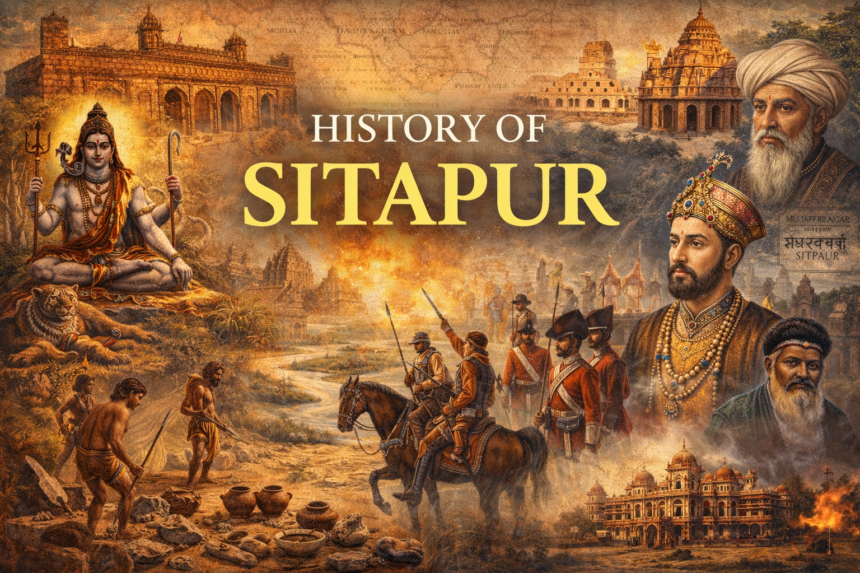
Sitapur History: Nestled in the heart of Uttar Pradesh, the district of Sitapur stands as a living testament to India’s rich and layered history. Spanning from the shadows of ancient mythological times to the bustling modernity of the 21st century, Sitapur’s story is woven into the very fabric of India’s historical tapestry. This comprehensive exploration traces the incredible journey of this land, uncovering how it evolved from prehistoric settlements to becoming a crucial administrative and cultural center in modern India.
The name ‘Sitapur’ itself whispers legends, believed by many to derive from ‘Sita,’ the revered consort of Lord Rama from the Hindu epic Ramayana. Whether mythological or historical, this connection establishes Sitapur’s deep roots in Indian cultural consciousness. Covering approximately 5,743 square kilometers, this region has witnessed the rise and fall of empires, the clash of civilizations, and the quiet evolution of cultures that have shaped its unique identity.
As we embark on this 8,800-word journey through time, we’ll uncover archaeological secrets, revisit legendary battles, trace cultural transformations, and examine how Sitapur has navigated the complex transition into modernity while preserving its historical essence. This isn’t merely a chronological account but an immersive exploration of how geography, politics, culture, and economics have continuously reshaped this remarkable region.
Geological Foundations: The Land Before History
Before human history began its slow march across the region, the land that would become Sitapur was shaped by geological forces that made it particularly hospitable to civilization. Situated in the fertile Gangetic plain between the mighty Ghaghara and Gomti rivers, the area benefited from rich alluvial soil deposited over millennia. This geographical blessing would prove instrumental in attracting successive waves of settlers throughout history.
The Gomti River, a tributary of the Ganges, has been the lifeline of Sitapur since time immemorial. Its gentle flow and reliable water supply created ideal conditions for agriculture, while its course served as a natural transportation route long before roads were conceived. The river basin’s ecology supported diverse flora and fauna, providing early inhabitants with abundant resources for sustenance and development.
The region’s relatively flat topography, interspersed with gentle undulations and occasional wetlands, created micro-environments that supported different types of human activity. Elevated areas provided safety from seasonal floods, while the fertile lowlands yielded bountiful harvests. This environmental diversity allowed for the development of complex societies capable of adapting to changing conditions—a resilience that would characterize Sitapur throughout its history.
Archaeological evidence suggests that the climate of the region has remained broadly stable for the last 10,000 years, with monsoon patterns establishing themselves in a form recognizable today. This climatic stability provided the predictability necessary for agricultural societies to flourish, setting the stage for the historical developments that would follow.
Prehistoric Beginnings: The First Inhabitants
While written records of Sitapur’s earliest periods are scarce, archaeological discoveries paint a compelling picture of human activity dating back to the Paleolithic era. Stone tools discovered in various parts of the district, particularly near riverbanks and elevated grounds, indicate that nomadic hunter-gatherer communities roamed this land as early as 50,000 BCE. These early inhabitants, whose names and specific cultures are lost to time, followed migratory patterns dictated by seasons and prey availability, leaving behind only their durable stone implements as evidence of their passage.
The transition to settled life began during the Neolithic period (approximately 7000-2000 BCE), when communities in the region started practicing primitive agriculture and domesticating animals. Excavations at various sites have revealed evidence of early farming communities that cultivated barley and pulses while maintaining hunting and gathering practices. The discovery of handmade pottery with simple geometric designs suggests the development of basic craft specialization within these communities.
The Chalcolithic period (Copper Age, approximately 3000-1500 BCE) witnessed significant technological and social advancements in the region. The introduction of copper tools alongside continued use of stone implements marked a transitional phase toward metal-based technology. Settlements became more permanent, with evidence of wattle-and-daub structures and increasingly sophisticated pottery. The presence of copper artifacts in Sitapur suggests either local production or trade networks extending to mineral-rich regions, indicating that even in this early period, the area was connected to broader cultural and economic systems.
What makes Sitapur’s prehistoric period particularly fascinating is its location at a cultural crossroads. Situated between the Indus Valley civilization to the west and the emerging Ganges civilization to the east, the region likely served as a zone of cultural exchange and transmission. While no major Harappan sites have been discovered within modern Sitapur district, certain artifact styles and technological innovations suggest indirect influence from this great Bronze Age civilization.
The Vedic Era: Mythological Foundations and Early Kingdoms
The Vedic period (1500-500 BCE) represents a crucial phase in Sitapur’s historical development, marking the transition from prehistory to proto-history. During this era, the region found mention in early Vedic texts as part of the broader Madhyadesa (middle country) that formed the heartland of Vedic civilization. The fertile lands watered by the Gomti and its tributaries would have been highly attractive to the pastoral-agrarian Vedic tribes migrating eastward along the Ganges basin.
According to some scholars and local traditions, Sitapur was part of the ancient kingdom of Kosala during the later Vedic period. The Shatapatha Brahmana and other texts mention Kosala as one of the prominent Mahajanapadas (great realms) that emerged in the Ganges plain. While the core of Kosala was centered around Ayodhya and Shravasti to the east, its influence likely extended into the Sitapur region, bringing with it Vedic religious practices, social structures, and political organization.
The archaeological evidence from this period, though limited, suggests the development of more complex social hierarchies and economic specialization. Iron technology, introduced around 1000 BCE, revolutionized agriculture and warfare, enabling more extensive land clearance and more efficient food production. This technological advancement supported population growth and the emergence of larger, more stable settlements that would eventually evolve into towns.
Local folklore and place-name etymology provide intriguing insights into this period. The name ‘Sitapur’ itself, according to popular belief, derives from ‘Sita,’ the consort of Lord Rama. While historical verification of this connection remains challenging, the persistence of this tradition suggests deep cultural memory linking the region to the Ramayana narrative. Numerous temples and local legends throughout Sitapur district reference events and characters from the epic, indicating that the area was thoroughly integrated into the cultural geography of the Rama story cycle.
The late Vedic period also witnessed the development of early urbanization in the region. While not yet reaching the scale of major cities like Kaushambi or Rajagriha, settlements in the Sitapur area likely served as local administrative and ritual centers for surrounding agricultural communities. The foundations were being laid for the more complex political entities that would emerge in the subsequent period.
The Mahajanapadas and Early Buddhism: Integration into Ancient Political Systems
The period from approximately 600 BCE to 300 BCE witnessed the crystallization of political entities in northern India into 16 major states known as Mahajanapadas. During this transformative era, the Sitapur region found itself integrated into larger political systems that would shape its destiny for centuries. Historical and archaeological evidence suggests that the area was part of the powerful Kosala Mahajanapada, which reached its zenith under kings like Prasenajit, a contemporary of the Buddha.
The integration into Kosala brought the Sitapur region into contact with two of the most significant developments in ancient Indian history: the rise of Buddhism and Jainism as major religious movements, and the emergence of urban centers as hubs of political power, economic activity, and cultural innovation. While no major Buddhist monastic complexes have been discovered in Sitapur comparable to those at Sarnath or Kushinagar, the region’s position along trade routes connecting the Buddhist heartland with western India suggests it would have been exposed to these new religious ideas.
The administrative structure of Kosala likely included the Sitapur area within its western territories. The kingdom was known for its relatively sophisticated governance system, with officials overseeing revenue collection, justice, and military organization at regional levels. The adoption of such administrative practices would have represented a significant development in the political evolution of the Sitapur region, moving from tribal organization toward more formal state structures.
Economic development during this period was spurred by several factors. The increasing use of iron tools allowed for more extensive agriculture, while the emergence of coinage (punch-marked coins) facilitated trade beyond barter systems. The Sitapur region’s position between the Gangetic plain and the forests of the Terai likely made it a zone of exchange between agricultural and forest-dwelling communities, each providing resources the other lacked.
Urbanization, while still in its early stages compared to metropolitan centers like Shravasti or Kaushambi, began to transform the settlement pattern. Strategic locations, particularly along rivers and trade routes, developed into towns serving as local markets, administrative centers, and defensive positions. The archaeological remains from this period, though not extensively studied in Sitapur specifically, would likely show evidence of planned settlements, fortifications, and specialized craft production areas.
The Mauryan Imprint: Integration into India’s First Empire
The rise of the Mauryan Empire under Chandragupta Maurya in the 4th century BCE marked a watershed moment in Indian history, and the Sitapur region was inevitably drawn into this first pan-Indian political entity. Following his conquest of the Nanda Empire, which had previously absorbed Kosala, Chandragupta established control over much of northern India, including the Gangetic plain where Sitapur is located.
The most significant Mauryan connection to the region comes through the emperor Ashoka (c. 268–232 BCE), whose reign left an indelible mark on the subcontinent. While no major Ashokan edicts or pillars have been discovered in Sitapur itself, the district’s proximity to important Mauryan centers suggests it was firmly integrated into the imperial administrative system. The discovery of Northern Black Polished Ware (NBPW)—a distinctive pottery type associated with Mauryan period urban sites—at various locations in Sitapur district provides material evidence of this integration.
Mauryan administration was remarkably sophisticated for its time, with a hierarchy of officials overseeing everything from revenue collection to law enforcement. The Sitapur region, with its agricultural productivity and strategic location, would have been an important source of revenue for the empire. The famous Mauryan network of roads, described by Greek ambassador Megasthenes, likely included routes passing through or near the region, facilitating movement of troops, officials, and traders.
Ashoka’s conversion to Buddhism and his vigorous propagation of Dhamma (righteousness) had profound cultural implications across his empire. While the direct evidence of Buddhist establishments in Sitapur during this period is limited, the region’s position between major Buddhist centers like Sarnath (where Buddha gave his first sermon) and Shravasti (where he spent many rainy seasons) suggests it would have been exposed to Buddhist missionaries and institutions. The Mauryan period likely saw the establishment of early Buddhist viharas (monasteries) and stupas in the area, though these may have been modest compared to imperial foundations elsewhere.
Economically, the Mauryan period brought increased monetization and trade. The standardization of weights and measures, along with improved security along trade routes, would have stimulated economic activity in the Sitapur region. Agricultural surplus could now be more easily converted into other goods through market mechanisms, encouraging specialization and economic growth. The archaeological record shows an increase in trade items, including beads, ornaments, and pottery from distant regions during this period.
Post-Mauryan Developments: Shungas, Kushanas, and Local Kingdoms
Following the decline of the Mauryan Empire in the 2nd century BCE, northern India entered a period of political fragmentation before being partially unified under the Shunga and later Kushana empires. During these centuries, the Sitapur region experienced shifting political allegiances while continuing its economic and cultural development.
The Shunga dynasty (c. 185–73 BCE), which succeeded the Mauryas in much of northern India, continued many administrative practices of their predecessors while promoting a Brahmanical revival. This period saw the construction of numerous Hindu temples and the patronage of Vedic rituals. In Sitapur, this likely meant increased importance for Brahmanical institutions and practices, though Buddhism continued to flourish as evidenced by archaeological remains from this period across Uttar Pradesh.
The most significant development for the region came with the expansion of the Kushana Empire (1st–3rd centuries CE) under rulers like Kanishka. The Kushanas, originally Central Asian nomads who adopted many aspects of Indian culture, created an empire that stretched from Central Asia deep into northern India. While the core Kushana territories were northwest of Sitapur, their influence extended across the Gangetic plain, bringing the region into contact with the vibrant cultural synthesis of Indian, Persian, and Hellenistic elements characteristic of Kushana art and architecture.
Economically, the Kushana period was a golden age of trade, with the Silk Road connecting India to Central Asia, China, and the Roman Empire. Although Sitapur was not directly on the main transcontinental routes, it benefited from being part of a network of secondary routes connecting major trade centers. The increased flow of goods, ideas, and people during this period would have brought prosperity and cultural diversity to the region.
Numismatic evidence from this period is particularly revealing. The discovery of Kushana coins in Sitapur district indicates integration into broader economic systems. These coins, often bearing images of Kushana rulers and various deities, not only facilitated trade but also served as vehicles for cultural exchange, with Hellenistic, Persian, and Indian artistic influences blending in their design.
Religiously, this period was marked by remarkable diversity and syncretism. Buddhism, Hinduism, Jainism, and various local cults coexisted and influenced one another. The Kushanas were particularly supportive of Buddhism, convening the Fourth Buddhist Council and sponsoring the construction of monasteries and stupas. While no major Kushana-period Buddhist sites have been identified in Sitapur, the region’s proximity to Mathura (a major Kushana center and important Buddhist site) suggests it would have participated in these developments.
The Gupta Golden Age: Cultural and Administrative Refinement
The rise of the Gupta Empire in the 4th century CE ushered in what is often described as a “Golden Age” of classical Indian civilization. Under rulers like Chandragupta I, Samudragupta, and Chandragupta II Vikramaditya, much of northern India was unified under a single administration that promoted unprecedented cultural flourishing. The Sitapur region, as part of the Gupta heartland in the Gangetic plain, shared in this remarkable period of achievement.
Administratively, the Gupta period saw the refinement of systems that had developed over previous centuries. The empire was divided into provinces (bhuktis), districts (vishayas), and smaller units. While the exact administrative status of the Sitapur region during this period is not documented, it likely formed part of the Ayodhya bhukti or a similar provincial division. Gupta administration was characterized by relatively light taxation, local self-government in villages and towns, and efficient revenue collection—factors that contributed to economic prosperity.
The economic vitality of the Gupta period is well-documented, and Sitapur would have benefited from this general prosperity. Agriculture remained the foundation of the economy, with advancements in irrigation technology increasing productivity. The region’s position along trade routes connecting Gupta capitals like Pataliputra with western India would have facilitated commerce. The widespread use of gold coins (dinars) of exceptional purity and artistic quality indicates a sophisticated monetary economy in which Sitapur would have participated.
Culturally, the Gupta period was transformative. This era saw the codification of classical Sanskrit literature, the development of the decimal system and zero, remarkable achievements in astronomy and mathematics, and the flowering of Hindu temple architecture. While no major Gupta monuments have been identified in Sitapur itself, the region’s proximity to Gupta centers like Kannauj and Ayodhya ensured exposure to these cultural developments.
Hinduism underwent significant transformation during this period, with the decline of Vedic sacrifice and the rise of devotional (bhakti) worship centered on temples. The Gupta rulers were particularly devoted to Vishnu, and this sectarian preference likely influenced religious practices in regions under their control. The construction of the earliest structural temples in stone began during this period, replacing earlier wooden and brick structures. While no Gupta temples survive in Sitapur, later temple foundations in the district may have Gupta-period origins.
Buddhism continued to flourish during the Gupta period, supported by both royal patronage and popular devotion. The famous Chinese pilgrim Faxian, who traveled through India between 399 and 412 CE, reported numerous Buddhist monasteries flourishing across the Gangetic plain. Though he didn’t specifically mention Sitapur, his description of the region between Mathura and Kannauj likely includes areas that would encompass modern Sitapur district.
Post-Gupta Transitions: Harsha and Regional Kingdoms
Following the decline of the Gupta Empire in the 6th century CE, northern India entered another period of political fragmentation before temporary unification under Harshavardhana (c. 606–647 CE). The Sitapur region found itself within Harsha’s kingdom, which stretched from Punjab to Bengal. The Chinese pilgrim Xuanzang, who visited India during Harsha’s reign, provides valuable insights into this period through his detailed travel accounts.
While Xuanzang’s narrative doesn’t specifically mention Sitapur, his description of the region between Kannauj (Harsha’s capital) and Ayodhya likely includes areas within modern Sitapur district. He describes a prosperous landscape with abundant agriculture, numerous Buddhist monasteries alongside Hindu temples, and generally peaceful conditions under Harsha’s administration. This suggests that Sitapur shared in the relative stability and prosperity of Harsha’s reign.
Harsha’s administration continued many Gupta practices while adapting to changing circumstances. The king was known for his religious tolerance, supporting both Buddhism and Hinduism. He convened grand religious assemblies that brought together scholars from different traditions—events that would have attracted participants from regions like Sitapur. The intellectual climate of this period, with its debates between Buddhist and Brahmanical thinkers, would have influenced religious and philosophical developments in the region.
Following Harsha’s death, his empire rapidly disintegrated, and northern India again fragmented into regional kingdoms. During this period (7th–10th centuries CE), the Sitapur region likely came under the control of various regional powers based in Kannauj, Ayodhya, or other centers. The political instability of this period was offset by continuities in economic and cultural life at the local level. Village communities, with their own governance structures, provided stability despite changing royal overlords.
One significant development during this post-Gupta period was the emergence of Rajput clans as political and military elites across northern India. While the Rajputization of the region accelerated later, the foundations were laid during these centuries as local ruling families adopted kshatriya (warrior) identities and established hereditary control over territories. The social structure that would characterize much of Sitapur’s history—with Rajput landlords, Brahman priests, and various agricultural and artisan communities—began to take shape during this transitional period.
The Early Medieval Period: Rajput Kingdoms and Temple Construction
The period from approximately 800 to 1200 CE witnessed significant transformations in the Sitapur region as it became integrated into various regional kingdoms dominated by Rajput clans. During these centuries, the political landscape of northern India was characterized by numerous small to medium-sized kingdoms frequently at war with one another while also facing the growing threat of Turkic invasions from the northwest.
Sitapur likely fell under the control of various Kannauj-based powers before coming under the influence of the Gahadvala dynasty in the 11th–12th centuries. The Gahadvalas, who rose to prominence under Chandradeva (c. 1089–1103 CE), established their capital at Kannauj and controlled much of what is now eastern Uttar Pradesh. Under rulers like Govindachandra (c. 1114–1155 CE), the Gahadvala kingdom reached its zenith, promoting Hinduism while also maintaining diplomatic relations with neighboring Muslim powers.
This period saw a remarkable flourishing of temple architecture across northern India, and Sitapur shared in this cultural efflorescence. While no major temple complexes from this period survive intact in Sitapur district, archaeological remains and later reconstructions suggest the existence of significant religious architecture. The Nagara style of temple architecture, characterized by its curvilinear spires (shikharas), reached its maturity during this period. Temples served not only as religious centers but also as economic hubs, with lands endowed for their maintenance and communities of priests, artisans, and service providers growing around them.
Economically, the early medieval period saw the consolidation of the manorial system, with land grants (often to Brahmins or temples) creating semi-autonomous economic units. Inscriptions from this period across Uttar Pradesh document such grants, which typically transferred revenue rights and administrative authority over villages to donees. While no such inscriptions have been specifically reported from Sitapur, the prevalence of this practice across the region suggests it would have been implemented there as well.
Society became increasingly stratified during this period, with the varna (caste) system hardening into more rigid forms. The rise of Rajputs as a dominant martial elite transformed social hierarchies, while Brahmins solidified their position as religious and intellectual authorities. At the same time, various artisan and service communities developed specialized skills and hereditary occupations that would characterize the region’s social structure for centuries.
The period also witnessed important developments in agriculture, including the further expansion of cultivated land and improvements in irrigation technology. The introduction of new crops and more efficient agricultural practices supported population growth and urbanization. Market towns became more numerous, serving as centers for exchange between rural producers and specialized artisans.
The Delhi Sultanate Period: Islamic Conquest and Administration
The establishment of the Delhi Sultanate in the early 13th century marked a profound transformation in Sitapur’s history, as it did for much of northern India. The region’s incorporation into this new political entity brought significant administrative, cultural, and religious changes that would reshape its identity over subsequent centuries.
Sitapur likely came under Muslim control during the reign of Iltutmish (1211–1236), the third Mamluk Sultan of Delhi, who consolidated and expanded the territories conquered by Qutb al-Din Aibak and Muhammad of Ghor. The region’s strategic location between Delhi and the eastern provinces made it important for maintaining control over the Gangetic plain. The initial conquest would have been followed by the establishment of a new administrative system based on the iqta system, where land revenue assignments were granted to military commanders in exchange for military service.
The iqta system transformed the region’s political economy. While local Hindu rulers (Rajas and Thakurs) often retained control over their lands by accepting Muslim suzerainty and paying tribute, the overall administrative framework became centralized under Delhi. The introduction of Persian as the language of administration brought the region into a broader cosmopolitan world connected to Central Asia and the Middle East.
Religiously, the Sultanate period witnessed the establishment of Islam as a significant presence in the region. While forced conversions were relatively rare, the patronage of Muslim rulers, the settlement of Muslim soldiers and administrators, and the arrival of Sufi saints all contributed to the gradual spread of Islam. Sufi orders, particularly the Chishti and Suhrawardi silsilas, played a crucial role in this process by establishing khanqahs (Sufi hospices) that attracted followers through their spiritual charisma and social services.
Architecturally, this period saw the introduction of new forms and techniques. While no major Sultanate-era monuments survive in Sitapur itself, the region would have seen the construction of mosques, tombs, and fortifications incorporating Islamic architectural elements. The fusion of Indian and Islamic styles that characterized this period across northern India would have been reflected in whatever structures were built in Sitapur.
Economically, the Sultanate period brought both disruption and new opportunities. The initial conquest may have caused temporary dislocation, but stability under strong rulers like Alauddin Khalji (1296–1316) and Muhammad bin Tughlaq (1325–1351) fostered trade and agriculture. The introduction of new crops from Central Asia and the Middle East, improvements in irrigation, and the expansion of the monetized economy all contributed to economic growth, despite the periodic upheavals caused by succession struggles and Mongol incursions.
Socially, the period witnessed the development of a composite culture as Hindu and Muslim communities interacted in various spheres of life. While religious identities remained distinct, cultural exchange occurred in language, literature, music, and art. The bhakti and Sufi movements, both emphasizing personal devotion over ritual formalism, created shared spiritual idioms that facilitated interaction across religious boundaries.
The Sharqi Sultanate and Mughal Ascendancy
During the 15th century, as the Delhi Sultanate weakened, the Sitapur region came under the control of the Sharqi Sultanate of Jaunpur (1394–1479). Founded by Malik Sarwar, a eunuch who rose to power during the confusion following Timur’s invasion of Delhi, the Jaunpur Sultanate became an important center of culture and learning in its own right. Under rulers like Ibrahim Shah Sharqi (1402–1440), Jaunpur emerged as a major patron of Indo-Islamic architecture and scholarship.
Sitapur’s position between Delhi and Jaunpur made it strategically important during the frequent conflicts between the two sultanates. The region likely experienced the passage of armies and the shifting of allegiances as the balance of power changed. The Sharqi sultans are credited with developing a distinctive architectural style characterized by massive pylons, elaborate mihrabs, and bold, simple lines. While no major Sharqi monuments survive in Sitapur, the region’s architectural traditions may have been influenced by the Jaunpur style during this period.
The cultural environment under the Sharqis was notable for its syncretism. The sultans patronized both Islamic and Hindu learning, and their courts attracted scholars from different religious traditions. This atmosphere of relative tolerance likely extended to regions under their control, including Sitapur, fostering intellectual and cultural exchanges between communities.
The Sharqi Sultanate eventually fell to the Lodi Sultans of Delhi, who in turn were defeated by Babur at the First Battle of Panipat in 1526, marking the beginning of Mughal rule in India. The Sitapur region’s incorporation into the Mughal Empire was gradual, with full control established during Akbar’s reign (1556–1605). Akbar’s administrative reforms fundamentally reshaped the region’s governance, economy, and society.
Under the Mughal administrative system, Sitapur became part of the Subah of Awadh, with its precise administrative status varying over time. The Mughal revenue system, based on detailed land surveys and standardized assessment, brought a new level of bureaucratic efficiency to the region. The introduction of the mansabdari system, where officials were ranked according to the number of troops they were required to maintain, created a new military-administrative elite.
Akbar’s policies of religious tolerance (sulh-i-kul) created conditions for Hindu-Muslim collaboration in administration and cultural life. Rajput chiefs from the region were incorporated into the Mughal nobility through marriage alliances and military service. This integration brought stability and prosperity to the region, as reflected in the Ain-i-Akbari’s detailed records of the productivity and revenue potential of various areas.
Economically, the Mughal period was generally prosperous for the Gangetic plain. The region’s agricultural productivity, particularly in food grains and cash crops like indigo and cotton, made it economically valuable. The improved security along major roads facilitated trade, with Sitapur benefiting from its position on routes connecting Delhi with eastern provinces. The increasing monetization of the economy and the standardization of the rupee further stimulated commerce.
Mughal Zenith to Decline: Aurangzeb and Beyond
The Mughal Empire reached its territorial zenith under Aurangzeb (1658–1707), but his reign also sowed the seeds of decline through costly military campaigns and religious policies that alienated many non-Muslim subjects. For Sitapur, as for much of northern India, this period was marked by both the burdens of imperial expansion and the strains of maintaining an overextended empire.
Aurangzeb’s policies represented a departure from the religious tolerance of his predecessors. The reimposition of the jizya (tax on non-Muslims) in 1679 and restrictions on Hindu temple construction affected the region’s social harmony. While these policies were implemented unevenly across the empire, they contributed to growing resentment among Hindu elites and commoners alike. Rajput chiefs who had been pillars of Mughal authority became increasingly alienated, weakening the empire’s foundations.
Despite these tensions, the late 17th century was generally prosperous for the Gangetic plain, including Sitapur. Agricultural production remained high, and trade continued to flourish along established routes. The region’s artisans produced textiles, metalwork, and other goods for local markets and long-distance trade. The cultural synthesis that had developed over centuries continued, with Hindu and Muslim traditions influencing each other in language, music, art, and daily life.
Following Aurangzeb’s death in 1707, the Mughal Empire entered a period of rapid decline. The War of Succession weakened central authority, while the rise of regional powers like the Marathas, Sikhs, and various Afghan groups challenged Mughal supremacy. In this environment of political fragmentation, the governors of Awadh began to assert increasing autonomy, eventually establishing what would become the independent kingdom of Awadh.
For Sitapur, the early 18th century was a transitional period as power shifted from Delhi to regional centers. The weakening of central authority created opportunities for local zamindars (landlords) to enhance their power, sometimes at the expense of imperial administration. Law and order deteriorated in some areas, though local institutions helped maintain basic stability. The changing political landscape set the stage for the emergence of Awadh as a major regional power with which Sitapur would be closely associated for the next century.
The Nawabs of Awadh: Sitapur’s “Golden Age” of Regional Rule
The rise of Awadh as an independent kingdom in the 18th century marked a distinctive period in Sitapur’s history. Under the Nawabs of Awadh—beginning with Saadat Khan Burhan-ul-Mulk (1722–1739) and reaching its cultural zenith under Asaf-ud-Daula (1775–1797) and Wajid Ali Shah (1847–1856)—the region experienced what is often remembered as a golden age of cultural sophistication and relative prosperity.
Sitapur’s importance grew during this period due to its strategic location on routes connecting Lucknow (the Awadh capital) with Rohilkhand and Delhi. The Nawabs invested in the region’s infrastructure, building and improving roads, bridges, and caravanserais to facilitate trade and administration. The construction of the Mahmudabad Canal during Asaf-ud-Daula’s reign improved irrigation in parts of Sitapur, boosting agricultural productivity.
Culturally, the Awadh period was remarkable for its synthesis of Persian, Indian, and eventually European influences. The Nawabi court at Lucknow became famous for its patronage of music, dance, poetry, and cuisine—cultural trends that spread to important regional centers like Sitapur. The region’s architecture during this period reflected the distinctive Awadhi style, which blended Mughal elements with local traditions and, increasingly, European neoclassical features introduced through the East India Company.
Religiously, the Awadh period was characterized by remarkable syncretism. The Nawabs, though Shia Muslims, continued the Mughal tradition of patronizing Hindu institutions alongside Islamic ones. Hindu festivals like Holi and Diwali were celebrated with enthusiasm, sometimes even at the Nawabi court. This atmosphere of religious tolerance fostered a unique cultural environment where Hindu and Muslim traditions enriched each other.
Economically, the period was generally prosperous, though with increasing strain from the demands of the East India Company. Awadh’s fertile lands, including those in Sitapur district, produced surplus grain that fed Lucknow and other urban centers. The region’s artisans produced luxury goods for the Nawabi court as well as everyday items for local markets. The famous chikan embroidery of Lucknow likely had counterparts in Sitapur, part of a broader textile tradition in the region.
Socially, the period saw the consolidation of a landed aristocracy comprising both Hindu Thakurs and Muslim zamindars. These elites competed for status through patronage of religious institutions, construction of havelis (mansions), and support for cultural activities. The qasbah (small town) culture that developed during this period, with its distinctive blend of landed wealth, Islamic learning, and refined etiquette, left a lasting imprint on Sitapur’s social landscape.
However, this golden age was increasingly shadowed by the growing power of the British East India Company. Through a combination of military pressure, financial extraction, and political manipulation, the Company steadily eroded Awadh’s independence. The Treaty of Allahabad (1765) granted the Company the diwani (revenue collection rights) of Bengal, Bihar, and Orissa, establishing a model that would eventually be extended to other regions. For Awadh, and by extension Sitapur, this meant increasing British interference in internal affairs and growing financial demands that strained the economy.
East India Company Rule and the 1857 Rebellion
The formal annexation of Awadh by the British East India Company in 1856 marked a decisive turning point in Sitapur’s history. The deposition of Nawab Wajid Ali Shah and the absorption of his kingdom into British India ended nearly a century of semi-independent rule and initiated direct colonial administration. For Sitapur, this transition brought profound changes in governance, land tenure, and social relations that would culminate in the cataclysmic events of 1857.
British rule began with the implementation of the land revenue system that had been developed in Bengal. The Summary Settlement of 1856, conducted hastily to maximize revenue extraction, largely dispossessed the traditional talukdars (landlords) of Awadh in favor of village-based settlement with actual cultivators. This policy, implemented by Chief Commissioner Sir James Outram and his successor Sir Henry Lawrence, alienated the powerful landed aristocracy that had been pillars of the Nawabi regime.
Simultaneously, the British disbanded the Nawab’s army, leaving thousands of soldiers unemployed and resentful. These disaffected sepoys, many of whom came from the villages of Awadh including Sitapur district, would become the core of the rebellion that erupted in May 1857. The introduction of new cartridges greased with animal fat (offensive to both Hindu and Muslim soldiers) provided the immediate spark, but the underlying causes ran much deeper, encompassing political, economic, and cultural grievances against British rule.
Sitapur played a significant role in the 1857 Rebellion, which Indians often call the First War of Independence. The district’s military station was one of many where Indian sepoys rose against their British officers in May 1857. The rebellion quickly spread to the civilian population, with talukdars, peasants, and townspeople joining the uprising. For nearly a year, British authority collapsed across much of Awadh, including Sitapur, as rebel forces established control.
The Siege of Sitapur was one of the many dramatic episodes of the rebellion. British civilians and loyal Indian troops took refuge in the district jail, which had been fortified, while rebel forces controlled the rest of the town. The siege lasted for months, with both sides suffering casualties before British relief forces finally arrived. The recapture of Sitapur was followed by brutal reprisals against the rebel population, reflecting the pattern of violence that characterized the suppression of the rebellion across northern India.
The aftermath of 1857 brought dramatic changes to Sitapur’s administration and society. The British government assumed direct control of India from the East India Company, implementing policies aimed at preventing another such uprising. In Awadh, this meant reversing the pre-1856 land settlement and restoring the talukdars to their estates through the Oudh Settlement of 1859. This policy, designed to create a loyal landed aristocracy, solidified the power of big landlords in Sitapur district for generations to come.
The trauma of 1857 left deep scars on Sitapur’s collective memory. The violence of the rebellion and its suppression, the breakdown of communal harmony in some areas, and the profound political changes that followed created divides that would influence the region’s development for decades. At the same time, the rebellion fostered a new sense of Indian identity that transcended regional and religious differences—a nationalism that would eventually lead to the independence movement.
High Colonial Period: Economic and Social Transformation
The period from 1858 to 1947, often called the High Colonial era, witnessed Sitapur’s integration into the British Raj’s administrative, economic, and social systems. This integration brought significant transformations that reshaped the district’s landscape, economy, and society while simultaneously planting the seeds of nationalist resistance.
Administratively, Sitapur became part of the United Provinces of Agra and Oudh (later simply United Provinces). The district was divided into tehsils, each with its own headquarters, courts, and revenue offices. The introduction of modern bureaucracy, with its emphasis on written records, standardized procedures, and hierarchical organization, replaced the more personalistic administration of the Nawabi period. The district collector, a British civil servant, became the most powerful official, overseeing revenue collection, law and order, and general administration.
One of the most visible symbols of colonial rule was the construction of the “Civil Lines”—areas where British officials lived in bungalows surrounded by gardens, separated from the “native” city. In Sitapur, as in other district headquarters, this spatial segregation reflected and reinforced racial hierarchies. The construction of neo-Gothic or neoclassical public buildings—courthouses, post offices, railway stations—visually announced British power and introduced new architectural forms to the region.
The economic impact of colonial rule was complex and multifaceted. The construction of railways, particularly the extension of the Oudh and Rohilkhand Railway through Sitapur in the late 19th century, dramatically improved connectivity. This facilitated the movement of goods and people, integrating Sitapur more fully into regional and national markets. Agricultural production became increasingly commercialized, with crops like wheat, sugarcane, and cotton grown for sale rather than local consumption.
However, this economic integration had contradictory effects. While some landowners and merchants profited from new opportunities, many peasants suffered under the inflexible revenue system and indebtedness to moneylenders. The frequent famines of the late 19th century, exacerbated by colonial economic policies that prioritized revenue collection over famine prevention, caused immense suffering. The Famine of 1896-97 particularly affected the United Provinces, including Sitapur, revealing the vulnerabilities of the colonial economic system.
Socially, the colonial period witnessed both continuity and change. The British policy of classifying Indian society through censuses and ethnographic surveys hardened caste identities, even as social reformers worked to challenge caste discrimination. Education expanded with the establishment of government schools and colleges, though access remained limited primarily to higher castes and urban populations. The medium of instruction shifted from Persian to Urdu and eventually to English for higher education, creating new opportunities for those who could master the language of power.
Religiously, the period saw both communal harmony and tension. The everyday life of most Sitapur residents continued to reflect the syncretic traditions that had developed over centuries. At the same time, colonial policies of divide and rule, combined with the emergence of religious revival movements (both Hindu and Muslim), sometimes exacerbated communal identities. The establishment of the All India Muslim League in 1906 and the growth of the Hindu Mahasabha reflected these changing religious politics.
Culturally, Sitapur experienced the complex interplay of Western influence and Indian tradition. Western education introduced new ideas about science, history, and politics, while newspapers and journals (both in English and Indian languages) created a new public sphere for debate. Traditional arts and crafts faced challenges from imported manufactured goods but also found new markets among British officials and the emerging Indian middle class.
The Freedom Struggle: Sitapur’s Role in India’s Independence Movement
Sitapur’s journey through the Indian independence movement reflects the broader patterns of nationalist mobilization in the United Provinces while also showcasing unique local dimensions. From the early stirrings of political consciousness in the late 19th century to the climactic events of 1947, the district contributed significantly to the struggle against British rule.
The early phase of political awakening in Sitapur was influenced by broader movements across India. The establishment of the Indian National Congress in 1885 provided an organizational framework for political activity, though initial participation was limited to Western-educated professionals and landed elites. The partition of Bengal in 1905 and the subsequent Swadeshi movement stimulated nationalist sentiment even in districts far from Bengal, with calls for boycotting British goods and promoting Indian industry finding resonance in Sitapur.
The Non-Cooperation Movement launched by Mahatma Gandhi in 1920 marked a turning point, transforming the independence struggle into a mass movement. In Sitapur, as across India, students left government schools, lawyers boycotted courts, and citizens resigned from government positions. The movement’s emphasis on Hindu-Muslim unity was particularly significant in a region with a substantial Muslim population. The Khilafat Movement, which aligned with Non-Cooperation, mobilized Muslims around the issue of the Ottoman Caliphate, creating a rare moment of pan-religious solidarity against colonial rule.
The Civil Disobedience Movement of 1930–1934 brought another wave of mobilization to Sitapur. Gandhi’s Salt March to Dandi inspired similar acts of defiance closer to home, with activists producing salt in violation of the salt tax. The movement also included boycotts of foreign cloth, picketing of liquor shops, and non-payment of taxes. British repression was swift, with mass arrests of Congress workers and imposition of punitive fines on villages. The martyrdom of local activists became part of Sitapur’s contribution to the national narrative of sacrifice for independence.
The Quit India Movement of 1942 represented the most dramatic phase of the struggle in Sitapur. Gandhi’s call for “Do or Die” prompted widespread protests, strikes, and attacks on government infrastructure. In Sitapur district, as across the United Provinces, British authorities responded with severe repression, including mass arrests, public floggings, and collective fines. The underground resistance that developed during this period created networks of activists who operated despite the arrest of most Congress leaders.
Throughout these movements, Sitapur produced its share of notable freedom fighters whose names became part of local lore. These included not only educated elites but also peasants, women, and members of marginalized communities who participated in protests, hid underground activists, and faced British repression. Their stories, often preserved in family memories and local histories, constitute an important part of Sitapur’s historical identity.
The independence movement also witnessed the complex interplay of nationalist and communal politics. While the Congress represented the dominant nationalist organization, the Muslim League gained significant support among Muslims in the 1940s, particularly after the Lahore Resolution of 1940 called for separate Muslim-majority states. In Sitapur, as in other parts of the United Provinces, this created tensions within the independence movement that reflected the broader challenges of building unity across religious communities.
The final approach to independence in 1947 was marked by both celebration and tragedy in Sitapur. The joy of impending freedom was tempered by the communal violence that accompanied Partition. While Sitapur did not experience the scale of violence seen in Punjab or Bengal, it witnessed tension, displacement, and some violence as the implications of Partition became clear. The integration of princely states and the reorganization of administrative boundaries created additional challenges during the transition to independence.
Post-Independence Development: Challenges and Progress
The dawn of Indian independence on August 15, 1947, opened a new chapter in Sitapur’s long history. As part of the newly formed state of Uttar Pradesh within the Indian Union, the district embarked on the complex journey of post-colonial development, facing challenges of poverty, social inequality, and economic underdevelopment while striving to build a more just and prosperous society.
The first decades after independence focused on consolidating democratic institutions and addressing the legacy of colonial underdevelopment. Land reform initiatives aimed to break the power of the zamindari system that had been reinforced by British policy. The Zamindari Abolition Act of 1950 sought to redistribute land to actual cultivators, though implementation faced resistance from powerful landed interests. The Bhoodan Movement led by Vinoba Bhave, which encouraged voluntary land donations, also had supporters in Sitapur who worked to promote more equitable land distribution.
Agricultural development became a priority, with initiatives to expand irrigation, introduce high-yield varieties, and provide credit to farmers. The construction of the Sardar Patel Canal (part of the Sharda Sahayak system) in the 1970s brought significant irrigation benefits to parts of Sitapur district, transforming agricultural productivity in command areas. The Green Revolution of the 1960s and 1970s increased wheat and rice production, though benefits were unevenly distributed, favoring larger farmers with better access to resources.
Industrial development in post-independence Sitapur has been modest compared to other regions of Uttar Pradesh. The district’s economy remains predominantly agricultural, with small-scale industries focusing on agro-processing, textiles, and handicrafts. Government initiatives to promote industrial growth, including the establishment of industrial estates and incentives for small enterprises, have had limited impact in transforming the economic structure. The challenge of providing employment for a growing population, particularly educated youth, remains pressing.
Education has seen significant expansion since independence, with increased literacy rates and greater access to schools and colleges. According to recent data, Sitapur’s literacy rate has risen from abysmally low levels at independence to approximately 62% in the 2011 census, though still below the national average. The establishment of degree colleges, technical institutes, and professional schools has created educational opportunities, though quality remains uneven and access for marginalized communities continues to be a challenge.
Infrastructure development has transformed connectivity within the district and with the rest of India. The improvement of national and state highways, expansion of the railway network, and development of telecommunications have reduced Sitapur’s isolation and facilitated economic integration. Electrification, though progressing slowly, has brought power to most towns and many villages, enabling new economic activities and improving quality of life.
Socially, post-independence Sitapur has witnessed both continuity and change in its caste and community relations. Affirmative action policies (reservations) for Scheduled Castes and Tribes have created new opportunities for historically marginalized groups, though caste discrimination persists in various forms. The implementation of Panchayati Raj (local self-government) has devolved some power to village councils, though elite capture often limits the benefits for the most disadvantaged.
Politically, Sitapur has been part of Uttar Pradesh’s vibrant and sometimes tumultuous democracy. The district’s voters have supported various political parties over the decades, reflecting changing alignments of caste, community, and economic interests. The emergence of regional parties like the Samajwadi Party and Bahujan Samaj Party has transformed Uttar Pradesh politics since the 1990s, with Sitapur participating in these broader shifts.
Contemporary Sitapur: Navigating the 21st Century
As Sitapur moves deeper into the 21st century, it faces both familiar challenges and new opportunities. The district, like much of rural India, stands at a crossroads between tradition and modernity, between agricultural dependence and economic diversification, between local identities and global connections.
Demographically, Sitapur continues to experience population growth, though at a slowing rate. The 2011 census recorded a population of approximately 4.48 million, with a density of 780 persons per square kilometer—higher than the national average. The district remains predominantly rural, with only about 12% of the population living in urban areas. This rural character shapes many aspects of life, from economic activities to social structures to political priorities.
Economically, agriculture remains the backbone, employing the majority of the workforce. Major crops include wheat, rice, sugarcane, and pulses, with horticulture and dairy farming providing additional income sources. However, agricultural productivity faces challenges from fragmented landholdings, inadequate irrigation in some areas, and vulnerability to climate variability. The transition to more sustainable and profitable agricultural practices represents a key priority for the district’s development.
The non-farm sector has grown but remains underdeveloped. Small-scale industries include sugar mills, textile units, food processing, and handicrafts. The service sector is expanding in urban areas, with education, healthcare, retail, and government services providing employment. However, the lack of major industrial or corporate investment limits employment opportunities, leading to significant outmigration, particularly of educated youth seeking better prospects in larger cities.
Infrastructure development continues to be a focus, with ongoing projects in roads, electricity, water supply, and digital connectivity. The Pradhan Mantri Gram Sadak Yojana (Prime Minister’s Rural Roads Program) has improved connectivity to many villages, while initiatives like the Jal Jeevan Mission aim to provide tap water to every household. Digital India initiatives are bringing internet connectivity to rural areas, though the digital divide remains significant.
Education and healthcare have seen improvements but face persistent challenges. While primary school enrollment is nearly universal, learning outcomes remain poor, with many students lacking basic reading and mathematical skills. Access to quality healthcare is limited, particularly in rural areas, with high rates of maternal and infant mortality compared to national averages. Government schemes like Ayushman Bharat aim to address healthcare access, but implementation challenges persist.
Socially, Sitapur continues to grapple with issues of caste, gender, and religious relations. While legal protections and affirmative action have improved opportunities for marginalized groups, social discrimination persists in various forms. Women’s literacy and workforce participation remain low, though self-help groups and microfinance initiatives have created new economic opportunities. Communal harmony is generally maintained, though tensions occasionally surface around religious festivals or political mobilization.
Environmentally, the district faces challenges from groundwater depletion, soil degradation, and pollution. The overexploitation of groundwater for irrigation has caused declining water tables in many areas. Agricultural runoff and inadequate waste management contribute to pollution of water bodies. Climate change poses additional threats, with increased variability in rainfall and temperature affecting agricultural productivity. Sustainable development initiatives that balance economic growth with environmental protection represent a critical need.
Culturally, Sitapur maintains rich traditions of music, dance, crafts, and festivals that reflect its historical synthesis of Hindu and Muslim influences. The annual fairs (melas) at various temples and shrines, the celebration of festivals like Diwali, Eid, and Holi, and the preservation of crafts like chikan embroidery and pottery maintain cultural continuity even as globalization introduces new influences.
Historical Landmarks and Heritage Sites of Sitapur
Sitapur’s long and diverse history has left behind a rich architectural and cultural heritage that tells the story of its evolution through various periods. While many historical structures have been lost to time, neglect, or development pressures, several important landmarks survive, offering glimpses into the district’s past.
Ancient and Medieval Sites:
Though no major ancient urban centers have been excavated in Sitapur district, several sites contain mounds (known locally as “khera” or “garh”) that likely conceal archaeological remains from ancient and medieval periods. These include locations near rivers or on elevated ground that would have been suitable for early settlements. Systematic archaeological investigation could potentially reveal important information about Sitapur’s early history.
Temple Architecture:
Sitapur contains several historically significant temples reflecting various architectural styles and periods. The Shiv Temple at Khairabad, with its Nagara-style shikhara, likely dates to the medieval period and showcases the region’s Hindu architectural heritage. The Badi Devi Temple in Misrikh is another important religious site with possible ancient origins, though the current structure may be more recent. Many villages contain small temples that, while modest in scale, represent centuries of continuous worship and community life.
Islamic Architecture:
The region’s Islamic heritage is reflected in several mosques, dargahs (Sufi shrines), and imambaras. The Jama Masjid in Sitapur city, though rebuilt over time, occupies a site that likely hosted a mosque since the medieval period. The dargah of Shah Muhammad Qadri in Khairabad attracts devotees from different communities, reflecting the syncretic Sufi traditions of the region. Various imambaras built during the Nawabi period for Muharram observances, though often in need of conservation, represent an important aspect of Shia Muslim heritage.
Colonial-Era Structures:
British rule left its architectural imprint through various public buildings in the colonial style. The District Collectorate building, the Court complex, the Railway Station, and several educational institutions built during the late 19th and early 20th centuries showcase the blend of Victorian and Indian elements characteristic of colonial architecture. The Sitapur Club, originally established for British officials, represents the social spaces of colonial rule. Many of these buildings continue to serve their original functions while also standing as historical monuments.
Fortifications and Palaces:
While no major forts survive intact, several locations in the district contain remnants of fortifications from various periods. The ruins at places like Maholi and Biswan suggest the existence of medieval forts that served as local administrative and military centers. Some talukdars’ (landlords’) palaces from the 19th and early 20th centuries, often blending European and Indian architectural elements, survive as private residences or institutional buildings, reflecting the lifestyle of the landed aristocracy during colonial rule.
Freedom Struggle Memorials:
Various locations in Sitapur district are associated with the independence movement, though few have formal memorials. The sites of protests, meetings, and confrontations during the Non-Cooperation, Civil Disobedience, and Quit India movements form part of the district’s historical landscape, even if not always marked. The homes of local freedom fighters, some of which have been preserved by families, serve as informal memorials to their contributions.
Conservation Challenges:
Like much of India’s architectural heritage outside major tourist circuits, Sitapur’s historical structures face significant conservation challenges. Limited awareness, inadequate funding, development pressures, and sometimes indifference have led to the deterioration or destruction of many historical buildings. Recent initiatives by the Archaeological Survey of India and the Uttar Pradesh State Archaeology Department to document and protect historical sites offer hope for better preservation, but much remains to be done.
Cultural Tapestry: Arts, Crafts, and Traditions
Beyond its political and economic history, Sitapur possesses a rich cultural heritage that reflects the synthesis of various influences over centuries. This cultural tapestry, woven from Hindu and Muslim traditions, rural and urban practices, and historical continuity with contemporary innovation, gives the district its distinctive identity.
Traditional Crafts:
Sitapur has been home to various craft traditions, though many face challenges in the modern economy. The region’s chikan embroidery, related to but distinct from the more famous Lucknow chikan, features delicate white-on-white threadwork on fine cotton or muslin. While less commercially prominent than its Lucknow counterpart, Sitapur’s chikan work represents a local adaptation of a craft that flourished under Nawabi patronage.
Pottery has been another traditional craft, with distinct styles for functional and ritual objects. The black pottery of some villages, created through a special firing process, is particularly notable. Other crafts include basket weaving from locally available materials, wooden toy making, and metalwork producing utensils, agricultural tools, and decorative items. These crafts, often organized along caste lines, represent both economic activities and cultural expressions.
Performing Arts:
Music and dance have been integral to Sitapur’s cultural life, with both classical and folk traditions. The region has produced musicians in the Hindustani classical tradition, particularly in the vocal and tabla genres. Folk music includes the birha (ballads recounting historical or legendary events), kajri (seasonal songs), and sohar (childbirth songs). These folk traditions, often performed in village settings, reflect agricultural rhythms, seasonal changes, and life cycle events.
Dance forms include the charkula (dance with multi-tiered oil lamps balanced on the head), particularly associated with the Braj region but also performed in parts of Sitapur. Various folk dances performed during festivals and celebrations incorporate local themes and styles. During the Nawabi period, Sitapur would have been exposed to the sophisticated courtly music and dance traditions of Lucknow, influences that may have filtered into local practices.
Literary Traditions:
Sitapur has contributed to literary traditions in both Hindi and Urdu. The region’s poets and writers have worked in various genres, from devotional poetry to modern fiction. The qasbah (small town) culture of the 19th and early 20th centuries, with its emphasis on refined language and literary accomplishment, produced several notable literary figures. The establishment of printing presses and literary societies in the colonial period facilitated the production and circulation of literary works.
Festivals and Fairs:
The festival calendar in Sitapur reflects its religious diversity and agricultural cycles. Major Hindu festivals like Diwali, Holi, Dussehra, and Janmashtami are celebrated with community participation. Muslim observances include Eid-ul-Fitr, Eid-ul-Adha, and Muharram processions. The month of Muharram, in particular, has historically been observed with impressive processions (juloos) and the construction of temporary imambaras, reflecting the region’s Shia heritage.
Various melas (fairs) held at temple sites or river banks combine religious observance with commercial activity and entertainment. These include the Kartik Purnima Mela at the confluence of rivers, the Shiva Ratri celebrations at various temples, and local fairs honoring village deities. These events serve as important occasions for social interaction, cultural expression, and economic exchange across community lines.
Culinary Heritage:
Sitapur’s cuisine reflects the broader Awadhi culinary tradition, known for its subtle spicing and slow cooking techniques. Dishes like kebabs, biryanis, kormas, and various breads show Muslim influence, while vegetarian dishes based on lentils, vegetables, and dairy products reflect Hindu traditions. Sweet specialties include various milk-based confections and fried sweets. The distinction between everyday food and festive cuisine, between household cooking and professional chefs’ creations, adds to the richness of the culinary landscape.
Cultural Challenges and Preservation:
Like many traditional cultures, Sitapur’s cultural heritage faces challenges from globalization, changing lifestyles, and economic pressures. Younger generations often have less interest in or opportunity to learn traditional crafts and arts. Government initiatives to support crafts through marketing assistance and training programs, along with efforts by non-governmental organizations to document and revitalize cultural traditions, offer some hope for preservation. The growing interest in heritage tourism also creates potential economic incentives for maintaining cultural practices.
Notable Personalities from Sitapur’s History
Throughout its long history, Sitapur has been home to individuals who made significant contributions in various fields—politics, literature, social reform, spirituality, and more. While not exhaustive, the following profiles represent some of the notable personalities associated with the district.
Raja Rao Ram Bux Singh (c. 1813-1858): A prominent talukdar (landlord) of Sitapur who played a controversial role during the 1857 Rebellion. Initially cooperating with British authorities, he later joined the rebellion and was declared the Raja of Sitapur by rebel forces. After the suppression of the rebellion, he was captured and executed, becoming a martyr figure in local memory of 1857.
Munshi Premchand (1880-1936): While not born in Sitapur, India’s greatest Hindi-Urdu writer served as a teacher at the Government Normal School in Sitapur from 1900 to 1905. This formative period in his career influenced his writing, with several early stories reflecting his observations of rural life in the district. His time in Sitapur marked the beginning of his transition from writing in Urdu to Hindi.
Shiv Mangal Singh ‘Suman’ (1915-2002): A noted Hindi poet and academic who served as Vice-Chancellor of Bhagalpur University. Born in Jhunsi, Allahabad, he had ancestral connections to Sitapur and often wrote about the region’s landscape and culture. His poetry, known for its romantic and humanist sensibility, earned him the Sahitya Akademi Award in 1974.
Dr. Raja Ram Shukla (1920-1992): A freedom fighter, social reformer, and politician from Sitapur. He participated in the Quit India Movement and was imprisoned by British authorities. After independence, he served as a Member of the Uttar Pradesh Legislative Assembly and worked for educational and social development in the region.
Pandit Vishnu Narayan Bhatkhande (1860-1936): While primarily associated with Lucknow, this seminal figure in Hindustani classical music had connections to Sitapur through his work in documenting and systematizing Indian music. His classification of ragas and efforts in music education influenced musical practice across North India, including in Sitapur.
Swami Sahajanand Saraswati (1889-1950): Though born in Ghazipur, this peasant leader and founder of the Bihar Provincial Kisan Sabha had significant influence in neighboring Uttar Pradesh, including Sitapur. His advocacy for tenant rights and against zamindari exploitation resonated with the agrarian struggles in Sitapur district.
Contemporary Figures: In more recent times, Sitapur has produced individuals who have achieved distinction in politics, bureaucracy, academia, and other fields. These include members of parliament and state legislators, civil servants, scholars, and professionals who have carried forward the district’s legacy of contribution to national life.
The stories of these and other notable individuals from Sitapur illustrate how the district has been part of broader historical currents while also contributing its own unique voices and actors. Their lives and work connect local history to regional and national narratives, showing how Sitapur has both shaped and been shaped by the larger Indian experience.
Conclusion: Sitapur’s Journey Through Time.
From its prehistoric beginnings to its contemporary challenges, Sitapur’s history is a microcosm of the broader Indian experience. The district’s journey through time reveals patterns of continuity and change, of synthesis and conflict, of local identity and integration into larger political and cultural systems.
Several themes emerge from this comprehensive exploration of Sitapur’s history:
Geographical Continuity: Throughout its history, Sitapur’s development has been shaped by its geographical location in the fertile Gangetic plain, between important rivers and along significant routes. This location attracted successive waves of settlers, conquerors, and traders, making the region a zone of cultural exchange and synthesis.
Agricultural Foundation: Across millennia, agriculture has remained the economic foundation of the region. The fertile soil and generally favorable climate supported settled life from ancient times, while improvements in irrigation and farming techniques across different periods increased productivity. Even today, despite economic changes, agriculture remains central to Sitapur’s economy and identity.
Cultural Synthesis: Sitapur’s history demonstrates remarkable cultural synthesis, particularly between Hindu and Muslim traditions. From the early medieval period through the Nawabi era, the region developed syncretic traditions in religion, architecture, music, cuisine, and daily life. This synthesis, while sometimes strained by political and religious tensions, has created a distinctive cultural identity that persists despite modernization pressures.
Administrative Evolution: The region has experienced various administrative systems, from early tribal organizations to imperial bureaucracies, from feudal arrangements to colonial rule, and finally to democratic governance. Each system left its imprint on land relations, revenue collection, and social organization, creating layers of historical experience that continue to influence contemporary institutions.
Resilience and Adaptation: Across wars, famines, political changes, and economic transformations, Sitapur’s people have demonstrated remarkable resilience. Communities have adapted to changing circumstances while maintaining cultural continuities. This capacity for resilience, born of long historical experience, remains a vital resource as the district navigates contemporary challenges.
Connection to Broader Currents: While possessing its own distinctive history, Sitapur has never been isolated. The region has been connected to broader historical currents—the spread of Vedic culture, the rise and fall of empires, the development of trade networks, the struggle for independence, and the challenges of post-colonial development. Sitapur’s history is thus both local and part of larger national and even global stories.
As Sitapur moves further into the 21st century, it carries this rich historical legacy while facing new challenges and opportunities. Issues of sustainable development, social equity, economic diversification, and cultural preservation will shape its future trajectory. Understanding the long historical perspective provides valuable context for these contemporary challenges, showing how past patterns of adaptation and innovation might inform future approaches.
The history of Sitapur is not merely a chronicle of past events but a living heritage that continues to shape identities, inform decisions, and inspire aspirations. From ancient settlements to medieval kingdoms, from Nawabi refinement to colonial transformation, from freedom struggle to independent development, Sitapur’s journey reflects the complex, multifaceted, and ultimately resilient spirit of India itself. As the district continues to write new chapters in its ongoing story, this historical foundation provides both roots and wings—connecting it to a deep past while enabling it to reach toward the future.