Scandinavia’s Viking days may be long gone, but its legacy of maritime exploration (and plunder) continues to capture our imagination. Tap into the region’s seafaring heritage by visiting excellent museums in Stockholm, Oslo, and just outside Copenhagen.
Scandinavia’s entrance into civilized Europe was swift and dramatic. On June 8, 793, a fleet of pirates came ashore on the northeast coast of England and sacked the Lindisfarne monastery, slaughtering monks, burning buildings, and looting sacred objects. Their victims called them Normanni, Dani, Rus—or worse—but the name they gave themselves came from the inlets and bays (vik) where they lived: the Vikings.
Strategically located along one such Danish inlet, in Roskilde (about 30 minutes from Copenhagen), is Denmark’s Viking Ship Museum. Here, you’ll see a ship like the one Leif Erikson took to America a thousand years ago, two longships, a wind-powered coastal trader, and a small row/sail hybrid that was used for whaling and hunting seals. These ships were deliberately sunk a thousand years ago to block the entrance to this strategic and rich city, and finally raised from their salty grave in the 1960s. Outside the museum, you can watch modern craftspeople hard at work trying to recreate Viking ships—and climb aboard replicas of the ones you saw inside.
In Norway, you’ll find multiple good maritime museums clustered in Bygdøy, a park-like peninsula just across the harbor from downtown Oslo. For decades, another Viking Ship Museum showed off two finely crafted, majestic oak vessels dating from the 9th and 10th centuries, and the scant remains of a third vessel—icons from those days of pillage and plunder. This museum recently closed, but is reopening in 2027 as the new-and-improved Museum of the Viking Age—specifically designed to house these precious boats and other remarkable artifacts that give insight into Viking culture.
The adjacent Fram Museum holds the 125-foot, steam- and sail-powered ship that took modern-day “Vikings” Roald Amundsen and Fridtjof Nansen deep into the Arctic and Antarctic, farther north and south than any vessel had gone before. The Fram was well equipped with instruments that enabled the explorers to bring back important new data from the polar frontiers. You’ll also see Amundsen’s Gjøa, the first ship to sail through the Northwest Passage. Together, the exhibit spins a fascinating tale of adventure, scientific exploration, and human determination…all at subzero temperatures.
The Kon-Tiki Museum next door houses two ships built by the larger-than-life anthropologist, seafarer, and adventurer Thor Heyerdahl. In 1947, the Norwegian explorer and his crew constructed the Kon-Tiki raft out of bamboo and balsa wood. They set sail from Peru on the crude and fragile craft, surviving for 101 days on fish, coconuts, and sweet potatoes. About 5,000 miles later, they landed in Polynesia. The point of this expedition was to show that early South Americans could have settled Polynesia. (While Heyerdahl proved they could have, anthropologists doubt they actually did.) In 1970, Heyerdahl’s Ra II made a similar 4,000-mile journey from Morocco to Barbados—on a vessel made of reeds—to prove that Africans could have populated the Americas.
Related Stories

Also in Bygdøy, the Norwegian Maritime Museum gives a wide-ranging look at Norway’s maritime heritage through exhibits, art, and a panoramic film soaring over Norway’s long and varied coastline.
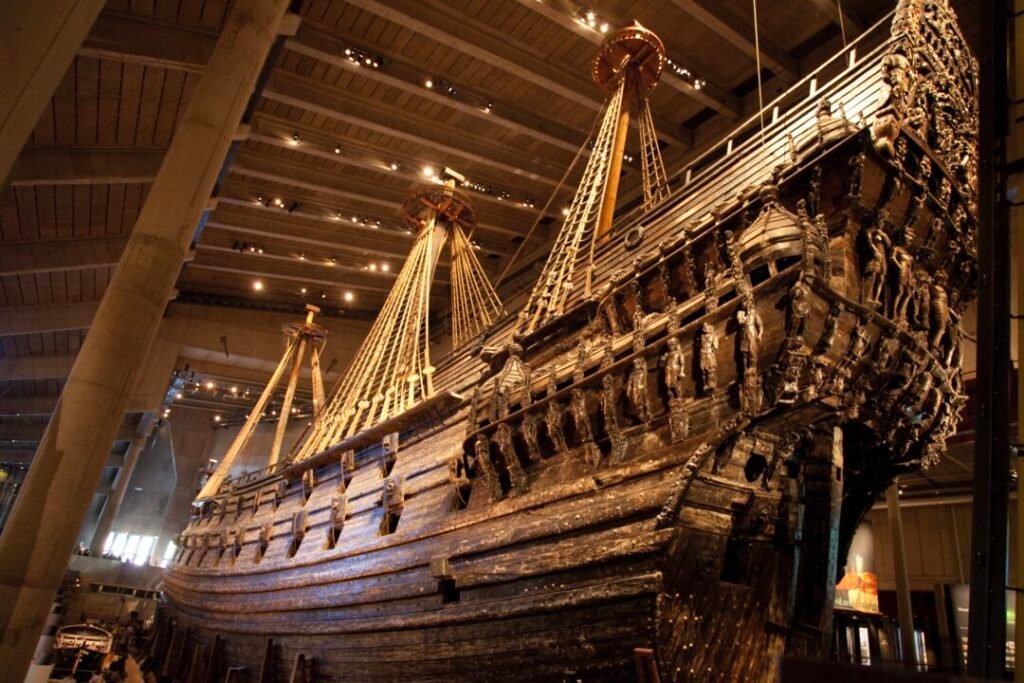
In Stockholm, the Vasa Museum is my favorite maritime museum anywhere, with the chemically petrified, ultimate warship housed in a state-of-the-art exhibit.
The Vasa sank just minutes into her maiden voyage. It was 1628 and the Swedish king was eager to expand the reach of his domain with a formidable new vessel. Unfortunately, his demands to build the ship 170 feet tall, but narrow and laden with an extra row of cannons, made it extremely unstable. As it sailed out, all the sailors went to one side, waved at their loved ones…and the most expensive ship in Europe tipped over and sank to the bottom of Stockholm’s harbor, where it sat in the mud for over 300 years. In 1961, with the help of steel cables and huge inflatable pontoons, the Vasa rose again from the deep.
The museum has turned this titanic flop into an excellent exhibit. Artifacts on display humanize naval life in the 17th century, while detailed models show life on board—and evoke the instant when the hopes and aspirations of this mighty ship and her crew were dashed. This awe-inspiring boat is a time capsule from an era when Sweden was a European power and was gearing up to expand its empire.
The Vasa may have been a failure, but there’s no doubt about the seafaring strength of the Scandinavians. From the Vikings to intrepid Arctic explorers and daring Heyerdahl and his Kon-Tiki, don’t miss the opportunity to delve into the fascinating maritime history as you visit Scandinavia’s great cities.