[ad_1]
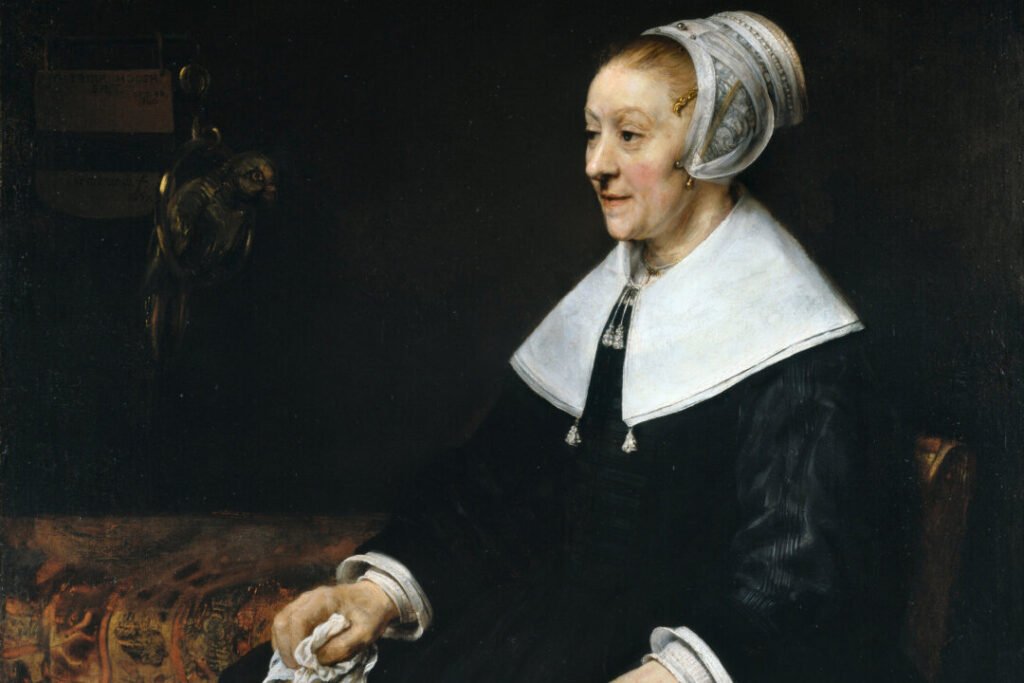
Rembrandt’s large, three-quarter-length, and dramatically lit portrait of Catrina Hooghsaet from 1657 is one of the artist’s greatest privately owned works. Housed in the UK, the painting’s scale, subject, aesthetic and technical excellence, and provenance make it a national treasure, literally; the UK government has just announced that this painting has been given that status. It is the most expensive artwork to ever be designated as such, and a temporary export ban has been placed on the painting.
Valued at 71.7 million pounds ($97.2 million), British museums, institutions, or another appropriate buyer will have a period of time to raise and offer this amount, plus the additional value-added tax.
Golden Age Portraitists

A self-portrait of the artist with a beret and turned-up collar, 1659, by Rembrandt. Oil on canvas; 33 1/4 inches by 26 inches. National Gallery of Art, Washington. Public Domain
Arguably the greatest Dutch Golden Age artist, Rembrandt (1606–1669) is renowned for his comprehensive self-portrait series done throughout his career. However, his prolific portraits of others were primarily painted during two periods: from 1631 to 1634 and the 1650s. The latter phase, to which the portrait of Catrina Hooghsaet dates, was occasioned by financial difficulties and coincides with the start of Rembrandt’s mature artistic period.
Portraiture was a popular genre in 17th-century Holland. An expanding middle class had the means to afford such works and having one’s portrait painted was a status symbol. Catrina Hooghsaet (1607–1685) was a wealthy Mennonite woman who lived in Amsterdam. She was married to a preacher but resided separately from him, an unconventional arrangement for the time. Her portrait is unusual for the genre as a whole.

Pendant portraits of (Left) Maerten Soolmans and Oopjen Coppit, 1634, by Rembrandt. Oil on canvas; 81 1/2 inches by 52 1/8 inches. Rijksmuseum, Amsterdam. Public Domain
Embodying multiple symbolic interpretations, parrots were popular additions to Dutch genre paintings. However, the Mennonite community disapproved of owning such luxuries. Its inclusion here hints at the sitter’s independent character.
Related Stories


A portrait of Catrina Hooghsaet, 1657, by Rembrandt. Oil on canvas; 48 5/8 inches by 37 7/16 inches. Public Domain
Catrina’s attire is curious as well. Mennonites were supposed to dress austerely. While she is depicted in somber black with touches of white, the dress’s silk material and her lace collar, along with accessories, advertise her wealth. The handkerchief in her hand was a luxury item in this era. She wears a white cap accented with pearls and fastened with costly gold “hoofdijsertgen,” or head-irons. The table behind her is laid with an imported Oriental carpet.
This sitter’s seemingly strong personality is also conveyed by Rembrandt through her pose. The placement of her hands on the arm of her chair gives her a determined, authoritative air. Such positioning is usually found in portraits of men. Rembrandt was revolutionary in portraying people’s inner life with profundity and sensitivity. In this work, he created a fascinating image of a confidant woman.
England’s Inheritance

A late 19th-century photomechanical print of Penrhyn Castle in Bangor, Wales. In 1860, Edward Douglas-Pennant, 1st Baron Penrhyn, acquired the portrait of Catrina Hooghsaet. Public Domain
After Catrina’s death, her third husband inherited her portrait. The canvas reached England by 1752, when it was purchased by the 7th Earl of Westmorland. As it has now been in the UK for several centuries, this Rembrandt is an important part of the country’s cultural history.
In 1860, Edward Douglas-Pennant, 1st Baron Penrhyn, acquired the painting. The work remained in the Douglas-Pennant family for generations. It was hung at the ancestral home, Penrhyn Castle, Wales. In 1951, upon the death of the 4th Baron, the castle and some of its contents were given to the National Trust. The portrait of Catrina Hooghsaet, valued at 1,000 pounds—three times less than their Rolls-Royce—was retained by the family. The picture, along with other items held back, were tax-exempt on the condition that they remain on public view. The Rembrandt was displayed in the Castle’s Breakfast Room.

The Breakfast Room at Penrhyn Castle with the portrait of Catrina Hooghsaet hanging above the fireplace mantle. Andreas von Einsiedel/Getty Images
In recent years, the family has sold off pieces of their important art collection. A notable example is Jan Steen’s masterpiece “The Burgomaster of Delft and his Daughter,” which was purchased by the Rijksmuseum, Amsterdam. The museum was in serious talks in 2007 to acquire the portrait of Catrina’s Hooghsaet, which would have enriched their already extensive Rembrandt holdings. They neither owned a 1650s Rembrandt nor a monumental female portrait by him. However, the Rijksmuseum was unable to raise the full sale price.

“Adolf and Catharina Croeser, (‘The Burgomaster of Delft and his Daughter’),” 1655, by Jan Steen. Oil on canvas; 32 1/2 inches by 27 inches. Rijksmuseum, Amsterdam. Public Domain
Sotheby’s brokered a transaction for the portrait with a private collector in 2015. Although an export bar was placed on the portrait, the buyer agreed to loan it to the National Museum Cardiff, in Wales, for three years. The matter of export was renewed when this anonymous buyer sold the painting in turn via Christie’s in 2025. The deferral period for the export license application is valid through Dec. 26, 2026. After that date, the owner will have a 15-day period to evaluate other offers. If an agreement is not reached, a second deferral period may occur and last for nine months.
The UK’s Reviewing Committee on the Export of Works of Art and Objects of Cultural Interest hopes that this Rembrandt will be able to stay on British soil and be permanently accessible to the public. Andrew Hochhauser KC, the committee’s chairman, states:
“Catrina Hooghsaet’s unusually well-documented life allows the portrait to be studied alongside rich historical evidence, providing rare insights into social relations … in the Dutch Republic. … It is also of outstanding significance to the study of the history of portraiture, the oeuvre of Rembrandt and the history of collecting his work in Britain.”
Time will tell if the campaign to secure it is successful.
[ad_2]
Source link