[ad_1]
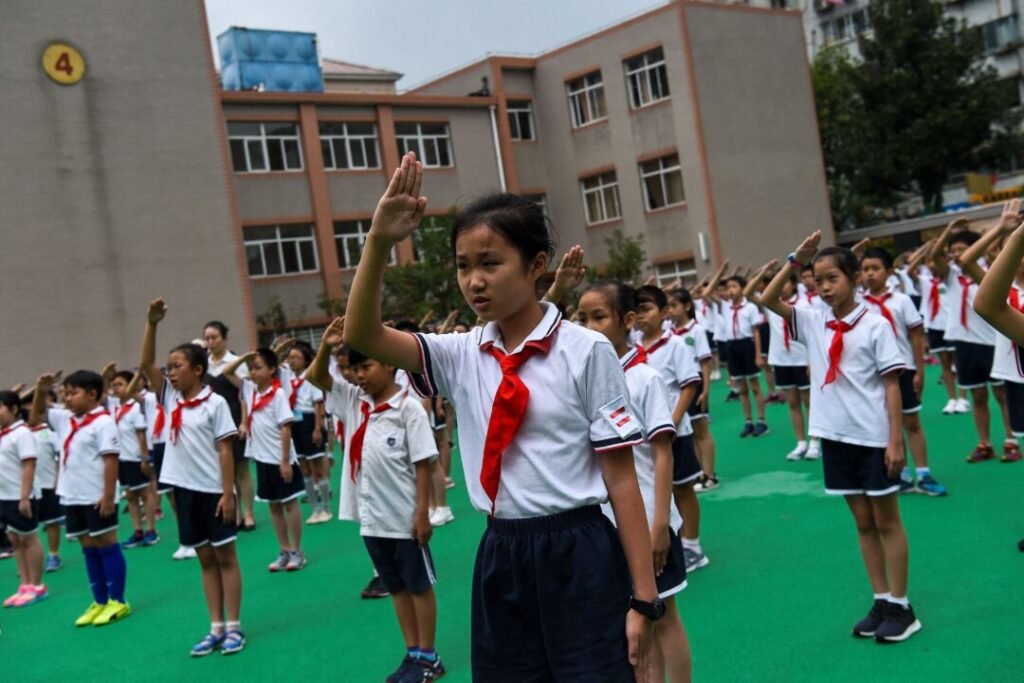
A Chinese high school’s requirement that students watch the state-run evening news every day has sparked criticism that political propaganda is being woven into students’ daily routines, extending beyond classrooms and textbooks into their after-school hours.
Screenshots circulating on Chinese social media show the schedule for the senior high school division of Haikou No. 4 Secondary School in Hainan Province, which includes students watching the state broadcaster’s flagship news broadcast for 30 minutes during evening study sessions.
The schedule requires students to get up at 6:20 a.m., attend nine classes during the day, and remain at school until the dormitories close and lights are turned off at 11 p.m. Beginning at 7 p.m., students are scheduled to watch the regime’s official news broadcast for half an hour, followed by two 70-minute evening study sessions.
The arrangement has drawn mockery and criticism online, with some Chinese netizens comparing the school’s timetable to prison routines and describing the mandatory viewing of communist state propaganda as political indoctrination.
The Epoch Times called the school requesting comment about the schedule. A woman who answered the phone said she was “not sure” after learning the reason for the call and then hung up.
The Epoch Times could not independently verify the screenshots.
Related Stories

Political Messaging in Daily School Life
The reported schedule has also prompted discussion about the broader role of political propaganda in China’s schools.
Several Chinese critics spoke to The Epoch Times on condition of anonymity out of fear of reprisal.
A resident in Jiangsu Province told the publication that political messaging has become a routine part of his child’s education.
“Schools here have to raise the national flag and sing the national anthem every day, and the textbooks are all praising the Communist Party,” the resident said.
He said his 4-year-old son recently began singing so-called “red songs,” which refer to songs with a revolutionary communist theme. Those were taught by teachers at kindergarten.
“Isn’t this indoctrinating children from an early age?” the resident asked. “We were also indoctrinated from childhood. How many people still believe in the Communist Party now?”
A Hainan-based academic told The Epoch Times the central issue was whether students were being given the opportunity to obtain information from sources other than state-controlled media.
“[The official] news broadcast is not an ordinary news program, but the main platform for the Chinese Communist Party (CCP) to release political propaganda and promote its leaders,” the academic said.
He said putting the program directly into a school timetable meant that students were being exposed to a single source of information at a fixed time every day.
“So many parents want to send their children abroad precisely because they don’t want their children to be brainwashed by this kind of education,” the academic said.
Political Propaganda Beyond the Classroom
A Chinese education scholar based in Australia told The Epoch Times that political education under the CCP has developed into a system that reaches well beyond formal classroom instruction.
“They want to cultivate students into slaves who serve the [communist] regime, doing whatever they are told,” the scholar said. “This textbook-style propaganda has extended from textbooks to [state] news broadcasts. Ordinary people think they are watching the news, but in reality they are receiving instruction from a totalitarian regime.”
She said the indoctrination process begins at an early age and continues through successive stages of education. The CCP promotes “love for the Party and love for the country” in kindergartens, linking patriotism with loyalty to the CCP. Similar political messaging, she said, is then reinforced through school textbooks and state media.
The scholar said the reported schedule at Haikou No. 4 Secondary School should be viewed as an example of how political propaganda can become integrated into students’ daily routines rather than as an isolated school policy.
Xiao Bin contributed to this report.
[ad_2]
Source link