[ad_1]
Sponsored Content by Aletha. This article includes affiliate links, which may earn us a commission, to support truthful and independent journalism (at no extra cost to you).
Your scan found something. Arthritis in the hip, maybe, or a tear in the labrum. So that became the explanation, and the plan followed from it: an anti-inflammatory, then an injection, then a conversation about surgery. And here you are, still hurting.
I’ve spent 25 years as a physical therapist, and I’ve watched this play out more times than I can count. People who had the labrum surgery. People who had the hip replaced. Months later, they’re sitting in front of me describing the same pain they had before the surgery. When the operation addresses the joint but the pain doesn’t change, that’s a strong sign the joint was never what was driving the pain.
Here’s the part almost no one checks. Just because arthritis or a tear shows up on an image doesn’t mean it’s what’s causing your pain. Plenty of people have significant arthritis on an X-ray and feel nothing. Others have clean imaging and hurt every day. The scan sees bone and cartilage. It doesn’t see muscle tension, and muscle tension is the thing almost no one tests for.
The pills and the injections don’t fix that either. They quiet the signal for a while, but they don’t release what’s pulling the joint out of position, which is why the ache keeps coming back, and the prescriptions keep renewing.

The iliacus is about the size of your hand, tucked inside the pelvis. With the psoas, it makes up the deep hip flexors. Source: Aletha Health
The muscles you’ve probably never touched
Your iliacus and psoas are deep hip flexors that live at the front of your hip and inside your pelvis. Most people have never felt them, and they don’t show up the way you’d expect. Muscle tension doesn’t appear on an MRI. It doesn’t appear on an X-ray. It shows up one way only: someone presses on the muscle, and it feels hard and often tender. That’s the whole test, and it’s the step the imaging skips.
The catch is that this muscle is hard to reach. You can try right now. Lie on your back and press your fingers just inside the front rim of your pelvic bone, toward the center. It’s deep. Without a skilled practitioner finding that muscle for you, it’s genuinely tough to locate on your own, which is part of why it’s hard to release on your own.
What’s easier to notice is how the tension changes the way your body works. When the iliacus and psoas stay tight, they pull on the pelvis and change how the hip joint sits and moves. So instead of hunting for the muscle, look for its fingerprints. If your hip flexors are tight, you might notice:
– Difficulty pulling your knee to your chest, or a pinch in the front of the hip when you try
– Hamstrings that feel tight no matter how much you stretch
– One leg that rotates open to the side when you lie on your back, relaxed
– A pelvis that looks rotated or twisted when you stand, often because one side is tighter than the other
– One glute that stays weaker than the other
None of those are the tension itself. They’re what the tension does to your alignment, and they’re usually the first thing you can notice from the outside.

A tight iliacus doesn’t just stay in the hip. It also shows up at the shoulder, the pelvis, the knee, even the ankle. Source: Aletha Health
Why what you’ve already tried hasn’t held
Stretching helps a muscle lengthen. It doesn’t teach a chronically tight one to let go, and I’ve felt rock-hard hip flexors on some of the most flexible people I’ve ever treated, lying down, fully relaxed.
Adjustments move the bones back into place. But if a tight muscle is pulling the joint out of position, the bones drift right back, which is why the relief fades and the appointments repeat.
Strengthening on top of that is like building on a slope. A tight muscle is a weak muscle, and it weakens the muscles working against it. You can train the glute endlessly and still feel weak on one side while the hip flexor stays locked.
And surgery. If the muscle pulling on the joint was never released, operating on the joint leaves the pull in place. That’s how someone ends up with a repaired labrum, or a brand-new hip, and the old familiar ache.
None of these are wrong. They’ve just skipped a step: releasing the tension first.

When the tension is what’s driving the pain, the fix isn’t in the medicine cabinet. It’s a tool you can reach for yourself.
The step that’s been missing
Physical therapists have a name for what actually releases a chronically tight muscle: ischemic compression. Not rubbing, not vibration, not movement. Direct, sustained pressure, held for about 90 seconds, until the muscle lets go. I did it with my own hands for years. The trouble is that few practitioners have time to hold that pressure session after session, and no one can reach their own iliacus.
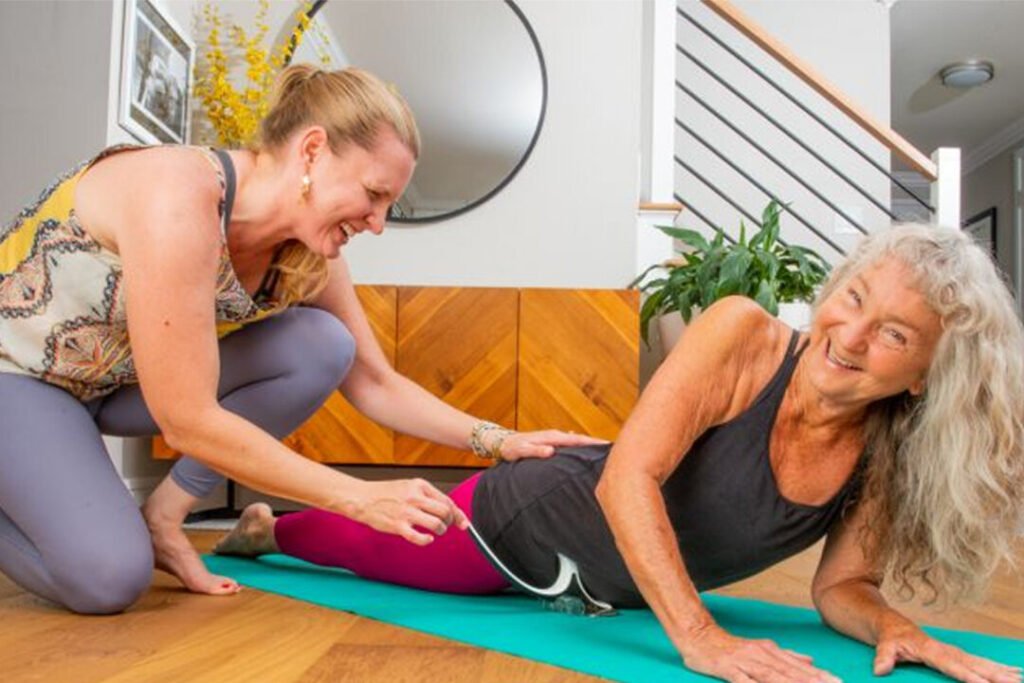
I designed the Hip Hook (Mark) to do what my fingers did: reach that deep muscle and hold precise pressure exactly where it’s needed, for as long as it’s needed. It’s drug-free. Nothing to swallow, nothing to numb. Every Hip Hook comes with the Orbit, which warms up the front of the hip and releases the glutes and piriformis at the back, plus a free companion app that guides your placement and pressure so you’re never guessing.
The way it works is something you can feel. Press on a tight muscle and it’s tender. Happy muscles don’t hurt. Keep holding, and the muscle starts to relax and the tenderness fades under your hand. That fade is the release.

Husband and wife teams from left to right: Chad & Beth Genengels, Manufacturer of the Hip Hook, Christine Annie & Shri Swaminathan, Founders of Aletha
The Hip Hook is patented and made in America by All-Rite Plastics, a family-run shop in Lake Zurich, Illinois, now in its third generation. Its owner, Beth Genengels, puts it plainly: “American made speaks quality in itself. The amount of time we put into research and development, and with tool and die making, is extensive. The amount of eyes we have on our parts is extensive as well.” A physical therapist designed it and a family builds it, which is not how most things in this category get made.
It’s now recommended by over 2000+ clinicians and is used in pro training rooms across the NFL, NBA, MLB, NHL, UFC and PGA, and by military members and first responders. “My first experience using the Hip Hook removed about 80% of my pain. And that’s when I stood up and realized the impact this product had made in my daily life. I now had power and control back in a holistic manner that took only a few minutes per day,” Tony, a retired navy officer who spent years managing lower back pain that no treatment had touched.
How to use the Hip Hook
-
Feel it first. Lie on your back and pull each knee to your chest. Notice which hip pinches more in front. Start on that side.
-
Place the Hip Hook about two inches in from your hip bone, angled toward the inside of your pelvic bone
-
Press the handle to sink slowly into the muscle until you reach the tender spot.
-
Hold for 90 seconds while you breathe and let the muscle soften.
-
Retest. Pull that knee to your chest again and feel the difference.
The free Aletha companion app is included so you have the support of Christine Annie, physical therapist, in your pocket, walking you through placement and pressure.
If the next thing on your table is an injection, more medication, or surgery, there’s a step that often gets skipped on the way there. Spending a few weeks releasing the iliacus and psoas at the front of the hip is that step to see if muscle tension in your hip flexors might be the culprit.
What to look for as it releases
When the hip flexors start to let go, the signs you checked for earlier begin to shift the other way. Many people notice that pulling a knee to the chest stops pinching in front. Hamstrings that felt tight loosen without being stretched. Standing feels more level, and posture looks more symmetrical side to side. The glute fires better, so getting up and down off the floor and sitting cross-legged get easier. Lie on your back, and the leg that used to fall open to the side starts to match the other one.
Release first, then keep it from coming back
The sequence that works is plain: release the tension, let the hip realign, then strengthen and move. Get to the muscles first, before drugs and surgery, and see if a lot of the pain and complexity you’ve been fighting quiets down.
Releasing it once isn’t the finish. Modern life keeps rebuilding tension: sitting, stress, old injuries, screens. A short release at home a few times a week is upkeep, the same way you brush your teeth to keep buildup from forming. A few minutes keeps the hip working the way it should.
The bottom line
You’re not broken, and your hip may not be either. It may just be holding tension no one has shown you how to release, in a muscle no scan was ever going to find. You know your body better than any image does. Learning to release it yourself is its own kind of freedom: no appointment, no referral, no prescription, and no waiting on someone else to tell you what’s wrong.
Christine Annie (Koth), MPT, is a physical therapist with a biochemistry background and 25 years of hands-on clinical experience. Trained to ask why and never satisfied with “just because,” she spent years watching the medical system look past muscle tension as a source of pain, treating the scan instead of the body. That frustration is what led her to build a better way, grounded in science and simplicity. Aletha Health is what came of it.
Mark®, Orbit®, Aletha®, the Aletha logo, and Hip Hook™ are trademarks of Aletha, Inc.
[ad_2]
Source link