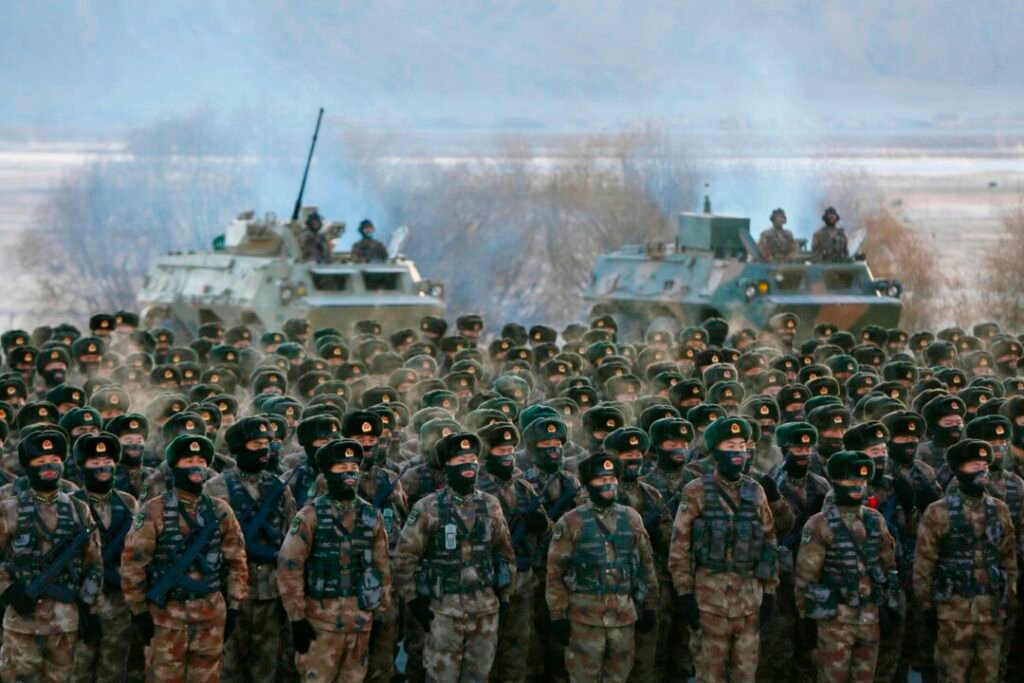
The Chinese communist regime revised its National Defense Mobilization Law on Aug. 28, expanding its power to seize assets in the private and tech sectors and conscript citizens.
Analysts warned that the sudden revision of the law could signal the intention of the ruling Chinese Communist Party (CCP) to prepare for war.
The law is the first major revision of China’s national defense mobilization framework since 2010.
The revised law, which will take effect on Oct. 1, significantly broadens the scope of mobilization to include the immediate seizure of civilian resources and private company assets. It also reduces limits on the conscription of citizens by eliminating age restrictions for performing national defense service for individuals with special expertise.
The new provisions expand the “requisition of civilian resources” to “expropriation and requisition of civilian resources.” Civilian means of transport, sites, equipment, manufacturing capacity, and even data and technical personnel can all be subject to requisition or expropriation, according to the revised law.
Meanwhile, Article 64 of the revised law states: “Any organization or individual has the obligation to accept the requisition or expropriation of civil resources in accordance with the law.”
Related Stories
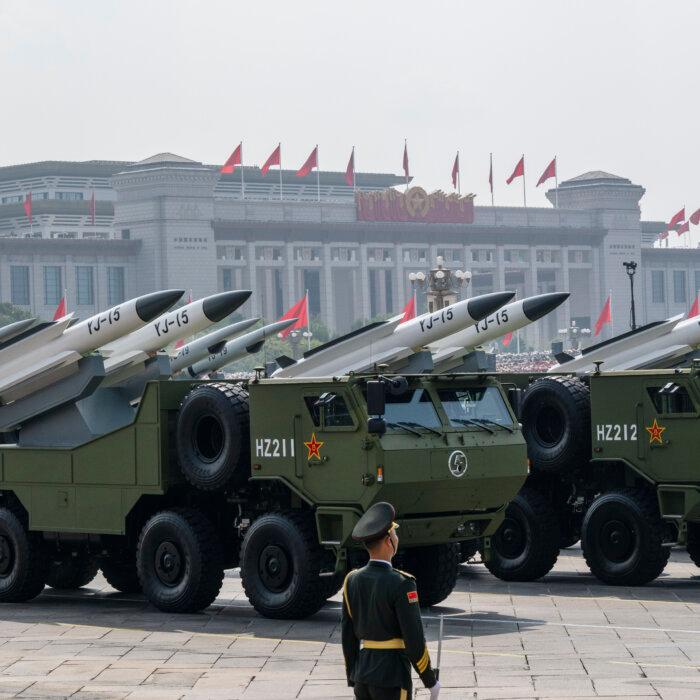

“Requisitioning property is a temporary measure; the government would pay you a daily fee or provide compensation for any damage,” Su Tzu-yun, researcher and director of Division of Defense Strategy and Resources at Taiwan’s Institute for National Defense and Security Research, said of the change of rhetoric in the newly revised law.
“Expropriation, however, is permanent: it involves converting private property into state property for public use—if it gets damaged, that’s just how it is, and no compensation is paid. Thus, this effectively expands the CCP government’s powers.”
Businesses and ventures owned by Taiwanese or foreign investors—whether joint ventures or wholly foreign-owned enterprises—operating in mainland China are also subject to requisition and expropriation under the law, Su warned.
“Anything falling within China’s sovereign jurisdiction is a potential target for requisition or expropriation; there is no distinction made between Chinese-owned and foreign-owned or Taiwan-owned businesses in this regard,” he told The Epoch Times.
“If expropriation occurs, private property will be seized for public use, meaning you naturally lose your entire investment,” Su said. “This would only accelerate the exodus of foreign businesses from China.”
The tech sector is also put under the People’s Liberation Army’s control, according to the revised law, as it requires the application of advanced technologies and the integration of civilian technological and industrial capabilities into the defense system, such as AI, drones, and cyberspace.
“If a war were to break out in the East China Sea, the Taiwan Strait, or the South China Sea, and democratic nations imposed sanctions on it, the CCP would have more internal resources at its disposal,” Su said of the revisions.

Chinese students practise marching under the supervision of a PLA soldier during their one week of first-year high school military service at a military base in Hefei, east China’s Anhui province on Aug. 5, 2010. STR/AFP/Getty Images
Whether the Chinese regime intends to attack Taiwan, engage in war with neighboring countries in the Indo-Pacific, or even enter into a military conflict with the United States, it must make logistical preparations for such a war, Lee Cheng-hsiu, an associate research fellow at the National Policy Foundation, a prominent think tank in Taiwan, told The Epoch Times.
The revised National Defense Mobilization Law contains elements that implicitly expand state power—a point that warrants serious attention, Cai Shenkun, an overseas veteran Chinese political commentator, said to The Epoch Times.
“Once this power is expanded, it could potentially place the entire nation in a state of war or a military state of emergency at any time.”
Chen Kuan-ting, a Democratic Progressive Party legislator serving on Taiwan’s Legislative Yuan’s Foreign and National Defense Committee, told Taiwanese media outlet FTNN on Aug. 31 that China has—for the first time in 16 years—significantly revised its national defense mobilization system.
“These revisions explicitly incorporate economic and social resources into the mobilization framework to strengthen capabilities for a rapid transition between peacetime and wartime operations.
“Taiwan must remain highly vigilant regarding China’s trend of further integrating civilian resources, industrial capacity, and technological capabilities into its national military system.”
Exit Ban to Preserve Troops
The revised national defense mobilization law also states that male citizens aged 18–60 and female citizens aged 18–55 are required to perform national defense service (individuals with special expertise are not limited by age restrictions).
“The CCP restricts Chinese citizens from leaving the country in order to retain a pool of military manpower for war preparations,” Su said of the exit ban and the revised law.

A security guard guides passengers at Beijing International Airport on July 6, 2025. Wang Zhao/AFP via Getty Images
Cai said that after Sept. 15, many people, especially wealthy ones, might be unable to leave the country.
“The Chinese regime is aware of its low birth rate and aging population; it needs to clearly define the age range so that the general public understands that, in the event of war, they could potentially be conscripted,” Li said.
The revised law has caused concern in the Chinese public.
“The war is looming; there is now a legal basis for mandatory conscription and the requisitioning of private property,” one social media post read.
“By suddenly signing the revised National Defense Mobilization Law, ‘Supreme Leader’ may drag the Chinese people into the abyss of war!” another post said.
Judging by the current trajectory, preparations are being made for the annexation of Taiwan by force, Cai said.
“Once war breaks out, young people—especially those currently unemployed—are highly likely to end up as cannon fodder.”

People attend a job fair in Shenyang, in northeastern China’s Liaoning Province on Oct. 22, 2024. STR/AFP via Getty Images
With so many young people unable to find work, harboring grievances against society, and feeling dissatisfied with the CCP leader Xi Jinping, the only way to defuse this discontent might be through war, Cai said.
“It cannot be ruled out that, at some point, Xi might take a desperate gamble and attack Taiwan to divert the domestic pressure.”
Luo Ya and Li Deyan contributed to this report.