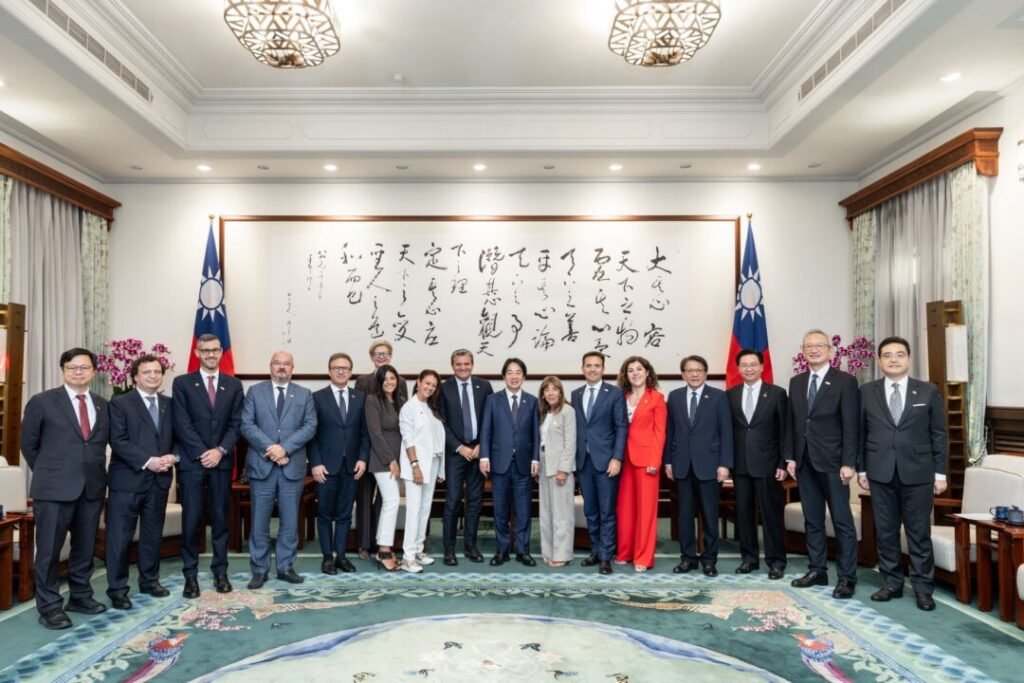
Italy’s largest-ever parliamentary delegation is visiting Taiwan this week for talks on trade and technology, as European officials hold separate discussions with the island’s semiconductor industry.
President Lai Ching-te met the 10-member group on Sept. 1. Led by Italian Senate Vice President Gian Marco Centinaio, the delegation includes lawmakers from both chambers of Parliament and from governing and opposition parties.
Taiwan’s Foreign Ministry said Centinaio described it as the largest Italian parliamentary delegation ever to visit Taiwan. The group was organized through the Italy–Taiwan Interparliamentary Friendship Group.
A day before Lai’s meeting, the European Commission held its second Europe–Taiwan Semiconductor Industry Dialogue in Taipei, bringing together European and Taiwanese companies and research institutions.
The commission said the Aug. 31 talks focused on growing European demand for artificial intelligence chips and data center infrastructure as well as on industrial cooperation under its proposed Chips Act 2.0.
Participants discussed pairing European strengths in chip design and intellectual property with Taiwan’s capabilities in foundry manufacturing, packaging and system integration, according to the commission.
Related Stories
Italy–Taiwan Ties
Lai thanked the Italian lawmakers for Parliament’s support for Taiwan’s international participation and called for closer economic, trade and industrial cooperation.
Centinaio is making his fifth visit to Taiwan, according to the Presidential Office. He also attended Lai’s presidential inauguration in May 2024.
Italy’s Chamber of Deputies Foreign Affairs Committee has separately examined Taiwan in a broader Indo-Pacific context. A 2025 inquiry addressed Taiwan Strait security, supply-chain dependence and Italy’s role in the region.
Technology is part of the delegation’s current program.
The group is attending activities connected to SEMICON Taiwan, a major semiconductor industry trade show running Sept. 2 to Sept. 4 in Taipei.
The exhibition includes an Italy Pavilion alongside pavilions representing the United States, Japan, South Korea, Germany, France, the Netherlands and other countries, as well as specialized areas covering advanced packaging, AI, cybersecurity, smart manufacturing and other parts of the chip supply chain.
Taiwan Legislative Yuan Vice President Johnny Chiang met the delegation on the same day and said 74 Italians with science and engineering backgrounds have received short-term semiconductor training in Taiwan through a Taiwan–Europe program.

Legislative Yuan Vice President Johnny Chiang poses with Centinaio and the Italian parliamentary delegation in Taipei on Sept. 1, 2026. Courtesy of Taiwan Legislative Yuan
Chiang said Italy is Taiwan’s fourth-largest trading partner in the European Union and cited the training program as part of growing technology ties.
The European Commission’s Taipei semiconductor meeting followed the first Europe–Taiwan Semiconductor Industry Dialogue, held during SEMICON Europa in Munich in November 2025.
At an EU forum in Taipei on Sept. 1, Lai called for European countries to pursue agreements with Taiwan covering double taxation and investment while expanding semiconductor cooperation.
He said Taiwan and Europe could combine Taiwan’s integrated semiconductor ecosystem with European capabilities in research and development, equipment, materials and advanced manufacturing.
Museum-Loan Law
Lai also highlighted a new Italian law protecting qualifying foreign cultural property temporarily brought into Italy from civil judicial seizure.
Law No. 134 was enacted July 16 and took effect Aug. 12.
The measure allows Italy’s Culture Ministry, subject to reciprocity and other conditions, to grant foreign cultural property immunity from seizure during temporary public exhibitions.
The issue had been linked to Taiwan in the Italian Parliament for more than a decade.
During a 2011 debate, Italian senators raised the difficulty of bringing works from Taiwan’s National Palace Museum to Italy.
The Senate record said Taiwanese authorities rarely loaned the museum’s imperial-era Chinese treasures overseas without explicit guarantees of their return, because Taiwan feared the People’s Republic of China, which claimed ownership of the works, could seek their seizure abroad.
Senators cited exhibitions in Paris, Berlin, Bonn and Vienna, where protections existed, and said Italy had been unable to organize a comparable exhibition despite Taiwan’s willingness to lend works.
The record cited the United States, France, Germany and Austria among countries that had adopted protections for temporarily loaned cultural property.
Lai said the Italian legislation had taken more than 20 years and five parliamentary terms to pass and would provide legal protection for future exhibitions of Taiwanese cultural treasures in Italy.
The delegation is scheduled to remain in Taiwan through Sept. 5.
Taiwan’s Foreign Ministry said its remaining program includes visits to the International Trade Administration and Industrial Technology Research Institute, along with other government agencies and stops in Tainan and Kaohsiung.