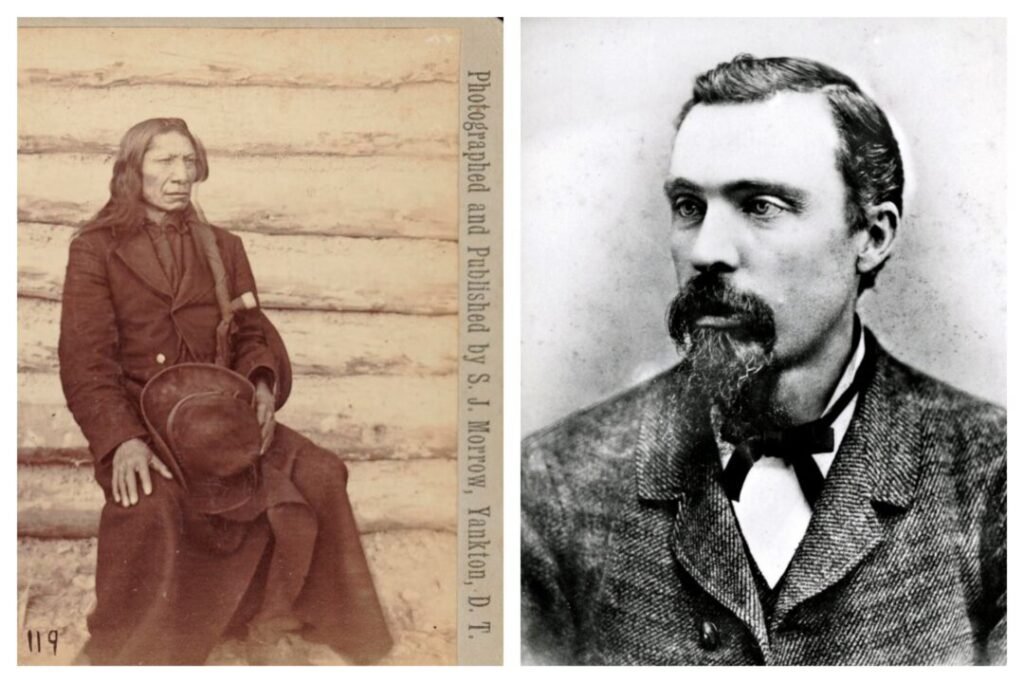
In the years after the Civil War, a photographer heading west carried a peculiar burden. There was the camera, of course, but also glass plates, chemicals, a tripod, and the equipment needed to turn a stretch of prairie, a military encampment, or a human face into a lasting image. Photography was still an exacting trade. A photographer needed patience, steady hands, and a tolerance for dust.
Stanley J. Morrow had all three.
The Photographer Goes West
Born in Richland County, Ohio, in 1843, Morrow entered photography during the Civil War. History Nebraska State Historical Society reports that he apparently volunteered in the photographic operation of Mathew Brady (circa 1822–1896), while the Smithsonian records identify him as Brady’s “volunteer assistant” during his Army service. Brady was already among the most prominent practitioners of the young medium, and Morrow learned the craft at a moment when photography was beginning to assume a documentary importance far beyond the portrait studio.
The technology was still determinedly physical. Louis Daguerre’s process had introduced photography to the public in 1839, but, by Morrow’s generation, English photographer Frederick Archer’s wet-plate collodion method had made photography far more practical beyond the confines of the studio. The process coated glass plates with a light-sensitive emulsion capable of relatively short exposures in daylight, allowing photographers to record landscapes, military camps, and people outdoors.

Illustration from a book which shows the process of coating a glass plate negative with collodion. Library of Congress. Public Domain
Glass negatives also had the advantage of producing multiple prints from a single exposure. The work remained cumbersome, however: Plates had to be prepared, exposed, and developed while still wet, requiring photographers working in the field to carry chemicals and processing equipment along with the camera.
After the war, Morrow and his wife, Iza Ketchum, settled in Yankton, Dakota Territory, where he established a photography gallery. Yankton became a base for a much more itinerant career. Morrow traveled to Sioux Falls to photograph its scenery and visited the Santee Reservation, where he took some of his early images of Native people. During the years that followed, he ranged through the Missouri River country, visiting settlements, military posts, and agencies with his photographic equipment in tow.
Among the pictures he offered were stereoscopic views. Two related photographs, examined through a stereoscope, produced an illusion of depth. For customers accustomed to learning about distant places through newspapers, books, and travelers’ tales, the effect could be startling. The West was suddenly something a person could hold in his hands.
Related Stories

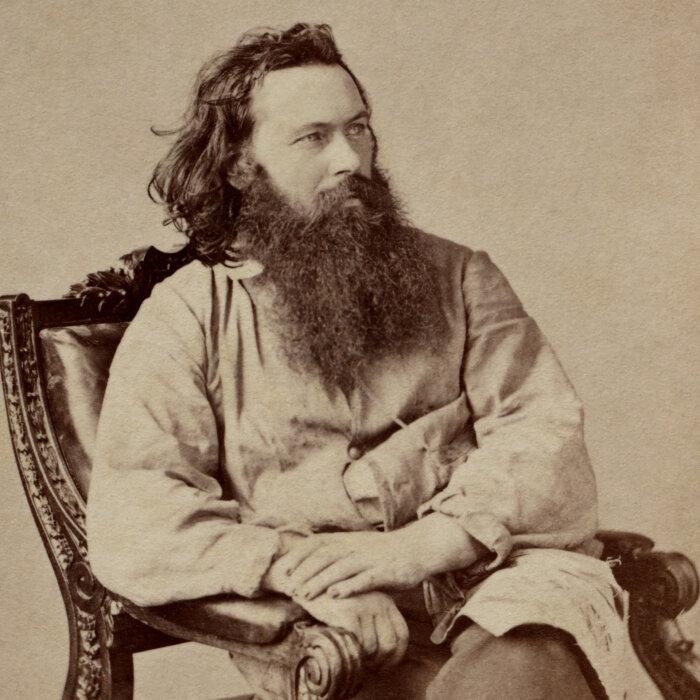
In 1876, the Black Hills gold rush drew Morrow to Deadwood. He photographed miners, their workings, and the rough settlements, which sprung up in the area. His camera also found Gen. George Crook’s soldiers returning from an expedition across the northern Plains. He photographed group portraits of officers as well.

City of Deadwood, from the south, 1876, by Stanley Morrow. Library of Congress. Public Domain
The camera then took Morrow into northwestern Nebraska. On Oct. 23, 1876, he arrived at the Red Cloud Agency, where he stayed for several weeks. One of the people who faced his camera was Red Cloud, the Oglala Lakota leader. The resulting portrait became one of the images most closely associated with Morrow.
Other portraits identified as Spotted Tail, Two Strike, Fast Bear, and Crazy in the Lodge appear to date from a subsequent phase of his work at the Spotted Tail Agency after its relocation to the Missouri River. The agencies were being moved or consolidated, and the people photographed were living through changes imposed by federal policy and military pressure.
Faces in the Frame
Perhaps the most arresting quality of Morrow’s portraits is their stillness.
To sit for a photograph in the 1870s required cooperation that is difficult to imagine now. The subject had to remain composed while the photographer managed a process that was slow and deliberate. There was no instant preview, no succession of exposures from which to choose. Once the plate was exposed, the moment was fixed.
Morrow’s photographs reward that enforced quiet. His sitters occupy the frame rather than merely filling it. A coat, a braid, a hat, a hand resting against a chair, or a fixed expression became part of the record. The pictures have the severity of objects made when photography was still an event rather than a reflex.

Photograph shows portrait of elderly Native American woman, probably Dakota. Taken by Stanley Morrow in Yankton, Dakota Territory. Library of Congress. Public Domain
Morrow was photographing Lakota people in the aftermath of the Great Sioux War of 1876– 1877, when reservation policies were constricting Native American independence and federal authority was expanding across the Plains. The images cannot be separated from that history. Yet the people in them should not be reduced to illustrations of government policy or military events. They were individuals who sat before a camera, and Morrow’s best portraits allow that individuality to remain visible.
He was one of several photographers working across the northern Plains. Among his contemporaries was D.S. Mitchell, whose work took him from Cheyenne in Wyoming Territory to Deadwood in Dakota Territory and the Red Cloud Agency in Nebraska. Charles Howard and David Rodocker also photographed the Nebraska agencies and surrounding country, including the Spotted Tail Agency, Camp Sheridan and the White River region. Together, their work suggests a photographic circuit that followed the military posts, reservations, boomtowns and trails of the northern Plains
After returning to Yankton in December 1876, Morrow continued making photographic trips along the Missouri River. He also established branch galleries at Fort Keogh and Fort Custer, extending his reach into the Montana Territory. In 1879, he became photographer for Fort Custer and accompanied Captain George Sanderson’s expedition to the Little Bighorn battlefield, where he photographed the effort to rebury the remains of soldiers from the 1876 battle.

Custer’s battlefield. Lettering the head-boards: Cross marks the grave of Lt. John Jordan Crittenden III (1854–1876) who died at the Battle of the Little Bighorn. Library of Congress. Public Domain
Morrow’s surviving work reveals how varied those subjects and settings could be. His photographs include Native peoples and agency life; soldiers connected with Crook’s expedition; Fort Keogh, a military post; the Little Bighorn battlefield, and the 1877 reburial expedition of fallen soldiers; along with scenes of Deadwood, Yankton and other places he visited.
The chronology of his final years contains a small discrepancy in the surviving records. The National Museum of the American Indian states that Morrow left for Florida in 1882, while the Smithsonian’s National Anthropological Archives places the family’s move there in 1883. The Smithsonian further records that Morrow continued photographing in the South and East until his death in Dallas in 1921.
A fire destroyed most of his original negatives, but substantial photographic material survived. More than 500 stereoscopic cards survived. The National Anthropological Archives preserves 434 copy prints associated with Morrow’s photographs, while the National Museum of the American Indian preserves 15 albumen prints and one photographic negative.
Indeed, what remains gives Morrow’s work a human scale. His photographs contain military men, miners, Western settlements, agency grounds, and Native communities, but their deepest pull is often found in the people who stopped before his camera.
Perhaps that is why the pictures still carry such force. The apparatus has disappeared. The chemicals, glass, and cumbersome field cases belong to another technological age. The towns have altered or vanished. Roads have been rerouted, buildings demolished, and landscapes remade.
Morrow ensured the faces remain.