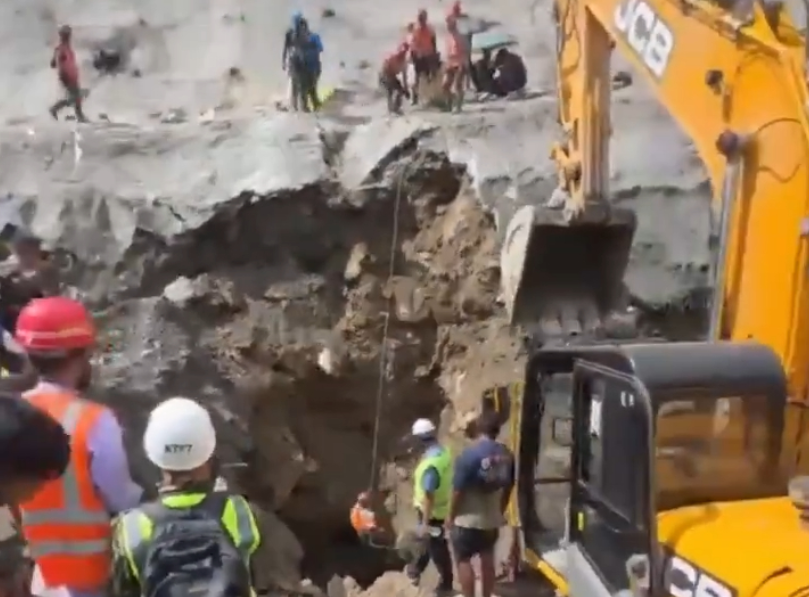
Nepal Army crews conduct rescue operations at the Upper Trishuli-3A hydropower tunnel following the Bhote Koshi River flood. Courtesy of Nepali Army
At least 1,109 bodies have been recovered or deaths confirmed after the Aug. 26 disaster along the Nepal-Tibet border, while China’s official toll for the Tibet side has remained unchanged for days.
Identification has lagged far behind recoveries. Police said details of 911 unidentified bodies had been posted to its website.

Search at Gyirong Port
China’s state-run Xinhua reported at 3:58 a.m. Sept. 2 that overnight repairs continued on National Highway G216 and that the rescue route to Gyirong Port was “about to be connected.” It said excavators working in the core rescue area were visible from the advancing roadworks.
In the public updates reviewed, Chinese authorities have not said how much of the buried port area has been excavated, whether signs of life have been detected beneath the debris, or how many of the 546 missing people are believed to have been at Gyirong Port.
Information Controls Draw Criticism
With independent reporters unable to reach the affected Tibetan area, there is no independent on-the-ground assessment of the casualty count or the scope of the search.
The Central Tibetan Administration, the Tibetan government-in-exile based in India, accused Beijing on Aug. 27 of concealing casualty figures for a day before announcing an initial toll, and said detailed information from Tibet remained unclear.
The International Campaign for Tibet, a Washington based nonprofit that advocates for Tibetan rights, called on Beijing on Aug. 27 to release more information and allow independent access.
“ICT calls on the Chinese government to disclose complete and verifiable information about the damage and casualties,” its president, Tencho Gyatso, said. She also called for independent reporting and unhindered humanitarian access.
Searches Continue in Nepal
On the Nepal side, rescue teams continued searching hydropower projects where workers remain unaccounted for.
At a Sept. 1 government briefing, a Nepal Army representative said teams from Nepal, India, and China were involved in searches at several hydropower sites, with blocked passages and water hindering access at some locations.
At 11:15 p.m. Sept. 1, Nepal’s Flood Forecasting Division warned that the Marsyangdi River at Bhakundebesi in Lamjung had crossed the danger level and was still rising, urging residents downstream to remain on high alert.