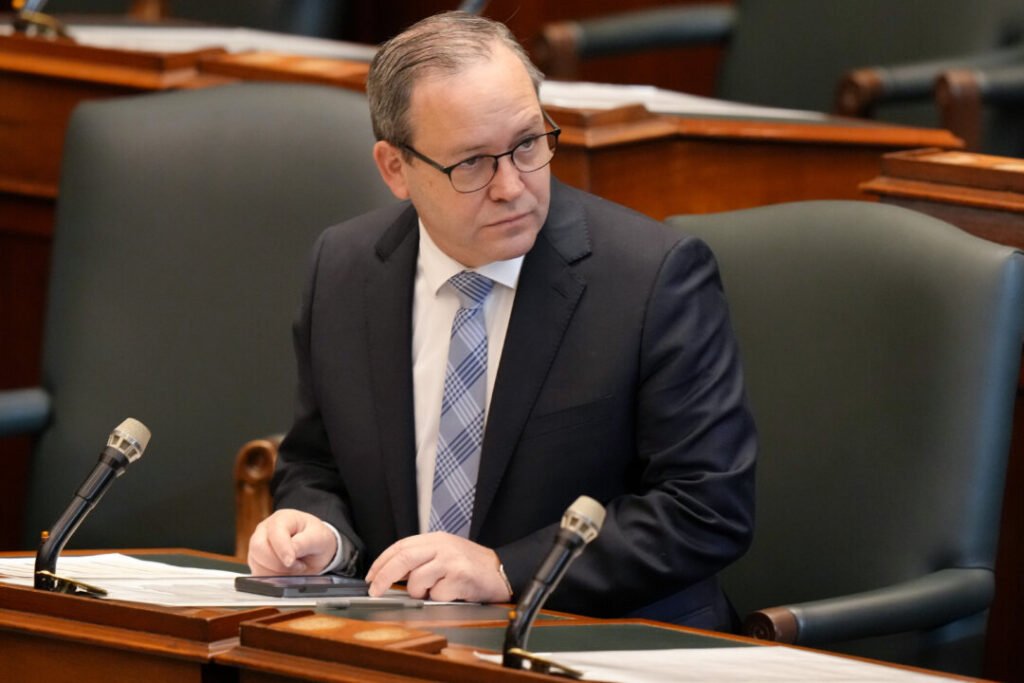

Ontario’s Attorney General Doug Downey attends question period at the Ontario legislature in Toronto on Nov. 28, 2023. The Canadian Press/Chris Young
Ontario’s recently implemented mandatory cash bail rules will be temporarily suspended while a Superior Court justice examines their compatibility with Canada’s constitution.
Justice William Chalmers granted the injunction sought by the Canadian Civil Liberties Association and the Criminal Lawyers’ Association after their legal teams and the province’s lawyers presented arguments in the case last week.
Individuals charged were previously obligated to make the payment only if the conditions for release were violated and the court ordered the payment.
The Canadian Civil Liberties Association and Criminal Lawyers’ Association argued in court last week that mandatory cash bail is unconstitutional because it creates a two-tier justice system—one for the rich, and another for those who cannot afford to pay.
Related Stories

The province has described the cash bail as an administrative adjustment that does not influence a person’s release conditions. It said the constitutional challenge put forward by the organizations is based on “speculation” regarding the potential impact of the new cash bail system.
The impact of the contested legislation could result in individuals who would have otherwise been granted release facing denial or postponement of that release due to challenges in obtaining a capable and willing surety, Chalmers said in the ruling.
“I am also satisfied that there is no harm to the province if the injunction is granted,” he wrote.
Ruling Reactions
The organizations challenging the mandatory cash bail law said they welcomed the judge’s ruling in a brief statement.
A representative from Ontario Attorney General Doug Downey’s office said the provincial government stands by its efforts to reform the bail system.
“We are using every tool available to make bail more consequential to protect victims and communities,” the spokesperson said in an emailed media statement. “As this matter is before the court, we have no further comment.”
The cash bail measures were implemented under Schedule 2 of Bill 75, the Keeping Criminals Behind Bars Act.
Downey’s comments echo those of Premier Doug Ford who has criticized Canada’s bail laws numerous times in recent years, saying the “catch-and-release” system fails to keep criminals behind bars.
Ford has previously called on the federal government to make changes and has also said that judges should take a tougher approach to crime, criticizing what he described as “bleeding hearts” on the bench.
The Canadian Press contributed to this report.