With gamblers now leveraging everything from election outcomes to mundane aspects of daily life on for-profit prediction markets, one Oxford philosopher warns that many public forecasts can be disastrous for individuals making decisions about their futures.
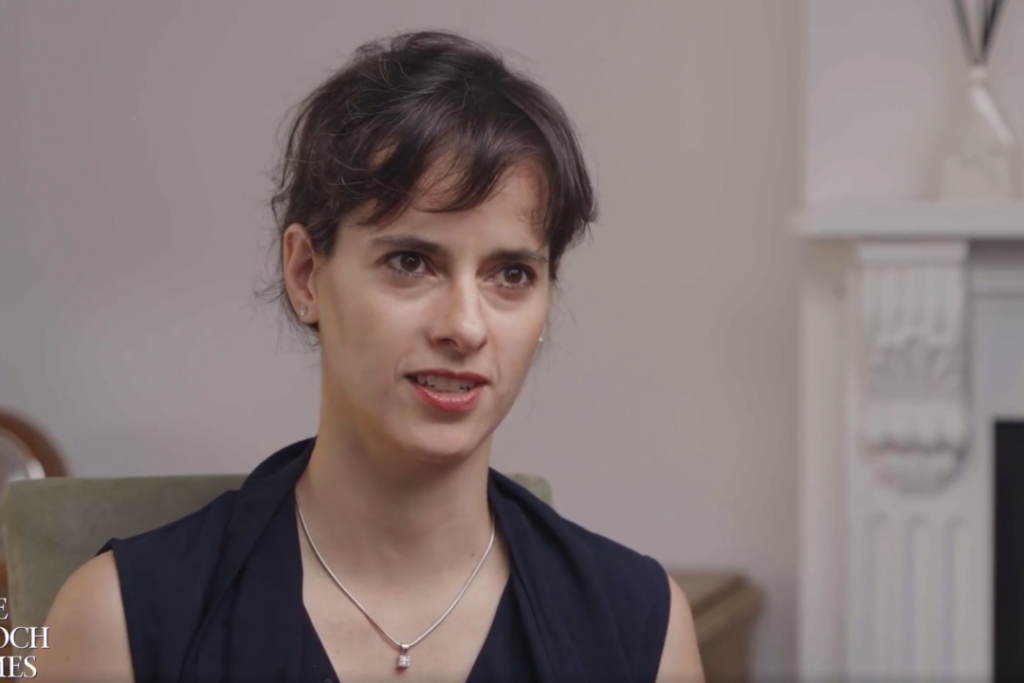
Carissa Véliz, an associate philosophy professor at Oxford University’s Institute for Ethics in AI, spoke to Epoch TV in an interview released on Aug. 11 about the risks of heeding public predictions about humanity’s future and how these proclamations can drive or derail individuals’ lives.
“If you take my prediction at face value and just act as if that were true, then you’re obeying. And that gets trickier when there are social predictions,” Véliz told “American Thought Leaders” host Jan Jekielek.
“If I tell you … ‘Tomorrow, AI is going to replace you,’ and you quit your job because it’s no longer worth it, then you’re obeying. And if I’m a tech executive who’s selling this product, well, then you’re doing me a favor.”
In a conversation about her new book, “Prophecy: Prediction, Power, and the Fight for the Future,” Véliz said that not only are public predictions unethical drivers of human behavior, but many of the most widely accepted forecasts never come to pass.
“There was a very, very strong belief that it was inevitable that there would be so much overpopulation, that there would be famine, and it would be a disaster. And that never happened,” she said.
“And then a few decades later, it was inevitable that we were going to shrink to nothingness and that the population was going to be dwindling. And that didn’t happen [either].”

A billboard advertising an artificial intelligence company is posted in San Francisco on Sept. 16, 2025. It can be risky to act based on predictions about humanity’s future, such as dire predictions about artificial intelligence, says Oxford professor Carissa Véliz. Justin Sullivan/Getty Images
The Prediction Market Economy
One of the most popular forms of public forecasts in the modern day is the prediction market industry.
Prediction markets allow users to place bets on outcomes from sports to elections to TV shows, as well as an increasing number of mundane incidents, such as how many times X CEO Elon Musk will post on the platform in a given week.
The two biggest players in the market, Polymarket and Kalshi, have generated $21.5 billion and $17.1 billion, respectively, in total notional trading volume since January 2025.


(Left) In this photo illustration, an app for Polymarket, an online prediction market site, is shown in Chicago on Feb. 25, 2026. (Right) A supporter checks gambling site “Kalshi” just before State Assembly member Alex Bores (D-N.Y.) gives a speech to supporters at his watch party at The Freehand Hotel after conceding the congressional race for New York’s 12th Congressional District, in New York City on June 23, 2026. Photo Illustration by Scott Olson/Getty Images, Laura Brett/Getty Images
The share of monthly revenue has increased significantly in less than a year’s time.

The markets’ combined monthly global trading volume surged from $5 billion in September 2025 to roughly $24 billion in April 2026, according to Pew Research Center’s analysis of data from digital assets media and information firm The Block.
Amid the rise in popularity of prediction markets, concerns have mounted not just over alleged insider trading incidents, but also the simultaneous increase in gambling addiction in the United States and how bettors are making wagers about nearly every aspect of human life, including the weather.
A majority—61 percent—of Americans view prediction market wagers as closer to gambling than legitimate investments, according to a March poll by the American Institute for Boys and Men and market research firm Ipsos.

Additionally, 44 percent of Americans believe it should be illegal to bet on election outcomes, and 57 percent say users should be barred from gambling on the outcomes of wars, according to a June Politico poll.
Meanwhile, an increasing number of media outlets are turning to prediction markets such as Kalshi and Polymarket in their reporting on elections, polling, and actions taken by the U.S. government.
Voters, looking for information and context on key races, increasingly engage with this reporting before casting their ballots.
But these public-facing predictions, driven by gambling and for-profit business models, may offer less precision than Americans realize, Véliz argued.
“Companies want profit. Profit and truth, or precision, or science, don’t always align well. And so this is not a scientific environment in which we are trying to maximize accuracy,” she said.

This photo illustration taken in Washington on Nov. 1, 2023, shows a phone screen displaying online prediction market PredictIt with a picture of the second Republican presidential primary debate in Simi Valley, Calif., on Sept. 27, 2023. Voters, looking for information and context on key races, increasingly engage with prediction market reporting before casting their ballots. Olivier Douliery/AFP via Getty Images
Ethics and Predictions
But according to Véliz, there are even bigger public forecasts that may have more profound impacts on human behavior and how a person plans for the future.
When AI moguls made heavy-handed predictions that their technology would soon replace human beings in a dizzying number of jobs across multiple industries, that was not only misleading but also marketing, “wishful thinking,” or “power plays in disguise,” she said.
“If we just assume that [the] future that is being predicted is the future, and we act in accordance with that, what we’re actually doing is obeying in advance because very often predictions have a veiled command,” Véliz said.
This could play out in someone quitting a job they believe will soon be replaced by AI, simply because they assumed the predictions made by the companies selling the product are correct.
But what if making accurate predictions was simply a matter of having more or better data? Véliz suggests this hope is somewhat misguided.
“We are collecting all this data with the promise that the more data, the better … but it’s not always the case,” she said.

Carissa Véliz, professor of philosophy at Oxford University, speaks with “American Thought Leaders” host Jan Jekielek in Oxford, England, on June 26, 2026. The Epoch Times
“Because often when we are searching for something in the data, it’s like searching for a needle in a haystack. And making the haystack bigger is not helpful.”
Data is only helpful if it’s relevant, she said.
One example she gives is tracking human behavior.
We might collect data on what a person does after receiving a loan from a lending institution, but rarely will one find data on the “counterfactual” example.

“If I don’t give a loan to someone else, I will never be able to figure out how well that person would have fared had I given the loan,” she said.
People may even choose inaction after believing a forecast is accurately predicting the future, which could impact their lives in substantial ways.
“The paradox is that the more we believe that we can do [something], the better our chances. If you don’t think you can do it and you stay home, the chances of succeeding are zero,” Véliz said.

An advertisement for AI company Artisan is posted in San Francisco on Dec. 5, 2024. Predictions from AI moguls that the technology will soon replace human beings can be marketing in disguise if it becomes a self-fulfilling prophecy. Justin Sullivan/Getty Images
“Sometimes in life, some battles are so important that I genuinely think that it’s better to fight them and be on the right side of history, even if you’re convinced that you’re going to lose.”
This is especially true when raising children, Véliz argued. We may encourage them to push forward in situations where they feel convinced of failure, but persistence is necessary for success and personal growth.
“For the very important battles in life, when it’s very important to be on the right side of history, it’s kind of inappropriate to make a calculation about whether you’re going to win or lose. It doesn’t matter. It’s that important,” she said.
Good Versus Bad Predictions
However, not all public predictions are necessarily bad, such as weather forecasts or medical prognoses, Véliz said.
“There are situations in which it’s tricky. It cannot be a blanket rule,” she said. “Because sometimes you need a sense of the diagnosis, and the diagnosis carries some prognosis to treat someone.”
As someone who lives in England, Véliz said she checks her weather app multiple times a day to monitor the forecasts.

A woman holds an Apple iPhone 11 Pro, in this file photo. Mobile phone apps allow millions of Americans to easily bet on politics, sports, and other subjects. grinvalds/Getty Images
Americans living in the Midwest may rely on these forecasts to seek shelter and survive during a tornado warning, and those along the Gulf Coast may check weather projections one or two weeks out during hurricane season to prepare their homes for a potentially catastrophic event.

“What I’m arguing for is a more enlightened use of prediction—to be clearer about the things that we can predict, the things that we can’t predict—and that if we have the illusion that we can predict, it’s going to lead us astray,” Véliz said.
For one, history is rife with predictions that were widely believed at the time but never came to pass.
“A few months before the Wright brothers managed to make an airplane fly, The New York Times published this scathing article saying that it would take from one million to 10 million years to make people fly in airplanes,” she said.
“They were completely wrong.”