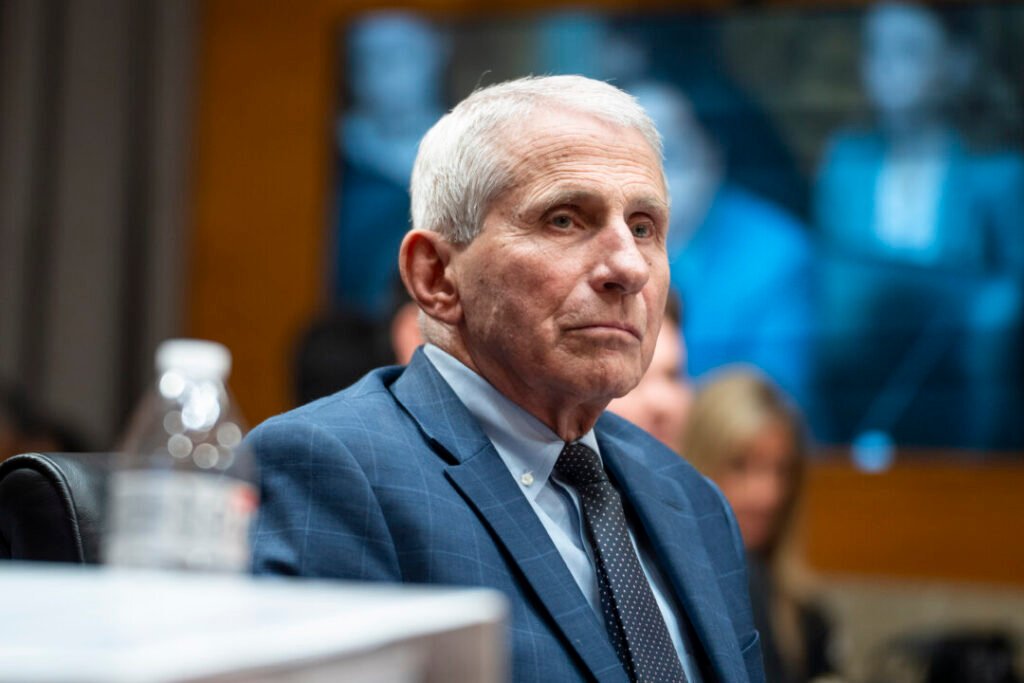

Dr. Anthony Fauci, former director of the National Institute of Allergy and Infectious Diseases at the National Institutes of Health, testifies before the Senate Committee on Homeland Security and Governmental Affairs in Washington on July 29, 2026. Madalina Kilroy/The Epoch Times
Dr. Anthony Fauci said an aide should delete an email about risky research his agency was funding, according to documents released on Aug. 29 by Sen. Rand Paul (R-Ky.).
“Please delete this e-mail and then delete from the deleted file,” Fauci told Dr. Clifford Lane, a senior official at the National Institute of Allergy and Infectious Diseases (NIAID), in a missive on March 4, 2012.
Fauci, NIAID’s director at the time, was commenting on an op-ed that criticized risky research that created a more transmissible H5N1 influenza virus. The research, led by European scientist Ron Fouchier, was funded by the NIAID.
The op-ed said the virus appeared to spread easily and would be lethal to humans if it escaped confinement or was stolen by terrorists. It highlighted the government’s funding of the research.
It also noted that the National Science Advisory Board for Biosecurity had recommended that papers prepared by researchers such as Fouchier omit key details that might help terrorists make their own versions of risky viruses.
Fauci told Lane that “people are getting to” Phil Boffey, the writer of the op-ed, “and he is swallowing it.” He said that the board’s decision was wrong. And he wrote that if the board maintained its stance, “the field of research on influenza transmissibility and host adaptability has a very serious problem.”
Related Stories
Fauci and Lane did not respond to requests for comment by publication time.
Boffey could not be reached.
Fouchier had told Science magazine that his team created “probably one of the most dangerous studies you can make.”
Several weeks later, Fauci coauthored an op-ed in the Washington Post that said work by Fouchier and another group funded by the NIAID involved careful work in isolated laboratories and advanced understanding of how mutations of H5N1, sometimes known as avian influenza, worked.
“This research has allowed identification of genetic pathways by which such a virus could better adapt to transmission among people,” the op-ed, titled A flu virus risk worth taking, stated.
Fauci’s directive to Lane was one of five times he told aides to delete emails, according to documents obtained and released by Paul. The other instances took place in 2009, 2011, and 2020. Fauci left the government in late 2022.
Prior to leaving office, President Joe Biden gave Fauci a preemptive pardon covering conduct from Jan. 1, 2014, to Jan. 19, 2025.