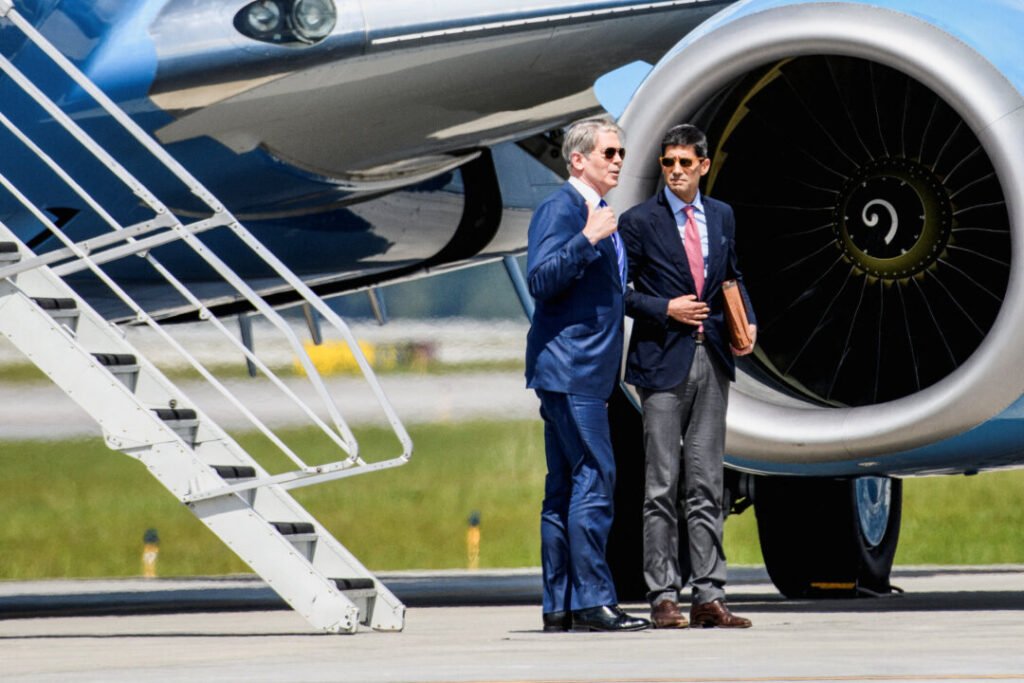

Treasury Secretary Scott Bessent and Federal Reserve Chair Kevin Warsh talk before entering a motorcade upon arrival in Asheville, before finance ministers and central bank governors from G20 countries meet in Asheville, North Carolina, on Aug. 30, 2026. Melissa S. Gerrits/Reuters
Bessent said that the current flood of Chinese exports was unsustainable, even though the U.S. direct trade position with China was “rapidly improving.” Bessent was speaking ahead of a G20 finance leaders meeting in Asheville, North Carolina, on Aug. 31 and Sept. 1.
“The world cannot have a China with a $1.2 trillion trade surplus,” he added.
“In China, the economy is quite weak, and they are trying to export their way out of it, and they need to rebalance their economy.”
“The rest of the world is going to have to examine their terms of trade with China,” Bessent added.
The United States has placed very high tariffs on a wide range of Chinese goods, and near-bans on some products, especially cars.
Most China-origin imports still face extra Section 301 duties. Other high-tariff or restricted categories include solar cells at 50 percent and advanced chips at 25 percent.
Related Stories

In July, the Office of the U.S. Trade Representative imposed a 12.5 percent tariff on Chinese Communist Party (CCP) goods (with some exemptions) due to China’s failure to prohibit imports made with forced labor.
Bessent said he told other industrial economies last year they would face pressures from the China import surge and that “now they are confronted with some very stark choices.”
Bessent said it was unclear whether he would meet with his Chinese counterpart, Chinese Vice Premier He Lifeng, in person ahead of a White House meeting between Trump and Chinese leader Xi Jinping slated for late September.
“I think that there probably are $30 billion of non-strategic, non-critical goods on each side that we could take the tariffs off,” Bessent said.
“Secretary Bessent will want to put Iran front and center and talk about tightening sanctions on Iran, and many countries around the G20 table will want to talk about anything else,” Josh Lipsky, international economics chair at the Atlantic Council, said on Aug. 30.
“They’ll want to talk about tariffs.”
Bessent said that any “entity that facilitates money laundering on behalf of Iran will be removed from the U.S. Dollar system.”
He warned that those who stand with the United States will “reap the rewards of our partnership” while those who “tether themselves to the Iranian regime” should expect major economic isolation.
Trump told reporters Aug. 27 he could be sanctioning Chinese banks.
“I don’t have to announce everything,” he said, according to a Fox News stream of the event.
U.S. Ambassador to China David Perdue said in an Aug. 27 post that he met with Chinese Foreign Minister Wang Yi and three other Chinese officials to discuss Xi’s upcoming state visit to Washington.
Asked on Aug. 25 whether China would change its dealings with Iran or act against Chinese entities named by the Treasury, Chinese Foreign Ministry spokesman Lin Jian said China’s cooperation with Iran should not be disrupted and that Beijing would take measures to protect what he called its rights and interests.
Reuters and Arthur Zhang contributed to this report.