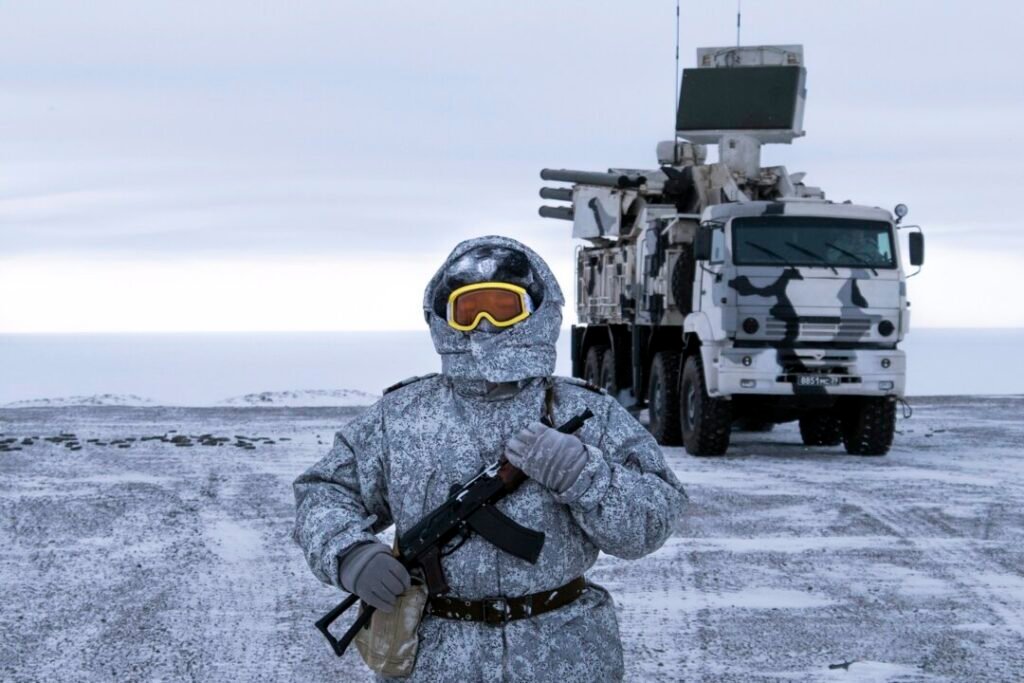

A Russian soldier stands guard beside a Pansyr-S1 air defense system on Kotelny Island, part of the New Siberian Islands archipelago located between the Laptev Sea and the East Siberian Sea, in Russia on April 3, 2019. Vladimir Isachenkov/AP
NATO military activity in the Arctic poses a direct threat to Russia’s security and could lead to disastrous consequences, Russian Foreign Minister Sergei Lavrov wrote in an article published by the Russian Foreign Ministry on Monday.
“Intensive military preparations are underway in close proximity to our northern borders,” Lavrov said. “NATO is conducting large-scale military exercises involving non-regional countries and introducing new components of its command-and-control system.”
He said such activity increases the “risk of incidents that could trigger an armed confrontation with potentially disastrous consequences.”
Lavrov said the West was also attempting to undermine Russia’s international cooperation in the Arctic with countries from the “Global Majority,” a term the Kremlin often uses to describe African and Asian countries.
Related Stories

‘Landmark’ Shipping Voyage
Moscow is keen on developing the Northern Sea Route, an Arctic shipping corridor that creates a shortcut between Europe and Northeast Asian markets, including China, South Korea and Japan. It could cut the time for a container ship by 10 days compared with the regular route via the Indian Ocean and the Suez Canal, according to the Korea Institute for International Economic Policy.
In his article, Lavrov said a “landmark event” in Arctic shipping occurred on Aug. 19.
“For the first time, a container ship from China arrived at the port of Murmansk via the Northern Sea Route, a vital part of the Trans-Arctic Transport Corridor,” he said.
The Barents Observer reported that the vessel was the Xin Xin Hai-1, a cargo ship that sails under a Hong Kong flag.
Lavrov said the Arctic contributed at least 10 percent of Russia’s GDP and was home to more than 2.5 million Russian citizens.

China’s Foreign Affairs Minister Wang Yi (L) and Russian Foreign Minister Sergei Lavrov (R) exchange documents during a signing ceremony following talks in Moscow on May 8, 2025. Kirill Kudryavtsev/AFP via Getty Images
He said Moscow was ready to cooperate with other nations over the development of the region.
“There are prospects for interaction in the Far North with Brazil, Indonesia, Iran and other BRICS countries,” Lavrov said, referring to an economic bloc which also includes India, Egypt, and Ethiopia.
“The vast resource, transport, and logistics potential of the Far North, its unique natural and climatic features, long-standing traditions of regional cooperation, and the rich cultural heritage of its indigenous peoples offer broad opportunities for advantageous partnership.”
Russia’s neighbor Norway said on Aug. 20 that it had expanded its Arctic brigade with an artillery battalion, an anti-aircraft battery, and a joint company.
“Russia’s illegal war of aggression against Ukraine and the worsening security situation underline the need to build up the Finnmark Brigade as quickly as possible,” the Norwegian Armed Forces stated.
Norway will also ignore the European Union’s demands for a moratorium on hydrocarbon exploration in the Arctic Circle and continue drilling for oil and gas in the Barents Sea, the country’s energy minister said last week.
The Russian invasion of Ukraine in February 2022 has led to increased fear among NATO member countries in Scandinavia, the Baltic, and eastern Europe that Russia poses a renewed threat, and there has been an uptick in defense spending as a result.
Moscow has previously dismissed allegations that it poses a threat to NATO.
Reuters contributed to this report.