Qiu Huijuan traveled through the night with her parents after losing contact with her two brothers, she told the Chinese edition of The Epoch Times.
Both men operated excavators near Gyirong Port and lived in dormitories nearby. Qiu said the dormitory area had been swept away in the Aug. 26 flood.
By midday, the family had reached a checkpoint near Gyirong, where Qiu said they found more than 200 other people who had also come looking for missing family members.
“Many were crying,” Qiu said.
Police would not allow the relatives to continue toward the port. Qiu said they remained in Gyirong town and had to find places to stay while waiting for news.
“The hotels here are all full,” she said.
Related Stories


On Aug. 28, Qiu said authorities allowed more than 200 relatives to go closer to the disaster area for a brief look.
“The families all went over there to take a look,” Qiu said. “There probably aren’t any survivors. You couldn’t see a single person. It was all flattened.”
Qiu said officials then told the relatives to return home.
Tong Guowei was also trying to get closer to the disaster area. His father, an employee of China Communications Construction Group, had been working about 980 feet from the border gate when the flood struck, he told The Epoch Times.
Tong traveled to Shigatse after learning that his father was missing but said police checkpoints prevented him from entering Gyirong.
“Gyirong County is closed. You can’t get in. Police are guarding it,” he said.
Tong also said he could not obtain the border-area travel permit needed to proceed.
China requires a border management area permit for travel into designated border areas in Tibet. After the disaster, the National Immigration Administration suspended electronic permits for travel to Shigatse beginning Aug. 28 and told people who already held permits not to travel there.
Authorities collected blood samples from relatives, Tong said, but the family was not told what the samples would be used for or when he might receive definitive information about his father.
“He probably can’t be found, but we still have to wait,” Tong said.
He said he wanted to go to the site at some point regardless of the outcome.
“If I can get there, I still have to go. Even bringing back a handful of soil would be something,” he said.
Qiu and Tong are pseudonyms. The Epoch Times is withholding the full names of interviewees in China who fear retaliation from Chinese authorities.
Missing Drivers, Few Public Details
A Lhasa tourism bus driver using the pseudonym Suoban told The Epoch Times that 15 drivers from his company had been near Gyirong Port when the disaster struck and all remained out of contact when he was interviewed.
“All 15 were from our company, Lhasa Transportation Industry Group, and now all of them are missing,” he said.
Suoban said the drivers operated 29-seat tourist buses. Some had gone to pick up tourists and others were dropping passengers off.
He estimated that there may have been more than 100 vehicles in the area, including freight trucks and passenger cars.
Chinese authorities said on Aug. 30 that the flood had killed 16 people and left 546 missing in Gyirong as of 6 p.m. Aug. 29.
At an Aug. 30 press conference, authorities released a country-by-country count of 261 missing foreign nationals from 23 countries and said the information had been provided to the countries’ embassies and consulates in China.
The published briefing listed nationalities and totals—including 104 Nepalese, 49 Indians, 33 Latvians and 18 Americans—but did not include the names, ages, or other individual details of those missing.
The briefing also did not provide a comparable public breakdown of the Chinese citizens among the missing by workplace or occupation, such as border inspection officers, tourism drivers, construction workers, freight drivers, or local residents.
Disaster Footage Difficult to Find Inside China
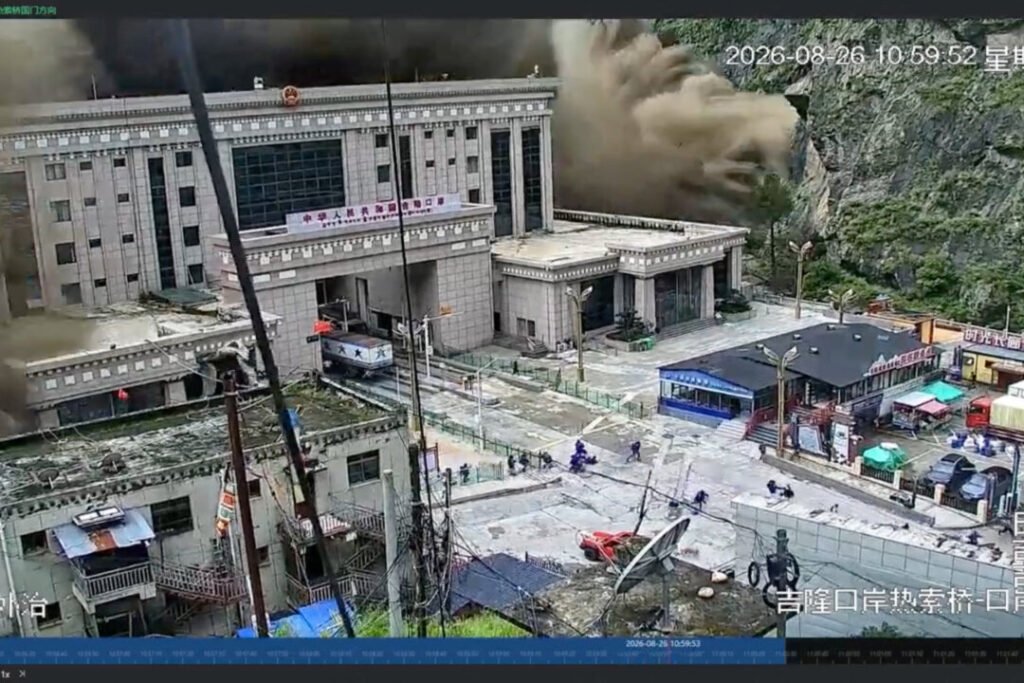
A fixed-camera video widely circulated on social media shows people running moments before a wall of mud, water, and debris engulfs the Gyirong border complex.
The Epoch Times searched major Chinese social media platforms for the same footage but could not locate the widely circulated sequence showing the port being overwhelmed.
Searches instead returned material including pre-disaster footage of Gyirong Port, videos centered on the Nepal side of the disaster, and clips whose titles suggested they showed the port being destroyed although the images did not show the flood striking the facility.
China Digital Times, a Berkeley, California-based independent bilingual media organization that monitors Chinese internet censorship, separately documented that users repeatedly failed when attempting to share two Gyirong complex videos through WeChat, a messaging and social-media service widely used in China.
Police Punish Disaster Comments
Chinese police have also taken action against people over comments about the flood.
An Aug. 29 police notice, republished by the Tibet regional government’s culture and tourism department, said authorities administratively punished a 38-year-old man surnamed Zhou after accusing him of fabricating and exaggerating death and missing-person figures beneath a disaster video.
Police ordered Zhou to delete the comments.
In a second case, police accused a 43-year-old woman surnamed Xu of posting what authorities described as false information about the disaster’s cause.
According to the notice, Xu deleted the comment, received “criticism and education,” and signed a pledge to regulate her future online conduct.
The notice warned that comments posted beneath news reports could also result in punishment when authorities classify them as rumors.
Foreign Reporters Kept Out
Foreign journalists have also been unable to independently report from the Tibet side of the disaster.
Australian Broadcasting Corporation China correspondent Allyson Horn said she made multiple formal requests to Chinese authorities for permission to travel to Tibet after the flood, either independently or as part of an official media trip.
The requests were rejected, she reported. China’s Foreign Ministry cited difficulties reaching the disaster area and the risk of further disasters. Horn said other foreign journalists seeking access were also refused.
Across the border in Nepal, foreign journalists have been able to enter accessible parts of the disaster zone and interview survivors and relatives.