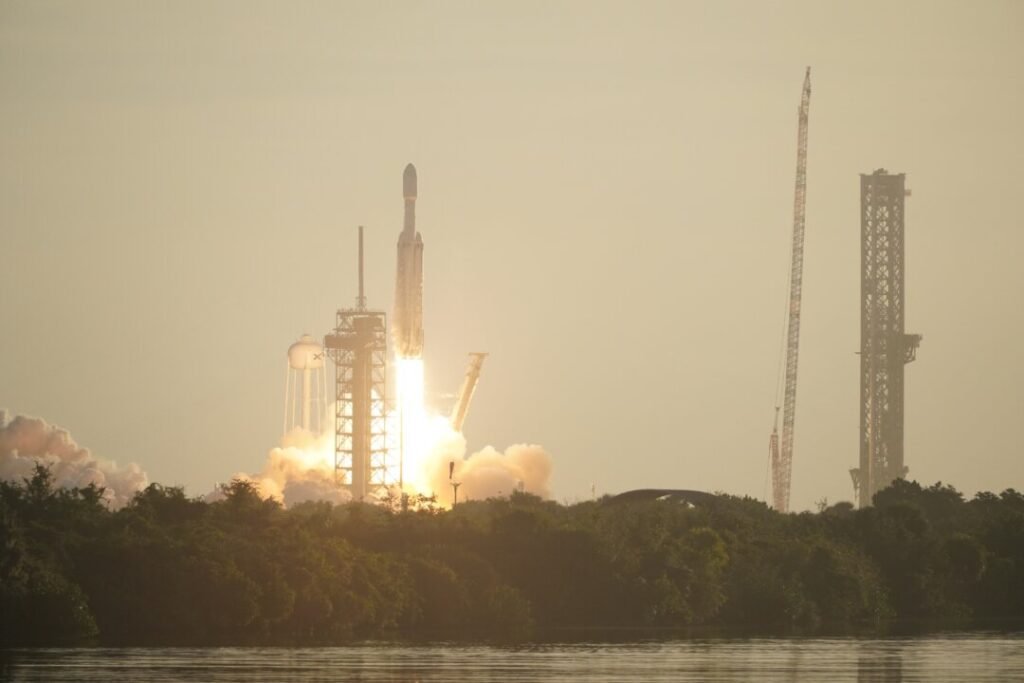
CAPE CANAVERAL, Fla.—NASA dispatched its latest addition to its fleet of space telescopes on Aug. 30, beginning a multi-year mission of cosmic discovery that is promising to dwarf that of its predecessors.
The Nancy Grace Roman Space Telescope, called Roman for short, will tackle several objectives. It promises to expand human understanding of dark matter and dark energy, and thereby shed more light on how the universe is expanding.
It will conduct an unprecedented cosmic survey of more than two billion galaxies, as well as the largest survey of planets across our galaxy outside the solar system. It will witness cosmic events undetectable by older telescopes and give new insights into the center of our own galaxy.
“Ninety five percent of the universe is unknown at this point in time,” Jason Hylan, Roman’s observatory project manager, told The Epoch Times in a pre-launch interview on Aug. 29.
The Hubble Space Telescope and James Webb Space Telescope helped us understand that first 5 percent over the last several decades, he said. This new one, the Nancy Roman Grace Space Telescope, will help us understand that remaining 95 percent.
“At any instance, Roman will see more than 100 times the amount of sky that Hubble can see, or just more than that,” Julie McEnery, Roman telescope senior project scientist at NASA’s Goddard Space Flight Center, said in a pre-launch science briefing. “Roman will move and stop and be ready to take the next image very quickly. So we can survey the sky more than 1000 times faster than Hubble.”
Related Stories


“Put this into context: a survey that would take Roman one month would take a century with Hubble. So Roman doesn’t do Hubble science faster; it addresses entirely new, ambitious science questions, while Hubble continues to do the great things that Hubble does,” she said.
One particular new feature Roman carries is technology called a coronograph, which Hylan said would be utilized to advance the ability to discover planets beyond our solar system, known as exoplanets.
NASA Administrator Jared Isaacman and Nicky Fox, associate administrator of NASA’s Science Mission Directorate, told reporters after the launch that Roman had the potential to reveal more than 100,000 exoplanets. As of Aug. 30, the total number of known exoplanets was roughly 6,000.
“In 1990, when we launched Hubble, you didn’t even know there were exoplanets, and so [look] how far we have come,” Fox said.
She and Isaacman were joined by McEnery, who added that Roman will provide the first “statistically significant” survey of exoplanets around the same size as Earth and orbiting a distance range from its star known as “the Goldilocks zone.” This is where it is not too hot and not too cold: just right for a planet like Earth to develop life.
The cutting-edge technology developed to conduct those initial surveys will lay the foundation for the upcoming Habitable Worlds Observatory.
However, Roman’s launch itself offered its own news stories. It set off atop a SpaceX Falcon Heavy rocket. This is the strongest rocket currently in the SpaceX fleet, synchronizing three reusable Falcon 9 boosters to send larger payloads to Earth orbit and beyond.
All three boosters are programmed to make a controlled landing simultaneously. However, this launch only saw the two side boosters return to landing zones at Cape Canaveral Space Force Station. The middle booster was expended, according to SpaceX.
NASA and mission leaders told reporters that the Falcon Heavy delivered Roman right where it was supposed to be, utilizing all 5 million pounds of thrust available. Telemetry was synced up to the ground almost immediately after the fairing cover was deployed. The sun shield and solar arrays deployed, and the spacecraft reported power positive ahead of schedule.
This was only the 13th Falcon Heavy launch, and the latest since April 29.
Isaacman told The Epoch Times that NASA will utilize the Falcon Heavy again for the upcoming Dragonfly mission to Saturn’s moon Titan and the launch of the nuclear fission-powered SR-1 Freedom to Mars, both of which are scheduled to launch in 2028.
He also said that a Falcon Heavy was planned to be used for at least one Moon Base mission.
Roman’s completion and deployment also came in on budget and several months ahead of schedule, a feat that Hylan credited to a workflow that trusted multiple teams to work in parallel with each other and optimized functionality over the need to achieve perfection.
“We have viewed cost and schedule just as serious a requirement as the technical performance requirements,” he said. “It has been part of our thinking every day.”
He commended the project management and the overall cooperation adopted by science and engineering teams to work simultaneously and trust each other to get their jobs done. As many as seven different teams were operating at once in parallel tracks towards a final integration.
“Roman becomes a shining example that it can be done,” he added. “There are a lot of people who always say, ‘hey, projects always drove past their cost,’ and the Roman team showed it is possible to stay within those bounds.”
But Roman’s development was still completed without compromise.
“Through the course of building and through the course of all the reviews, we didn’t make compromises,” McEnery said. “What got up there is exactly what we wanted.”
An overall excitement for the mission and the dedication that stood behind it to deliver it on budget ahead of schedule was shared by all the leaders at the press conference. President Donald Trump also called Isaacman to share a message with all in attendance.
“Like we are with the country itself, we’re the hottest there is,” he told the mission leaders. “The hottest in space, and we have the hottest country anywhere in the world. So let’s keep it all going. You’re a big part of it. Let’s keep it all going.”
After launch, the telescope will have a 100-day mission to its staging point in orbit around the Sun, 1 million miles away from Earth, mission leaders told reporters. But its cameras and systems will be tested beforehand.
They will spend three months commissioning the observatory’s instruments, and the first downloads could be expected before the beginning of 2027.
Mission leaders also promised that the enormous amounts of data collected by Roman will be made available to the public in real time.
“I think that one thing people will take away from the Roman [Space Telescope] is just how fast we can look at the universe, and because of that, we’re going to start to understand aspects of the universe that are just unknown right now,” Hylan said ahead of launch.
“I have no doubt that there’s just going to be some extraordinary things that we never thought we’d see when this starts looking at the sky.”