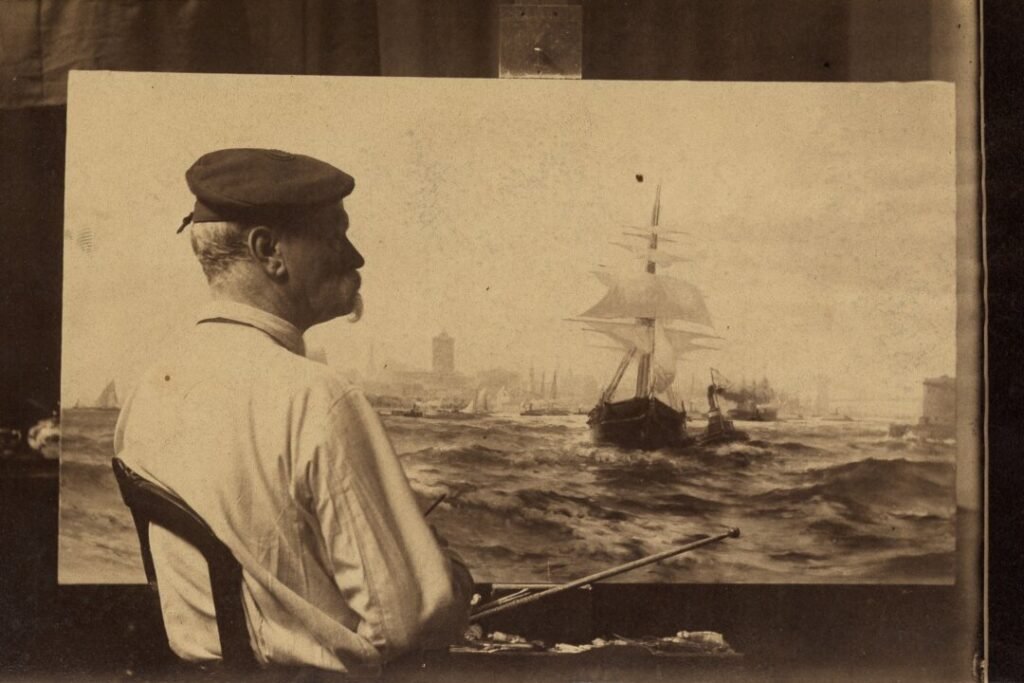
In the late 19th century, the Moran family included some of the most influential artists in the United States, including over a dozen professional painters, sketchers, etchers, lithographers, engravers, and photographers. It all started with the eldest brother in this group of English immigrants, Edward Moran (1829–1901).
Thomas and Mary Moran were handloom weavers in Lancashire, England, where their first child, Edward, was born on Aug. 19, 1829. By the early 1840s, the Industrial Revolution in England made it very difficult for the Irish-born Moran Sr. to find enough work to support his family.

Edward Moran, 1860, by John Moran. He is standing next to an easel with a painting of a ship at sea during a storm. Library Company of Philadelphia. Public Domain
In 1842, Thomas Moran emigrated to the United States, landing in Maryland. Most historical accounts agree that he sent for his wife and children after establishing himself.
By 1844, the family had settled in Kensington, Pennsylvania, just outside Philadelphia. There, they became part of the community of immigrant textile workers from the British Isles. Edward was a young adolescent when he arrived. As the oldest child, he was the greatest example of the American dream come to life for his family.
Beginnings in Art
Edward seems to have been the only Moran child to be apprenticed in handloom weaving. He learned the craft in England from his father and worked in the industry as a young man in the United States.
It’s also suggested that back in England, he developed an early passion for art. The story goes that Edward learned to draw from a street artist in Lancashire. He loved it so much that he persistently drew pictures on the fabric he was supposed to be weaving, much to his parents’ frustration.

“Life Saving Patrol,” circa 1893, by Edward Moran. Smithsonian. Public Domain
They told him that he should give up weaving and take up art instead. This may be a bit of creative license with the facts, since he appears to have worked as a weaver years later in Philadelphia.
Related Stories


For seven years, Edward worked as a power-loom boss in a mill in Kensington. As he helped support his family with this job, he sketched and painted in his spare time. Around 1853, one of his supervisors at the mill noticed young Moran’s talent and introduced him to the man who would become his friend and teacher, James Hamilton (1819–1878).
With no formal art training, Edward learned from James, who encouraged him and taught him fundamental painting techniques. James was one of Philadelphia’s foremost marine painters. He inspired Edward in his eventual development as a maritime painter.
He also introduced Edward to another local professional artist, G.D. Paul Weber (1823–1916), a portraitist and landscape painter who instructed the younger artist in the business of art.
A Maritime Painter
Edward painted professionally in the mid-1850s by displaying some of his early paintings at the Pennsylvania Academy of Fine Arts. This gave him the opportunity to show his work to professors and critics alike.

“Sandy Hook Lighthouse,” 1876, by Edward Moran. Public Domain
He established an art studio to create his oil paintings. In addition to selling some paintings, he supported himself by working as a lithographer. By the late 1850s, Moran was displaying his paintings at prominent museums in New York City and Boston.
In the second half of the 19th century, Edward established himself as one of the foremost maritime painters in the United States. He followed the example of James, his mentor, in creating romanticized oil paintings of ships, with beautiful lighting, shadows, and weather.

“Shipwrecked,” 1877, by Edward Moran. Brigham Young University Museum of Art. Public Domain
Many of his earlier paintings were dramatic shipwreck scenes. However, in the 1870s, he turned to seascapes that would appeal to particular audiences in New York. He pleased critics with his moody atmospheric paintings of maritime landscapes, while wealthy New York collectors liked his scenes of yacht racing.

“Off Calais Pier,” 1878, by Edward Moran. Public Domain
Some of Edward’s best-known work is a series of 13 historical marine paintings. These dramatic paintings depicted climactic scenes in American naval history, from the arrival of Vikings in North America to the U.S. Navy’s return from the Spanish American War. He began this series in 1885, and it was displayed at the World’s Columbian Exposition in Chicago in 1893.

“Viking Armada,” by Edward Moran. The Knohl Collection. Public Domain
A Guiding Brother
All three of Edward’s younger brothers became artists in various disciplines. Both Thomas (1837–1926) and Peter (1841–1914) shared his studio with him for a time, as he personally taught each of them techniques of oil painting and encouraged their artistic careers.
Thomas would end up becoming the most famous artist in the family, earning a reputation as the foremost landscape painter of his day. He honed his technique during a trip to London with Edward in the early 1860s, during which both studied the work of British landscape painter J.M.W. Turner (circa 1775–1851).
In addition to his younger brothers, Edward’s second wife, two of his sisters-in-law, his brother-in-law, his nephew, and both his sons became professional artists in various disciplines.
Edward left a beautiful legacy of Americanism, not just on the exquisite maritime canvases he created but also in the tapestry of the American dream he wove for himself and his family.