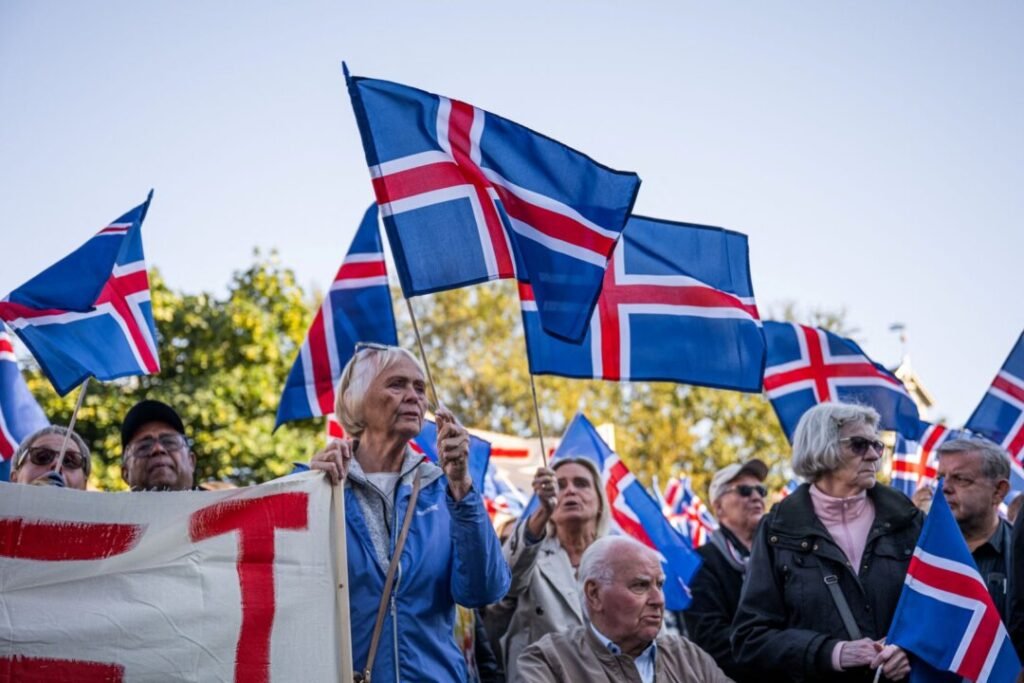
REYKJAVÍK, Iceland—Icelanders vote Saturday on whether to reopen negotiations to join the European Union, reviving a question this fiercely independent island nation of some 400,000 people thought it had settled when it shelved its membership bid more than a decade ago.
The last polls before the vote put the “yes” camp ahead by just 2.6 points, down from more than six points in June.
The ballot asks a single question: “Should Iceland resume accession negotiations with the European Union?”
A “yes” would not make Iceland a member. It would send the government back to Brussels, and any deal it brought home would face a second referendum and ratification by all 27 member states. A “no” would shelve the issue.
Behind the wording lies a far larger argument: whether a nation that became a republic only in 1944 should hand lawmaking authority, trade policy, and potentially its fishing grounds to Brussels in exchange for a seat at the table and a path to the euro.
Vote to Talk or Vote to Join?
Related Stories
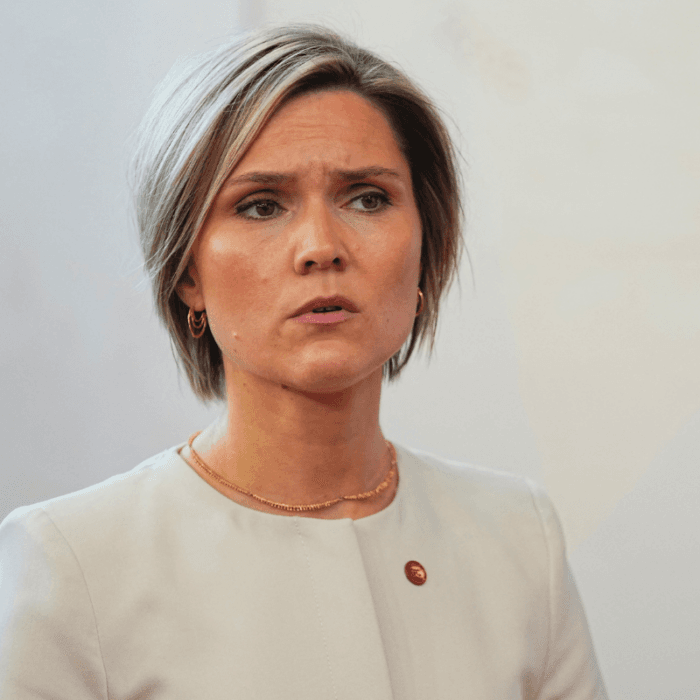
Social Democrat Prime Minister Kristrún Frostadóttir has described the vote as “an opportunity,” saying that “it’s not a final decision.”
For supporters, the prize is a say over rules Iceland already lives by. Full membership “would give Iceland a seat, a voice on decisions that already have a major impact on our economy and society,” Dagur B. Eggertsson, a Social Democratic Alliance lawmaker who heads Iceland’s delegation to the NATO Parliamentary Assembly, told The Epoch Times.
Opponents criticized the government’s framing as the campaign’s central deception.
The government is trying to convince people “that we are not really applying, that we are merely looking into what membership would entail,” Gudlaugur Thor Thordarson, a former foreign minister and current lawmaker for the opposition Independence Party, said in an interview with The Epoch Times. “If you apply to join the EU, you are applying to join the EU.”
Membership, he said, would mean EU law overriding Icelandic law, a sweeping transfer of legislative and executive power, and the jurisdiction of the EU’s courts on top.
Haraldur Ólafsson, a physics professor who chairs the eurosceptic movement Heimssýn, told The Epoch Times the question was worded so that people “find it very difficult to say no to discussions.”
Applying without wanting to join, he added, makes “a fool of the European Union.” “You should try to win over the people of the country before you submit an application, instead of submitting one in camouflage,” he said.

Iceland Prime Minister Kristrun Frostadottir participates in a listening session on the upcoming referendum in Reykjavik, Iceland on Aug. 26, 2026. Jonathan Nackstrand/AFP via Getty Images
The polls bear out the gap between the two questions. Voters are roughly evenly split on reopening talks, but support for membership itself “consistently shows a much lower number for yes,” Hallgrímur Oddsson, founder of Evrópustraumar, an Icelandic think tank focused on relations with the EU, told The Epoch Times.
Reviving a Frozen Bid
Icelanders have been here before.
Iceland applied to join the EU in July 2009, months after its banks collapsed. Talks opened in 2010, and 11 of 35 policy chapters had been provisionally closed by the time a new center-right government froze the process in 2013. The fisheries chapter, the most sensitive of all, was never opened.
In March 2015, Reykjavík asked Brussels to no longer regard it as a candidate country.
The current government contends that the application nonetheless remains valid, a view the European Commission has endorsed.
Thordarson disputes this. The “still valid” line, he said, was the product of government lobbying in Brussels and “came as a total surprise to all of us.”
He also said that visits by European ministers to Reykjavík over the summer to urge a “yes” amount to “foreign interference.”
Spanish Foreign Minister José Manuel Albares and his Austrian counterpart, Beate Meinl-Reisinger, both spoke favorably of Icelandic membership during visits to the country in June, with the referendum on the agenda.
France’s Jean-Noël Barrot struck a similar note during an official visit in July, saying Iceland “had nothing to lose” by reopening talks.
The Greenland Factor
The government’s own explanation for the timing points not to Brussels but to Washington.
Frostadóttir’s center-left coalition, formed after the late-2024 election, had pledged a referendum by 2027. In March it brought the vote forward, weeks after U.S. President Donald Trump renewed his push to acquire Greenland, which he said has become a national security concern for the United States because of increasing Russian and Chinese influence over the Arctic.
Foreign Minister Thorgerdur Katrín Gunnarsdóttir said it would be “both naive and irresponsible” not to take the moment in history into account.
Snærós Sindradóttir Bachmann, executive director of the European Movement in Iceland, told The Epoch Times that the vote is “about human rights and democracy, and about standing with like-minded nations against this threat from the West,” a reference to Washington’s pressure on Greenland.
“Greenland is 290 kilometers [about 180 miles] away from us. We have to be realistic,” she said.
Eggertsson, for his part, said he was “very cautious about speculating that similar pressure will be directed at Iceland,” citing the country’s “strong and longstanding ties with the United States.”
But as larger powers grow more willing to apply pressure, he said, “stronger cooperation with allies and like-minded countries becomes increasingly important.” He added: “I would not frame this as turning away from the United States or from NATO.”
Iceland has no armed forces of its own. A founding member of NATO, it relies for its defense on a 1951 agreement with the United States. In March, it also signed a security and defense partnership with the EU covering Arctic and maritime security, cyber issues, and economic security.
The Greenland episode weighs on her, Bachmann said, and she’s concerned it does not seem to worry many of her compatriots.
Thordarson, who said he too objected to Trump’s statements on Greenland, dismissed the argument as “a pretext” and a narrative that “does not hold up.” Frostadóttir, he added, had not campaigned on a referendum on reopening accession talks.
Ólafsson was blunter: the government, he said, had blown the Greenland issue “light-years out of proportion.”
Greenland has weighed on the debate “much less than people abroad would think,” Oddsson said. “The topics actually being discussed are much closer to home: the currency, fisheries, agriculture, and questions of sovereignty.”

A “Nei takk” (No thanks) sign opposing the ESB (EU in Icelandic) is displayed on wrapped hay bales outside a farm near Reykjavík, Iceland, on Aug. 26, 2026, ahead of a local referendum. Jonathan Nackstrand/AFP via Getty Images
Half In, Half Out
The sovereignty question turns on an arrangement that already binds Iceland to the bloc.
Through the European Economic Area, Iceland belongs to the single market and adopts much of the EU rulebook, with agriculture and fisheries carved out. It is also part of the passport-free Schengen zone.
“Today we implement much of the legislation governing that market without having a seat at the table or vote when the decisions are made,” Eggertsson said.
Thordarson sees the same arrangement from the opposite side. “We have all the exemptions now. Why should we hand powers we fought for over to Brussels?” he said.
“We control 100 percent today; we would give 100 percent to Brussels and then ask whether we could have 10 or 20 percent back.”
Inside the bloc, he said, Iceland’s seat would be “far smaller,” and the country would lose the trade deals it has struck through the European Free Trade Association.
For Ólafsson, the case is simpler still: “Joining the EU is the worst business idea Iceland could ever have.”
Krona Versus Euro
If sovereignty animates the “no” camp, the cost of living drives the “yes” vote. Iceland’s central bank raised its key rate to 8 percent on Aug. 19, its third increase in a row, while annual inflation stood at 5.3 percent in July, compared with 2.9 percent in the euro area.
Membership “would open a path towards adopting the euro, which I believe would bring greater economic stability and, over time, lower and more stable interest rates and inflation,” Eggertsson said.
Iceland is not in distress, Oddsson said. The krona lost half its value after 2008, yet the country “bounced back relatively quickly.”
“Most of Iceland’s economic indicators are positive,” he said. “Iceland is wealthy: the cost of living is high, but so are salaries.”
The sore point, he said, is price stability. “Inflation is always higher here, and that, together with our currency, is the core of the issue” for the “yes” camp.
Ólafsson said the economy “has been fairly stable since the crash of 2008” and dismissed the euro argument outright: “You do not get lower interest rates by changing currency.”
Thordarson noted that Frostadóttir herself, as opposition leader, had argued that the EU would not cure inflation.
“What happens so repeatedly with the European Union is when it’s doing badly, when there’s inflation, when there’s high interest rates, people start wanting to join the European Union,” she said in a podcast interview in August 2024.
Fish, the Sticking Point
The most sensitive issue of all is the one that halted the last attempt.
Marine products made up 38.9 percent of Iceland’s goods exports last year, and the country fought three “Cod Wars” with Britain between the 1950s and 1970s to win exclusive control of its waters. Opponents fear that under the EU’s Common Fisheries Policy, membership would eventually open those grounds to foreign fleets.
“No other fleet has fished our waters for more than half a century,” Eggertsson said, and any acceptable agreement “would have to reflect those special circumstances.”

An Icelandic Coast Guard vessel is docked in Reykjavík Harbor, Iceland, on Aug. 25, 2026. Jonathan Nackstrand/AFP via Getty Images
Oddsson sees “a consensus on both sides that some kind of solution, some accommodation, would have to be found.” The commission itself has spoken of “creative solutions,” in the words of Enlargement Commissioner Marta Kos.
But “the EU’s history is not one full of exemptions,” he cautioned, and any such accommodation would need the approval of all 27 member states.
Fisheries Iceland, the industry’s trade body, says the permanent opt-out it is seeking would be unprecedented.
Farmers see the same obstacle. “The EU is built on common rules and common policies, and no member state has secured the kind of permanent exemption that Icelandic agriculture would require,” Margret Agusta Sigurdardottir, executive director of the Icelandic Farmers’ Association, told The Epoch Times.
Eggertsson sees nonetheless “encouraging signals” of flexibility in Brussels but said negotiations are the only way to find out what can be agreed. “If an acceptable solution cannot be found, there will be no agreement to approve,” he said.