By Betty Hallock
Los Angeles Times
LOS ANGELES—Rose Wilde’s West Adams garden is a living, growing hub for L.A.’s vanguard of cake making and decorating. It’s teeming with tomato plants, passion fruit vines, roses, lavender, cosmos, herbs, and chickens for eggs.
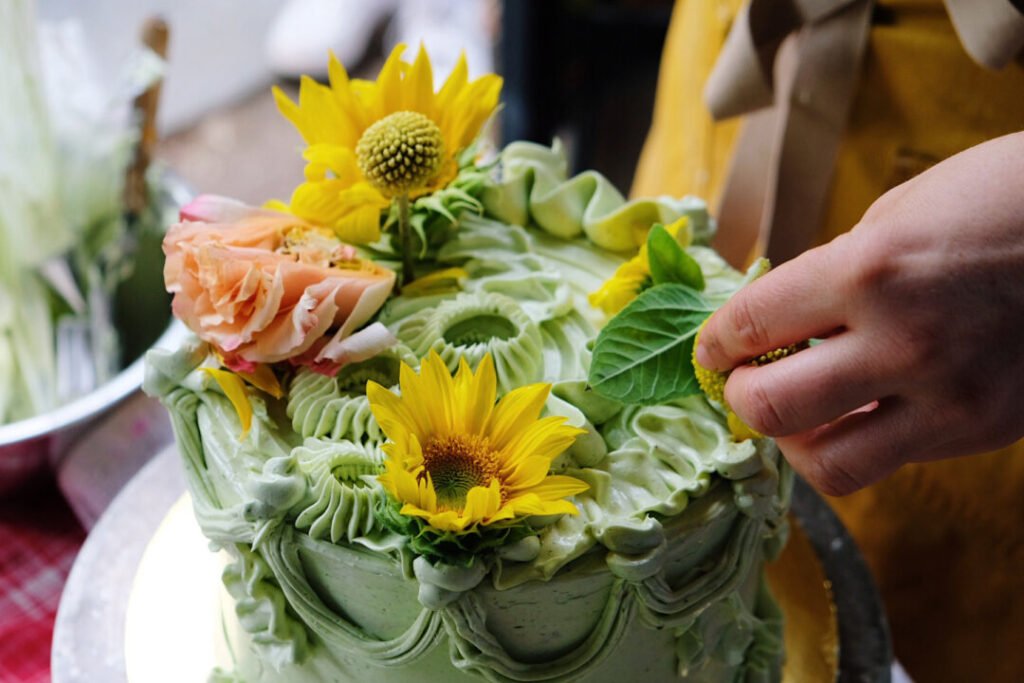
A large catering pan filled with the tomato leaf frosting sat next to whole tomatoes, strawberries, and bunches of sunflowers, chamomile blossoms, craspedia, and fresh tomato leaves. These are the telltales of L.A.’s most progressive cakes: florals, herbs, and fresh fruit and vegetables.
When it comes to cake, Paris is known for technical mastery and trompe l’oeil extravagance, Tokyo for pristine cake architecture and geometry, and Seoul for minimalism and pastel hues.
Related Stories

“We have access to more than anyone else anywhere,” said Wilde, who was a lawyer before the baking life took over. “Abundance and seasonality, how can you not? There’s too much to be inspired by.”
“Let the seasons lead,” Wilde said of L.A.’s cake style. “Abundance over precision, lots of asymmetry, soft architecture, and we have a lot of botanical knowledge.”

Rose Wilde spreads tomato-leaf buttercream on top of a three-layer cake during a cake decorating workshop in her backyard. Betty Hallock/Los Angeles Times/TNS
Here are Wilde’s tips for decorating cakes that will make your buttercream dreams come true:
Use a Cake Turntable
It’s worth making an investment ($10 to $70) in a rotating cake stand, which has a raised platform and allows you to spin a cake 360 degrees smoothly and continuously.
Make Sure Your Cake Is Stable
The weight of your cake should be supported by your buttercream: If you’re working with olive oil cake, for example, heavy buttercream is going to stabilize it better. Give yourself a solid base so you have the calm and time to decorate. If your cake is not structurally sound, it’s going to start sliding and melting. She builds the layers of cake with frosting in between and freezes the whole cake overnight.

Wilde’s piping work on her olive oil cake with tomato-leaf buttercream during a cake workshop. Betty Hallock/Los Angeles Times/TNS
Have Your Tools Laid Out
Choose piping tips before the cake is in front of you. Have your pastry bags filled with buttercream and any decorating items—flowers, fruit, sugar pearls, jams, any powders you want to play with—at the ready and within reach. “Set up your artist space, if you will,” Wilde said, “so you can allow yourself to have the time and space to decorate. If you pull out your cake, then choose your tips, you’re just burning time while the cake is melting.”
Start With a Crumb Coat
A first, very thin layer of frosting smooths out the surface of the cake, fills in cracks and crevices, and locks in the crumbs. It should be thin enough to see through it.
Get the ‘First Pancakes’ Out of the Way
Use a tray or a sheet of parchment to practice piping on. “Get those ‘first pancake’ swirls out of the way,” Wilde said. “So you’re not putting all of your hopes and dreams into the first squeeze. You can always scrape that back into your bowl.” You can just make buttercream (no cake necessary) and practice piping to see ”how this tip or that tip looks.” You should play.

Wilde practices piping buttercream on a tray before starting to decorate a cake. Betty Hallock/Los Angeles Times/TNS
Use an Offset Spatula Correctly
“I always see people on TikTok using it wrong,” Wilde said. Use the back side of the spatula. To frost a cake, put a generous dollop of frosting on the top and use either the tip or the bend of the offset spatula as an anchor in the center and spin the cake on your turntable, pushing the frosting away. To spread buttercream on the sides, use crescent-moon-shaped motions with the spatula. If you just go back and forth, it’s a rough motion for cake, Wilde said. The sweep of a “C” shape softens the friction of moving frosting.

Wilde uses her offset spatula to spread buttercream on top of a cake during a cake decorating workshop in her backyard. Betty Hallock/Los Angeles Times/TNS
Move Around
“A lot of students stay in the same position, stiff, moving only their hand and arm,” Wilde said. “I am bending, cocking my head as I move my offset spatula … [even when using a turntable] … so I can see what I’m doing.” There is more movement than you think to decorating a cake. Look at it from all sides. If you’re not moving around enough, you’re just decorating one side.
Use the Rule of Odds
Wilde said she thinks a lot about composition and relies on odd numbers, which force the eye to move around the entirety of the cake to try to resolve a pattern, creating dynamic visual interest.
Let Your Mistakes Guide You
Fight perfectionism. To take the pressure off, don’t be married to one particular outcome. Wilde encourages cake decorators to let the design come organically. Even if you have an exacting plan, you can pivot when your buttercream is nicked or there’s a gap or air bubble. “That’s the perfect place for a flower or a petal,” Wilde said. “When faced with the tyranny of a cake blank canvas, mistakes can be a great open door to creativity.”