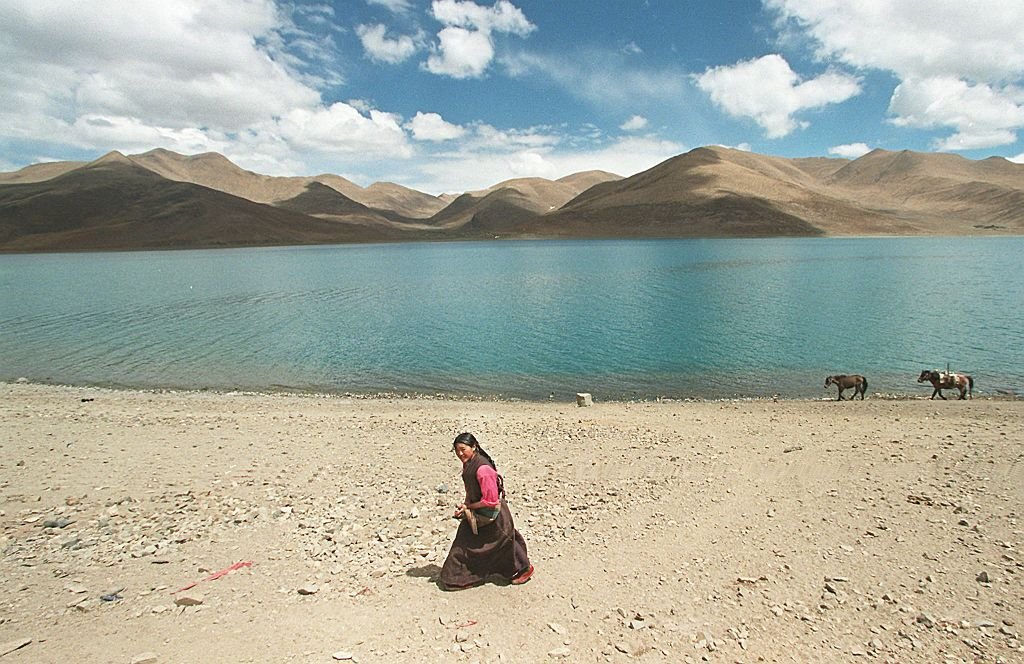
A Tibetan peasant walks by Lake Yamdrok Tso, 100 kilometres from Lhasa, one of the four holy lakes in Tibet 29 May, now used for generating the Yamzho Yumco Hydro-electric Power Station. Goh Chai Hin/AFP via Getty Images
As rescue crews continue digging through mud and debris along the Nepal-Tibet border, with the death toll from last week’s flash floods approaching 400 and well over a thousand people still missing, human rights groups are renewing calls for Beijing to halt its vast hydropower building programme on the Tibetan plateau.
The disaster, which struck Nepal’s Rasuwa and Nuwakot districts on Aug. 26 after a catastrophic flash flood originated upstream in the Tibetan Autonomous Region, has destroyed roads and bridges and left entire communities isolated and struggling to reach survivors.
The International Federation of Red Cross and Red Crescent Societies said it had released almost 1 million Swiss francs (US$1.24 million) in emergency funding for the flood response, with rapid assessments under way to determine the full extent of the damage once floodwaters recede and cut-off communities become reachable.
Its head of delegation for Nepal said support would extend beyond the immediate emergency, noting that “entire villages and market areas have been wiped out.” Australia has also provided $5 million.
Scientists from the International Centre for Integrated Mountain Development (ICIMOD) say the likely trigger was an ice-rock avalanche that dammed a tributary, the Lhende Khola, before bursting—not a glacial lake outburst as first speculated, and not the “Great Bend” dam (Medog Hydropower project), though the cause remains officially unconfirmed.
Even so, the tragedy has thrown a spotlight on the Chinese Communist Party’s (CCP) construction of the world’s largest hydropower station on the Yarlung Zangbo (Brahmaputra) river in Nyingchi, Tibet.
Related Stories
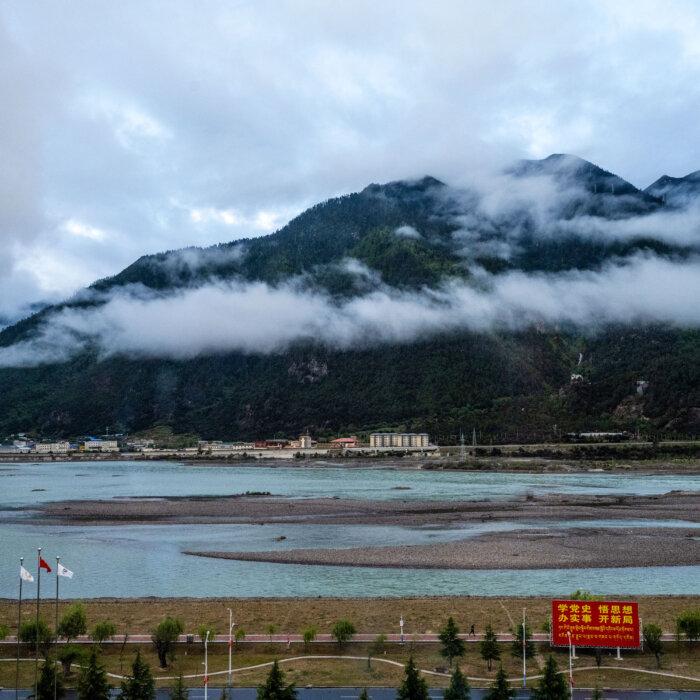
The Yarlung Tsangpo river in Linzhi, Tibet, on June 4, 2021. Kevin Frayer/Getty Images
Premier Li Qiang broke ground on the project in July 2025, with total investment estimated at 1.2 trillion yuan (about US$168 billion).
The site sits in one of the most seismically volatile regions on Earth.
A magnitude 7.1 earthquake struck the southern Tibetan plateau on Jan. 7 last year, leading CCP authorities to empty three reservoirs and relocate 1,500 residents downstream of existing dams as a precaution against structural failure.
Last year Chinese-born hydrologist Wang Weiluo, who currently resides in Germany and is a renowned hydraulic engineer with extensive knowledge of dam safety and flood risks in China, told The Epoch Times the project wasn’t needed.
“China currently has a power surplus. Many solar power facilities are underutilised,” he said, attributing it to a political endeavour by CCP leader Xi Jinping to revive national pride.
Report Links Dams to ‘Geological Destabilisation’
The International Campaign for Tibet says the risks are not hypothetical.
In a report published last November, the group linked the collapse of a bridge in eastern Tibet to “reservoir-induced geological destabilisation” from a nearby dam, warning that a rupture at the much larger Medog project “could unleash catastrophic floods” into parts of India.
It also estimates up to 1.2 million people face displacement if all of the CCP’s planned hydropower projects in Tibet go ahead.
The Australia-Tibet Council has gone further, calling on Canberra to press Beijing over the disaster.
“At the very least, Australia should be questioning China’s mega development activities in Tibet in the wake of this tragedy,” said the council’s executive officer, Zoe Bedford, in a statement to The Epoch Times.
“The Australian government should be demanding that international scientists, journalists and observers should be allowed to enter Tibet to understand the effect of these mega development projects on Tibetans, on Tibet’s environment and on the people and countries downstream.”
The council is campaigning for a total moratorium on new mines, dams and mega-developments in Tibet, arguing that Tibetans have no genuine way to give consent to projects imposed by Beijing and citing the arrest of more than 1,000 Tibetans, including monks, at a 2024 protest against a dam on the Drichu River.
Beijing has dismissed such concerns, according to the state-run Global Times.
Responding to India’s objections, Foreign Ministry spokesperson Guo Jiakun said the project “will not negatively impact the ecological environment, geological conditions, or water resource rights of downstream countries,” and would instead help with “disaster prevention and mitigation” further down the river system.
Independent verification of such claims is difficult because under CCP rule Tibet remains largely closed to foreign journalists, researchers and diplomats.
The consequences of that opacity are significant: the Tibetan plateau is the source of eight of the world’s largest river systems and a freshwater store for many of the planet’s most densely populated surrounding nations, from India and Bangladesh to Vietnam and China itself.
We had a problem loading this article. Please enable javascript or use a different browser. If the issue persists, please visit our help center.