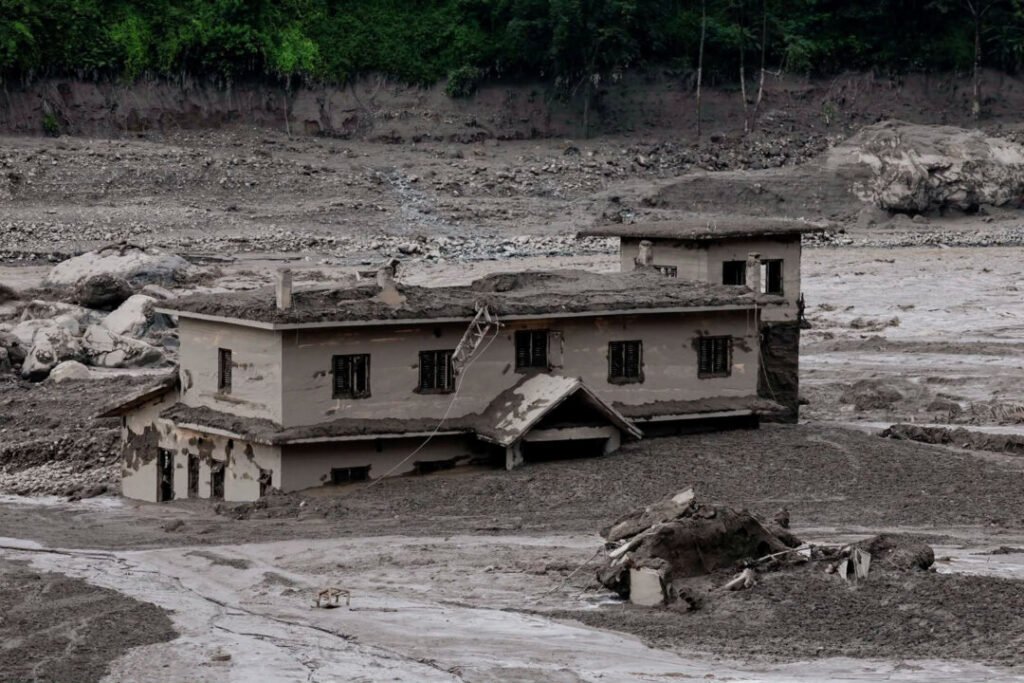
The road ahead was already disappearing when a woman surnamed Fang and others in a vehicle came within about 2.5 miles of Gyirong Port on the Nepal–Tibet border on Aug. 26.
Trees and utility poles had fallen across the route. Then she saw the water coming.
“Water carrying everything with it was chasing us,” Fang told state-owned Chinese outlet Xiaoxiang Morning Herald.
There was no room to turn the vehicle around, she said, so the driver began backing up.
The car kept reversing for nearly two miles.
Only then, Fang said, did the force of the water begin to ease.
Related Stories

Fang said she had left Gyirong town around 10 a.m. with a group traveling toward Nepal. They had planned to leave an hour earlier but were delayed.
As their vehicle backed away from the flood, another vehicle came up behind them. Fang said she and those traveling with her waved for its occupants not to continue toward the port.
The other vehicle continued forward.
Fang said she did not know what happened to the people inside.
Fang eventually made it back to Gyirong town. A friend who had been at the port remained unreachable when she spoke to Xiaoxiang Morning Herald.
Families Wait for Word
For a man from Sichuan Province interviewed by the Chinese edition of The Epoch Times, the last conversation with his older brother had been the day before the flood.
His brother drove freight between Tibet and Nepal for an international logistics company in Lhasa. During their last conversation, the driver told his family that a road collapse on the Nepal side had held him up and that he was waiting near the border gate.
Then came the flood.
“Until now, I can’t reach him,” the man said.
After the disaster, the trucking company told the family that his brother had been roughly 650 feet from the gate when the flood struck.
The man began traveling toward Lhasa. He said he could not go directly to the port because access had been closed, so he planned first to contact his brother’s employer there and wait for information.
“I’ve been to that port,” he said. “There are people everywhere.”
A man surnamed Xu in Inner Mongolia told The Epoch Times that he has been unable to reach a former military comrade assigned to Duty Team 3 of the Gyirong Entry-Exit Border Inspection Station.
“My comrade can’t be reached. The buildings were all washed away,” Xu said.
China’s National Immigration Administration later said that immigration-management officers who had been on frontline duty at Gyirong Port were among those out of contact. The agency did not disclose how many border-inspection officers were missing or which duty teams were affected.
Another man interviewed by The Epoch Times had worked on a construction project at the border until Aug. 19—one week before the flood.
After the disaster, he tried to contact former coworkers at the site.
“Dozens of people at the construction site are all out of contact,” he said. “The place where I lived is completely gone.”
He said most of the workers at his site were from Sichuan Province.
The former worker said he knew of around 500 staff and other personnel inside the port complex and estimated that 500 to 1,000 people may have been in the area when the flood struck.
He believed the eventual death toll could exceed 1,000.
The Epoch Times is withholding the full names of interviewees in China because they fear retaliation from Chinese authorities.
CCTV footage from Gyirong Port shows people running moments before mud, water and debris sweep through the border facility, where more than 10 buses can be seen parked.
Hundreds Dead, More Still Missing
By late Aug. 27 local time, Nepalese authorities had recovered 369 bodies and listed 977 people as out of contact, according to Nepal’s National Disaster Risk Reduction and Management Authority.
The report separately identified missing police, soldiers, customs and immigration personnel, as well as foreign nationals and residents of affected districts.
On the China side, the Gyirong disaster command’s latest publicly released count remained three dead and 558 missing, including 260 foreign nationals, as of 8 a.m. on Aug. 27.
Chinese authorities have not released a comparable breakdown of the 558 missing in Gyirong, including how many were border-inspection officers, other port employees, drivers, construction workers, or travelers.
Gu Xiaohua, Fang Xiao, and Tang Bing contributed to this report.