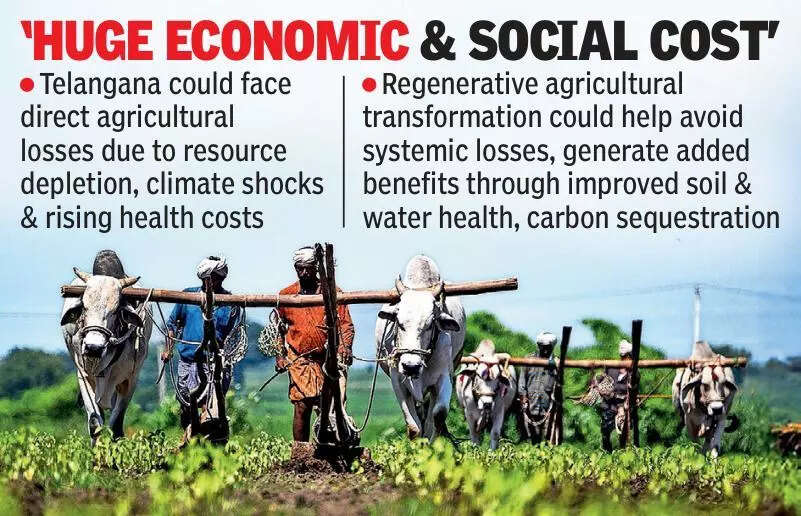
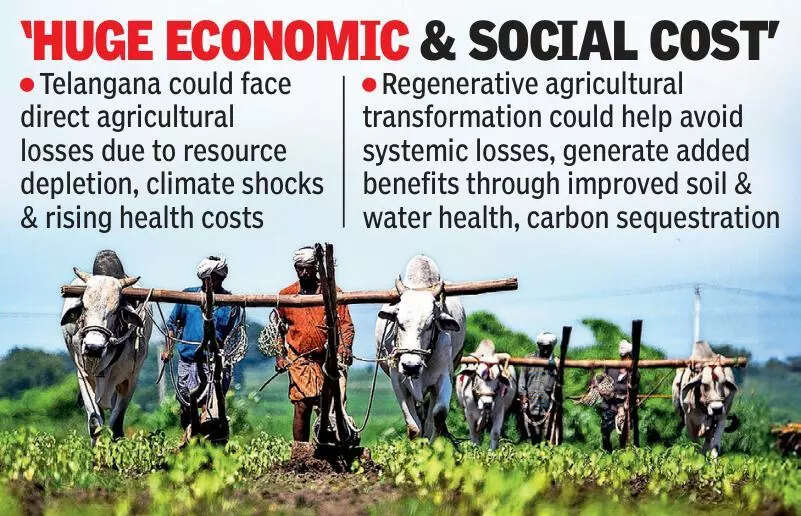
Hyderabad: A sobering assessment of Telangana’s agricultural future has sounded a loud warning. Staying on the current path could come at an enormous economic and social cost.An in-depth analysis by the Centre for Sustainable Agriculture (CSA) projects that under a ‘business-as-usual’ scenario, the state could face a near collapse of its farm economy, with direct losses estimated at ₹2.85 lakh crore by 2047. The analysis attributes these losses to a combination of worsening resource depletion, repeated climate-related shocks and rising health costs linked to environmental degradation. The ripple effects would extend well beyond farms. As agriculture becomes increasingly unviable, large-scale rural distress migration is expected to accelerate, pushing people towards cities. Accommodating this influx could require an additional ₹10,000 crore investment in new urban infrastructure, adding further strain to public finances. Set against this bleak outlook is an alternative pathway that the study describes as both economically viable and environmentally resilient. The proposed ‘regenerative agricultural transformation’ presents a proactive investment strategy that promises a 2.15 times return on investment, calculated on the basis of costs avoided by preventing systemic collapse. The transformation plan envisages a total investment of ₹1.32 lakh crore over 22 years, with funding drawn from a mix of public and private sources. Central to the rationale for early intervention is the rapid deterioration of soil health and groundwater reserves. Without corrective action, projected losses linked to declining soil fertility, falling water tables and repeated re-drilling of borewells alone could reach ₹75,000 crore. Regenerative practicesBeyond avoiding losses, the study highlights the economic upside of adopting regenerative practices. The plan estimates additional gains of ₹20,000 crore through carbon sequestration and associated benefits, including improved biodiversity, ecosystem resilience and better overall wellbeing for farmers.To operationalise the transition, the study proposes a structured financing framework spread across the 22-year horizon. The model calls for an annual investment of ₹6,000 crore, of which ₹4,000 crore per year would be contributed by the central and state govts together. Over the full period, this would amount to ₹88,000 crore in public funding. The remaining ₹44,000 crore is expected to come from private sector investments and farmer-producer organisations, supported by an annual contribution of ₹2,000 crore. The analysis stresses that this blended financing approach is critical to ensuring long-term sustainability, reducing public risk, and enabling a large-scale shift towards resilient and climate-smart agriculture in Telangana.