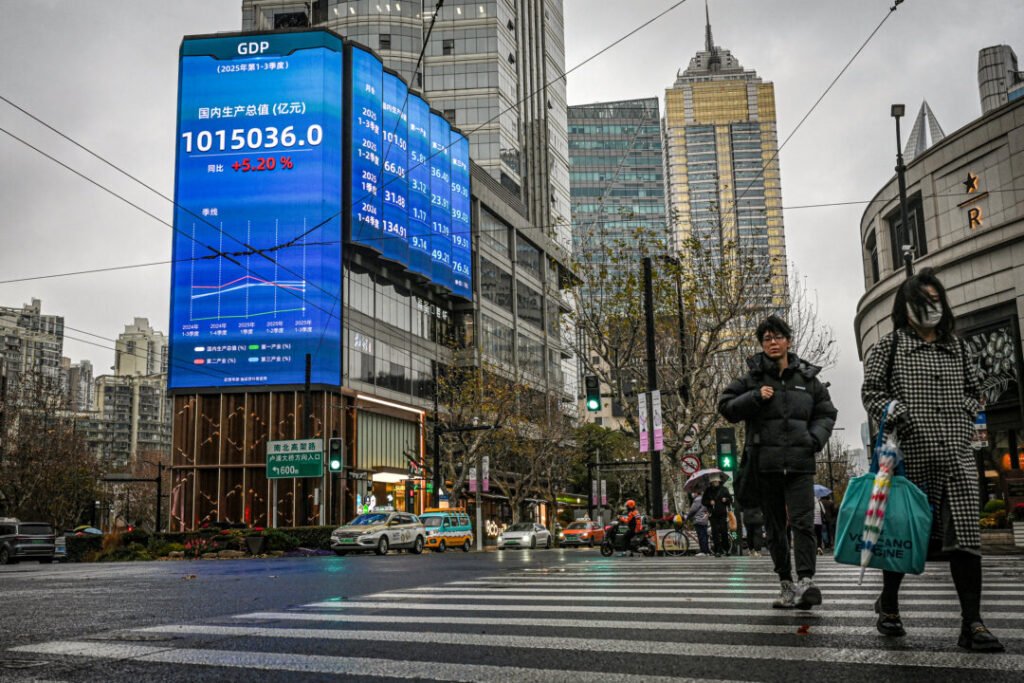
Shanghai, once one of China’s most prosperous and vibrant cities, is struggling with a prolonged economic slowdown following the COVID-19 lockdowns, a weakening property market, and the departure of foreign companies and highly paid workers.
The city, China’s largest economic center by GDP, has been hit by the broader deterioration in local government finances. China’s Ministry of Finance reported in late July that none of the country’s 31 provincial-level regions generated enough fiscal revenue in the first half of 2026 to cover their expenditures. Collectively, local governments’ fiscal self-sufficiency rate was just 56.3 percent.
Even Shanghai, traditionally one of China’s strongest fiscal performers, is now spending more than it collects from its own revenue sources.
Sun Kuo-hsiang, a professor of international affairs and business at Nanhua University in Taiwan, told The Epoch Times that the deterioration in Shanghai is significant, because it shows that the problem extends beyond China’s less-developed inland regions.
“If the self-sufficiency rate in high-income regions such as Shanghai also continues to decline, it shows that the weakening of real estate, corporate profits, and local tax bases is no longer just a problem in the central and western regions,” he said.
Foreign Firms Pull Back
Related Stories


A business insider who spoke to The Epoch Times said the downturn is increasingly visible in commercial districts once known for crowded shopping malls, restaurants, and office buildings. He spoke on condition of anonymity out of fear of reprisal.
The Shanghai-based insider in the property industry told The Epoch Times that consumer spending has weakened sharply in the city.
“Actually, the economy here in Shanghai is very depressed,” the insider said.
He said several shopping centers that were once packed with customers have closed or seen business decline sharply. High-end restaurants in the Lujiazui financial district have also shut down, he said.
However, the bigger problem, he said, is the loss of foreign businesses and their employees.
“Now many foreign companies and foreign capital are withdrawing,” he said. “After a large number of companies and factories moved away, there are far fewer foreigners in the central urban areas, including Chinese executives of foreign-funded companies. Shanghai’s consumption has declined a lot.”
Several foreign companies have reduced or ended their operations in Shanghai in recent years. Among those reported to have scaled back in 2026 are French cosmetics company Filorga and American industrial paint manufacturer Sherwin-Williams, which has liquidated its Asia-Pacific headquarters in Shanghai and withdrawn from China.
The insider said foreign companies once supported a large ecosystem of local businesses and employees.
The downturn has spread into Shanghai’s high-tech sector, including the Zhangjiang High-Tech Development Zone, a major center for pharmaceuticals and semiconductor companies.
The insider said many younger workers he knew in Zhangjiang have lost their jobs. Some have left China, while others have moved away from the city or adopted a less active lifestyle.
“Previously, there were so many people competing to rent factory warehouses and company offices in Zhangjiang that you couldn’t find one,” he said. “Now they are empty, and nobody wants to rent them. The economy is really not doing well.”
Property Downturn
The collapse in property demand has struck at a key source of revenue for Shanghai and other Chinese local governments.
Shanghai has also introduced successive measures to stimulate the housing market. The latest package includes subsidies for people who sell an existing home and buy a new one, as well as changes to mortgage policies.
The measures have done little to resolve the underlying fiscal problem, according to Wang Guo-chen, a research fellow at the Chung-Hua Institution for Economic Research in Taiwan.
“Local governments in mainland [China] can now be certain that they are all out of money,” Wang told The Epoch Times. “In addition, as foreign companies withdraw, the economy has collapsed, and local government revenue has disappeared.”
China’s Ministry of Finance reported that revenue from state-owned land-use rights fell 30.8 percent year over year in the first seven months of 2026, according to state media China News Service. Land-sale revenue has declined for four consecutive years since 2022.
“Previously, when local governments had no money, they relied on selling land to make money,” Wang said. “Now real estate is not worth much, land cannot be monetized, so land revenue has also fallen sharply.”
The frustration among Shanghai residents extends beyond the property sector, according to the property industry insider. Many residents worry about declining incomes, fewer jobs, and falling property values.
A former foreign-company employee based in Shanghai summed up the sentiment bluntly.
“The stubborn [Chinese regime] dictator has sounded the death knell for China’s economy,” he told The Epoch Times on condition of anonymity out of fear of reprisal.
Yi Ru contributed to this report.