Lynn Dong has been looking for a job since February after being laid off at a Shanghai branch of a Fortune 500 company.
She has had 22 interviews with 11 companies. None have resulted in an offer.
Many multinational corporations in Shanghai are cutting costs. For three positions with three foreign companies, Dong got to the last step and even finished negotiating her salary. Then the positions simply disappeared. The companies either went through restructuring or froze hiring.
“The job market this year has been truly surreal,” the 38-year-old marketing professional told The Epoch Times. She used a pseudonym to protect herself from reprisals from the regime.
However, she couldn’t “lie flat” because of her two children: one in elementary school, and one in kindergarten. “Lying flat” is a slang term referring to a social trend in which people refuse to work hard on improving their situations.
Lynn’s experience reflects a broader strain on companies as China’s economy slows. And while a gamble on advanced technology could alleviate Beijing’s economic troubles, current spending priorities are reinforcing the imbalances in China’s economy, analysts say.

People visit a job fair in the Jing’an District in Shanghai on June 5, 2024. With many multinational corporations cutting costs, job seekers in China are under pressure. Hector Retamal/AFP via Getty Images
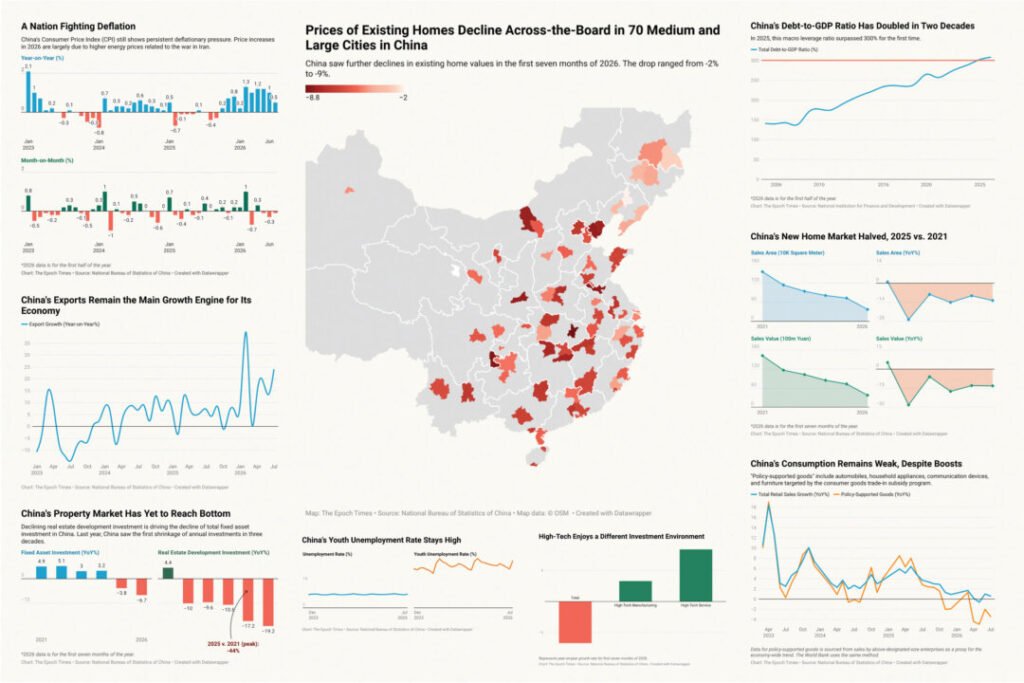
And the numbers for the first seven months of the year show a nation fighting deflation.
Compared to last year, the consumer price index picked up a little bit, at an average of 0.9 percent, in January through July this year. However, that rise came from higher energy prices related to the Iran war, according to the World Bank, not stronger domestic demand.
Consumption has also been sluggish, despite the regime’s trade-in programs to stimulate the upgrade of automobiles and big-ticket house items.
A major part of China’s economic picture is its plunging property market, which has yet to reach bottom.
Real estate investment has declined by 44 percent since it peaked in 2021, and the new housing market has halved in sales area and sales value.
The 70 medium- and large-sized cities Beijing uses to track the existing home market are also experiencing across-the-board drops, ranging from 2 to 9 percent.

Office buildings and apartments in Tianjin, China, on July 14, 2026. Adek Betty/AFP via Getty Images
Betting on High-Tech and AI
China has increased spending on advanced technology, in contrast with its overall investment decline. However, that investment has yet to translate into more jobs or consumption.
At the same time, Chinese leader Xi Jinping is sending clear signals about where he wants money to flow.
On July 17, at the World AI Conference in Shanghai, Xi touted China’s low-cost AI and said China is committed to providing AI services to the rest of the world.

A humanoid robot by Robotera works with packages during the World Artificial Intelligence Conference in Shanghai on July 18, 2026. China is investing heavily in AI despite an overall investment decline. Hector Retamal/AFP via Getty Images
“Xi is all-in on AI. He’s gambling with all of China’s resources. If he wins, he can arm-wrestle with the United States. Beijing can be an equal of Washington,” Mike Sun, an adviser to American investors in China for decades, told The Epoch Times.
“If he loses, China will be in a worse economic slump for decades onward.”
‘The Usual Playbook Doesn’t Work’
Meanwhile, China’s room for borrowing is getting narrower. Last year, the country’s debt-to-GDP ratio surpassed 300 percent for the first time, according to the National Institution for Finance and Development, a state-backed think tank in Beijing.
China has relied on expanding investment, such as the housing reform of the 1990s and the infrastructure investment after the 2008 global financial crisis, to propel it economy. The trade-off was incurring debt.

Pedestrians pass a screen showing figures of China’s gross domestic product on a street in Shanghai on Jan. 19, 2026. China’s economy grew at one of the slowest rates in decades last year. Jade Gao/AFP via Getty Images
“This usual playbook doesn’t work anymore,“ Cai Shenkun, an independent commentator, told The Epoch Times.
“Even the investment engine is cooling off,” he added, pointing to the 6.7 percent contraction in China’s fixed asset investment for the first seven months of the year compared to the same period in 2025. Last year was the time in three decades that China saw an annual decline in investment.
To boost market liquidity, China’s central bank is injecting 1.4 trillion yuan, or more than $200 billion, into the domestic economy through Jan. 15, 2027. Both Sun and Cai think that the central bank may provide additional capital to the market to support growth if that 1.4 trillion yuan doesn’t stimulate the economy into the target growth range of 4.5 percent to 5 percent.
While Beijing is good at increasing supply, that doesn’t necessarily translate to stimulated demand. China’s consumer price index fell 0.1 percent in July compared to June.

People walk past the People’s Bank of China, the country’s central bank, in Beijing on Oct. 19, 2024. Adek Berry/ AFP via Getty Images
Beijing’s current fiscal spending reinforces existing supply-demand imbalance, according to the July report by the World Bank. Keeping investing more in prioritized sectors sacrifices closing the imbalance gap for short-term growth, the authors added.
Hence, the World Bank expects China’s economy to grow at 4.4 percent this year, just short of the regime’s growth target.
Gu Xiaohua contributed to this report.