Crude oil prices extended their losses as traders weighed the United States’ move to ratchet up economic pressure on Iran rather than pursue military strikes.
A barrel of West Texas Intermediate—the benchmark for U.S. oil prices—declined more than 3 percent, or around $2.80, to nearly $82 on the New York Mercantile Exchange. However, U.S. crude is up 43 percent year-to-date.
The global benchmark Brent is down almost 4 percent, or more than $3, to set firmly below $88 per barrel in overseas trading.
A key component of the latest move is the imposition of secondary sanctions on countries that engage in commerce with Iran.
China, the world’s largest petroleum importer, is Iran’s largest energy customer. Tehran exports about 90 percent of its oil to China.
Related Stories


While Washington did not explicitly reference China, Bessent told reporters that no country should test the resolve of the United States.
“If they facilitate transactions and are part of the ecosystem that turns Iranian oil into money, into repression, they will be targeted,” he said.
President Donald Trump is scheduled to meet with Chinese leader Xi Jinping in Washington next month. It is unclear how much these measures will impact U.S.-China relations.
In the meantime, as global energy markets monitor the situation in the Strait of Hormuz, the oil market is in a holding pattern, according to Saxo Bank strategists.
“With no further military escalation and some tankers slipping through after buying heavily discounted oil to compensate for the elevated transit risk, the market remains in limbo,” they said in an Aug. 25 note.
“However, the drawn-out disruption continues to tighten the availability of crude and, not least, refined products, leaving the market vulnerable to renewed price spikes should flows deteriorate again.”
Investors are also reacting to reports that the State Department is preparing to return U.S. diplomats to the Middle East soon, suggesting that the White House may not be planning further military escalation.

Iranian crude oil tanker, Sevda, sails near Bandare Asaluyah, Iran, on Jan. 27, 2026. Sam/Middle East Images/AFP via Getty Images
In an Aug. 25 Truth Social post, Trump confirmed that all mines have been removed within international waters in the narrow Gulf channel. The waterway handles about 20 percent of the world’s oil supply.
“Iran has been notified that any ship or boat placing new mines will be immediately and systematically destroyed,” the president said on his social media platform.
“Through Space Force, we are watching every square inch of the Strait, as we are, also, with Pickaxe Mountain and the already destroyed three other Nuclear sites,” Trump added. “There is a Zero Tolerance policy on mine placement in full force and effect.”
Labor Day Gas Prices
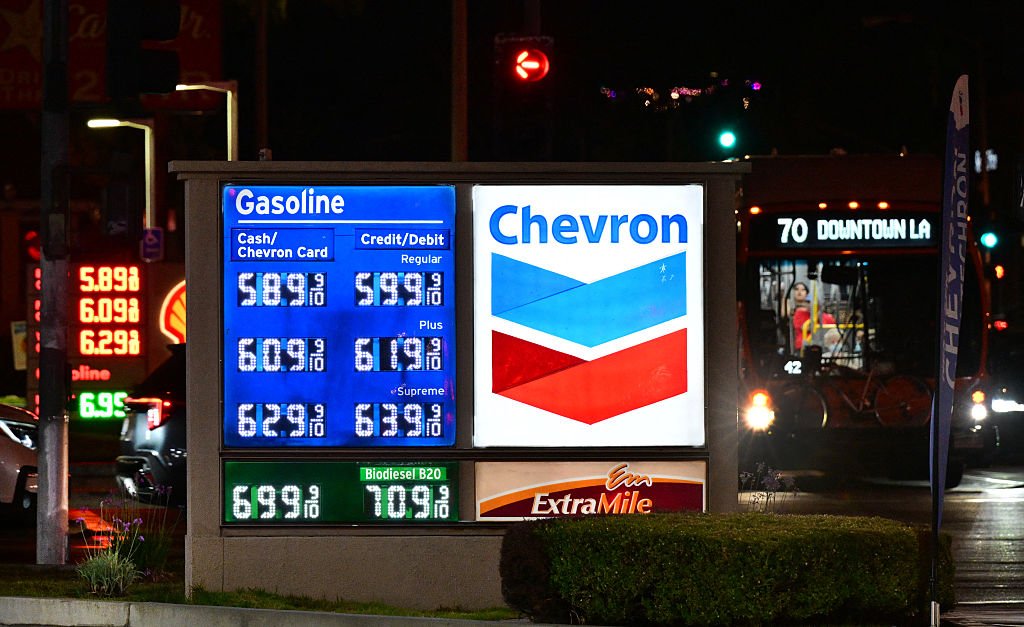
Despite the recent decline in the cost of barrels of crude, motorists are still contending with high prices at the pump.
As of Aug. 25, the national average for a gallon of gasoline is close to $4.10, according to the American Automobile Association. This is up 29 percent from the same time last year.
Heading into the Labor Day weekend, drivers could pay above $4 per gallon, according to Patrick De Haan, head of petroleum analysis at GasBuddy.
“Gasoline, while not at all-time records, is at its highest level ever recorded this late in the calendar year, meaning Americans could for the first time ever see a national average price of gasoline above $4 per gallon on Labor Day—eclipsing the previous record of $3.83 per gallon set in 2012,” he said in an Aug. 24 note.
Even though a portion of oil cargoes is still passing through the Strait of Hormuz, the real driver behind rising gasoline and diesel prices is the accelerating shutdown of Russian refineries as Ukrainian attacks sideline more facilities and squeeze global output of refined products, De Haan added.
“Until that refining supply picture improves, both gasoline and diesel prices face continued upward pressure.”
Domestic gasoline demand, meanwhile, has been lower during this year’s summer driving season.
Gasoline stockpiles rose by 688,000 barrels for the week ending Aug. 14, the Energy Information Administration reported last week. By comparison, gas inventories fell by 2.72 million barrels at the same time a year ago.
U.S. production of finished motor gasoline continues to be robust in the 8 million to 9.2 million range.
In its latest Short-Term Energy Outlook, the federal agency forecasts that retail gas prices will average $3.78 per gallon this year and $3.29 per gallon in 2027.