The moon always looks the same. If one were to diligently track the face of the moon from new moon to new moon—29.5 days—and then track it from every new moon to the next new moon ad infinitum, they would only ever see the same face. The Earth and moon are tethered by what is known as tidal locking, a phenomenon common among planets and their primary moon, which means the moon completes its axis rotation the same time as it completes a rotation around Earth.
The moon is 3.7 times smaller than Earth. With a telescope, especially during a full moon, it is easy to see how much Earth’s silver compatriot has taken a beating. Across the complete expanse of Earth’s satellite, there are millions of craters, most about a kilometer in diameter, but many scores and even hundreds of miles wide. The total number seems to grow annually.
On May 25, 1961, President John F. Kennedy issued the challenge to put an American on the moon before the end of the decade. The most difficult challenge was creating a spacecraft that could make the 238,855-mile journey to reach the moon. But it would be for naught if the astronauts flying the spacecraft had no place to land. If the face of the moon—known famously as the “Man in the Moon”—was any indication, the far side of the moon would hardly offer many more prospective landing spots.
A View From the Far Side
The Space Race between the Americans and the Soviets had begun in earnest four years prior when the Soviets launched Sputnik on Oct. 4, 1957, the first satellite to orbit Earth. By the time of Kennedy’s speech, the Soviets were becoming comfortable being first.

Not only were the Soviets the first to send an unmanned spacecraft (and a manned one in 1961) around the Earth, but they were also the first to circle the moon with Luna 3, the spacecraft launched on the second anniversary of the Sputnik launch. The Luna 3 took 29 photos, which captured 70 percent of this previously unmapped side of the moon. A few weeks later, the Soviets proved their accomplishment by publishing a 35-page book, which highlighted two of the 29 photos. A second book was published the following year in 1960, which showcased all 29 photos.
Much like Sputnik, Luna 3 was a coup in the Space Race. But for the purposes set forth by Kennedy, the images were not very helpful for finding places to land. NASA needed to take their own photos, and needed ones that would provide much clearer images, just in case the far side offered better landing spots.
Related Stories


The first full view of significant quality of the first series of photos of the far side of the Moon, taken by Luna 3, Oct. 7, 1959. Public Domain
Building a Better Spacecraft
NASA was formed shortly after the Sputnik launch and had its budget massively increased shortly after Kennedy’s speech in order to meet the president’s challenge and head off the Soviets in the Space Race. The space agency began working to form their own lunar imaging program.
On Aug. 30, 1963, NASA approved the Lunar Orbiter program, which called for sending five unmanned spacecraft to survey the moon. These orbiters were to be film labs in space. After assessing five competing proposals, Boeing was awarded the contract on May 7, 1964, to build the five Lunar Orbiters.
The spacecraft were to be identical to each other. They were over six feet long and slightly less than five feet in diameter. Each weighed just over 850 pounds. The small lightweight spacecraft’s objectives were simple in theory: Take photos with its hi-tech camera system, analyze the moon’s topography with its micrometeoroid detector, and measure radiation levels with its radiation dosimeters. From there, scientists and topographers would survey the images to identify safe areas for landing.
Each Lunar Orbiter came with four solar panels, which would power the engine and camera system. Although the satellites were launched into deep space via the multi-stage Atlas-Agena D rocket boosters, they also came with their own engine to be used for mid-flight thrust in order to stay on course. That course would be followed by NASA’s Deep Space Network (DSN) in Southern California, which would also receive the communications, as well as the digital images. For communicating, each satellite came with a 36-inch diameter dish antenna.

A diagram of a Lunar Orbiter. NASA. Public Domain
Capturing the Moon
The idea for the in-flight film laboratories actually came from the intelligence agencies. The Air Force and the CIA had been using spy satellites during their SAMOS Project and Project Corona, respectively. SAMOS, which stood for Satellite and Missile Observation System, conducted photographic and electromagnetic reconnaissance, capable of transmitting its images digitally (this project was short-lived and was not overly successful, but it did make advances). Project Corona used powerful cameras (KH-4B) affixed to the 145 satellites used during the project’s 12-year span, in which approximately 800,000 images were taken of the USSR and other nations.
The Lunar Orbiter used Eastman Kodak camera systems, which weighed about 150 pounds and used both wide-angle and narrow-angle camera lenses. The camera system was capable of taking photos, developing the film, scanning the images, and digitally transferring them through NASA’s DSN. From the distance the Lunar Orbiter was scheduled to be flying around the moon, the images would be far and away clearer than those of the Soviets’ Luna 3. The wide-angle lenses could reach resolution of up to a third of a mile from the ground, while the resolution of the narrow-angle lenses’ was between 200 feet and 260 feet.
From the ‘Man in the Moon’

Launch of Lunar Orbiter 1 from an Atlas-Agena rocket on Aug. 10, 1966. NASA Public Domain
On Aug. 10, 1966, in Cape Canaveral, the Atlas-Agena D rocket boosters launched Lunar Orbiter 1 into space with the goal of identifying landing sites—16 primary and secondary locations on the nearside and 11 on the far side. Four days after launch, the satellite entered the moon’s orbit. Over the course of the next two weeks, it photographed approximately 2 million square miles of the moon’s surface and sent clear images of 20 locations.
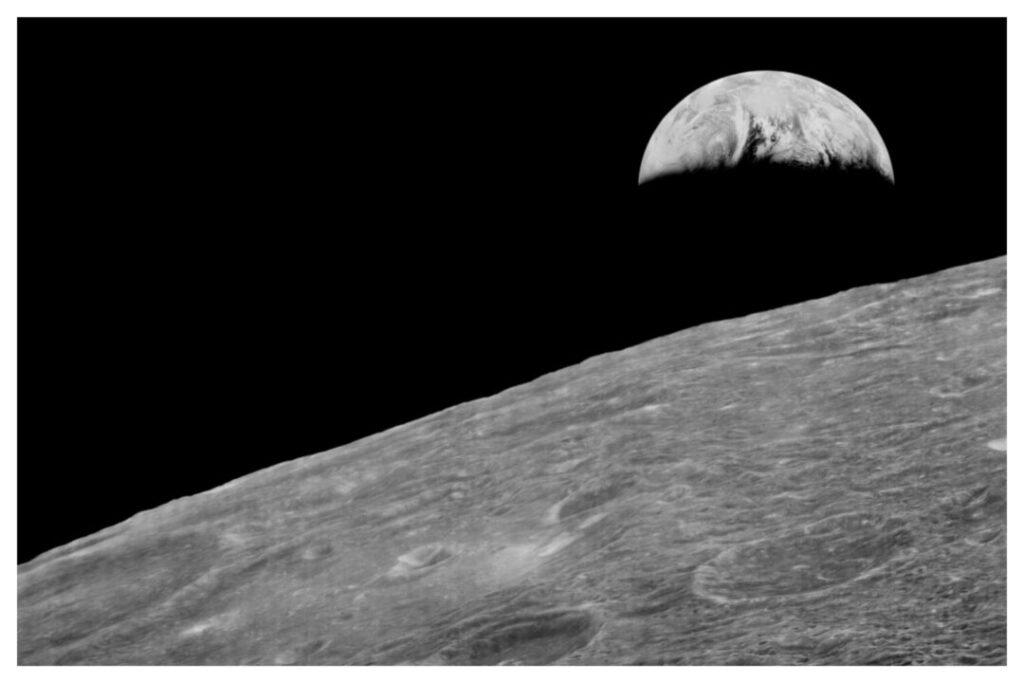
During one of its 577 orbits, it sent back an image no one had expected to receive. It was during this week in history, on Aug. 23, 1966, that Lunar Orbiter 1 took an unplanned, yet iconic photograph. Since the dawn of mankind, humans had only ever seen the moon from Earth. This incidental and historic photo showed Earth from the perspective of the moon. For the first time, people now saw what the “Man in the Moon” saw.

The view of Earth from the Moon, using wide-angle lenses. NASA. Public Domain
Mission Accomplished
After Lunar Orbiter 5 completed its mission, NASA’s satellite program had photographed 99 percent of the moon, had located 36 landing spots, and had successfully transmitted 90 percent of the photos taken. Interestingly, NASA chose the Sea of Tranquility as the site for the first landing, located on the near side of the moon rather than its far side.
Never miss a This Week in History story! Sign up for the American History newsletter here.
What arts and culture topics would you like us to cover? Please email ideas or feedback to [email protected].