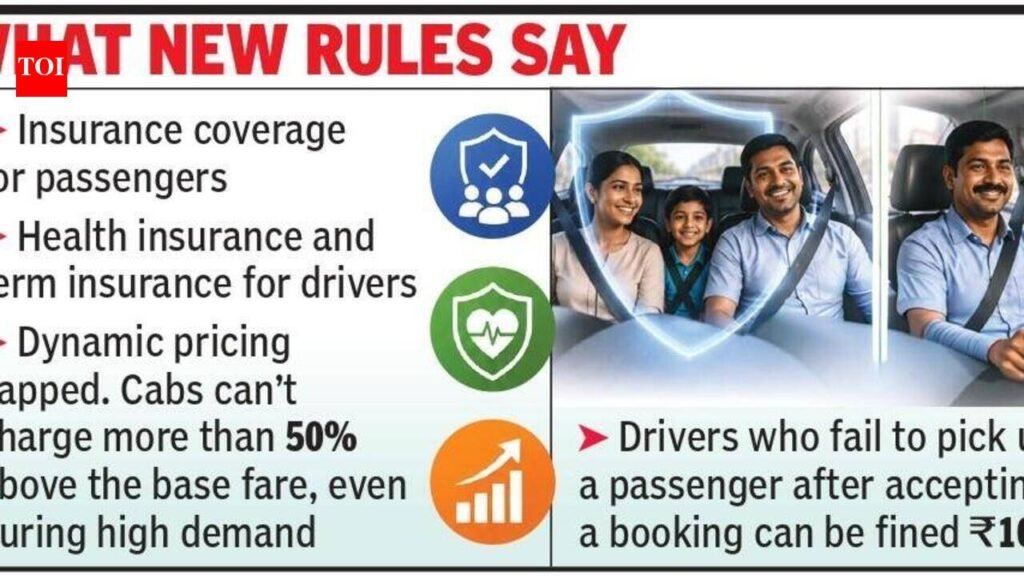
Lucknow: In a major move to make app-based transport and delivery services safer, more transparent and accountable, state govt has implemented the Uttar Pradesh Motor Vehicle (Aggregator and Delivery Service Provider) Rules, 2026, and launched the upmyfleet.com portal.This will end arbitrary practices in app-based rides in UP as govt will monitor fares.The new framework regulates aggregators and delivery service providers for the first time, covering passenger safety, driver welfare, fare transparency, grievance redressal, pollution monitoring and promotion of electric mobility.The rules, notified on May 22 this year, apply to digital platforms offering passenger transport services as well as those connecting drivers with vendors, e-commerce firms and consignors for delivery of products, couriers and parcels. As a result, app-based transport, delivery and logistics networks now come under a formal regulatory framework.Under the new policy, aggregators must follow a prescribed licensing process. The application fee has been fixed at Rs 25,000, while the licence fee has been set at Rs 5 lakh. Govt says the framework will provide companies with clear operational guidelines on safety, service standards and compliance, while enabling the transport department to monitor aggregator services more effectively.To enhance accountability, the policy introduces a graded security deposit structure linked to fleet size. Aggregators operating up to 100 buses or 1,000 other motor vehicles must deposit Rs 10 lakh; those with up to 1,000 buses or 10,000 other vehicles must deposit Rs 25 lakh; and larger operators must provide a Rs 50 lakh security deposit. The provision is intended to facilitate regulatory action in cases of violations of licence conditions or provisions of the Motor Vehicles Act.Passenger safety has been given top priority. The rules mandate character verification, police verification and psychological assessment of drivers associated with aggregators. Drivers will also be required to undergo periodic refresher training aimed at improving service quality and road safety.The policy also seeks to strengthen social security for drivers. Aggregators will have to provide insurance coverage for every passenger and ensure welfare benefits for drivers, including health insurance of Rs 5 lakh and term insurance of Rs 10 lakh. Officials say the move will offer financial protection to drivers and their families in the event of accidents, illness or untimely death.To prevent excessive fare surges, govt has capped dynamic pricing. Aggregators will not be allowed to charge more than 50% above the notified base fare, even during periods of high demand. The provision is expected to bring greater transparency and predictability to passenger fares while setting clear pricing limits for service providers.Passenger convenience has also been addressed through a penalty mechanism. Drivers who fail to pick up a passenger after accepting a booking can be fined Rs 100. The amount collected will be credited to the affected passenger for use in a future ride. The measure is aimed at reducing instances of unjustified cancellations and no-shows after bookings have been confirmed.To ensure prompt resolution of complaints, every aggregator will be required to appoint a Grievance Redressal Officer. Passengers will be able to raise issues related to fares, bookings, driver conduct and service quality through a structured redressal system. The rules also prescribe penalties for violations of licence conditions and provisions of the Motor Vehicles Act, strengthening oversight of aggregator operations.The policy places special emphasis on pollution control and electric mobility, particularly in the National Capital Region (NCR). A dedicated digital monitoring system will track emissions from vehicles associated with aggregator fleets. Authorities will also monitor the transition of fleets from conventional fuel-powered vehicles to electric vehicles, with the objective of reducing pollution and increasing EV adoption in transport and delivery services.According to govt, the biggest advantage of the policy is the creation of a uniform framework that benefits all stakeholders. The transport department will gain a digital mechanism to monitor companies, vehicles, compliance and pollution-control measures. Aggregators will get clarity on licensing, fees, deposits and operating standards, reducing uncertainty and helping formalise the sector.Drivers stand to benefit from verification procedures, training requirements and insurance coverage, while passengers will receive safer services through verified drivers, insurance protection, fare caps, grievance redressal and compensation for service failures.A key pillar of implementation is the upmyfleet.com portal, which is already operational. The platform will create a comprehensive database of aggregator-linked vehicles, helping govt monitor compliance, track emissions and oversee the sector’s transition towards electric mobility.