

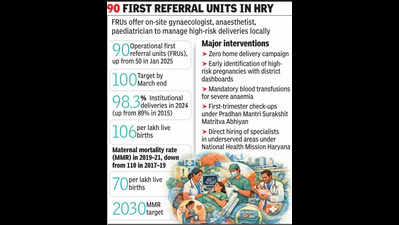
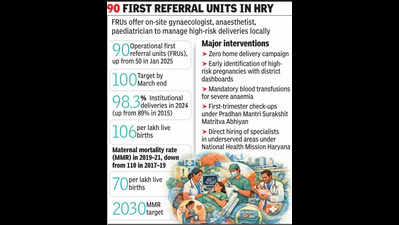
Gurgaon: Haryana, where most women choose institutional childbirth, is eyeing 100 first referral units (FRUs) by the end of March. Govt data shows 98.3% of deliveries in 2024 took place in medical facilities, compared with 89% in 2015. The state, which is ramping up facilities to make childbirth safer for mothers, now has 90 FRUs, up from 50 in Jan 2025 — bringing advanced maternal care closer to home and cutting maternal deaths.
Each FRU has a gynaecologist, anaesthetist and paediatrician on hand. These are in civil hospitals, sub-divisional hospitals and community health centres. This means high-risk pregnancies and delivery issues can be treated there, without rushing mothers to far-off large hospitals. Officials told TOI on Wednesday that expanding FRUs is the “next big milestone in the continuum of reforms” and is expected to significantly improve maternal health indicators in the coming years. They said that the rise in institutional deliveries is “one of the biggest drivers” behind safer childbirth and a reduced maternal mortality rate (MMR) in the state. Maternal mortality refers to deaths during pregnancy, during childbirth, or within six weeks after delivery.Mission director of Haryana chapter of National Health Mission (NHM) Ripu Daman Singh Dhillon said, “All labour rooms across the state have been upgraded with essential drugs, equipment and logistics. These advancements aim to ensure that every childbirth is safe, dignified and well-supported. The state focuses on identifying high-risk pregnancies to intervene well before complications arise.”The Special Bulletin on Maternal Mortality in India, released this month, recorded Haryana’s MMR declining from 110 per lakh live births in 2017-19 to 106 in 2019-21. The state aims to meet the global target of reducing MMR to 70 per lakh live births by 2030.According to the health department, the improvement is driven by multiple initiatives. The Zero Home Delivery campaign promotes childbirth in medical facilities with trained staff. Districts are instructed to improve antenatal care, identify high-risk pregnancies early, maintain dashboards of such cases at all govt health centres and ensure mandatory blood transfusions for women with severe anaemia.Pradhan Mantri Surakshit Matritva Abhiyan (PMSMA) helps ensure check-ups for pregnant women in early conception stages. Under NHM, Haryana implemented a “blanket sanction” policy that allows districts to directly hire doctors and specialists in understaffed regions.Targeted schemes are also part of the strategy. The Janani Surakshit Maah campaign facilitates additional attention and resources for high-risk pregnancies. The Janani Suraksha Yojana provides financial assistance for institutional delivery to women from economically disadvantaged backgrounds. The Janani Shishu Suraksha Karyakram eliminates out-of-pocket expenditure by offering free medicines, diagnostics, diet, blood transfusions, and referral transport services for pregnant women.NHM Haryana director Virender Yadav said, “The state also implemented a maternal death review system, conducting one-to-one reviews at the state level to identify systemic gaps and implement corrective measures promptly. This data-driven approach allows for continuous improvement in maternal care protocols.”