


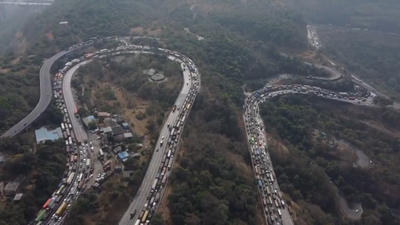
PUNE: The long-delayed ‘missing link’ on the Pune–Mumbai Expressway, slated to open on May 1, has come sharply into focus after a 32-hour traffic nightmare triggered by a toppled gas tanker in the accident-prone Khandala ghat section earlier this week.The 13.3-km missing link — designed to bypass the steep and winding ghat stretch — is expected to reduce travel time by at least 30 minutes and significantly improve safety. Maharashtra State Road Development Corporation (MSRDC) joint managing director Rajesh Patil told TOI that the project is 98% complete and in its final phase.“The missing link project near Lonavla is nearing completion and we have a firm target to open the stretch on May 1, coinciding with Maharashtra Day. Safety standards will not be compromised,” Patil said.The development comes amid growing public and political scrutiny following Tuesday evening’s accident, when a tanker carrying highly flammable propylene gas overturned near the Adoshi tunnel in the Borghat section, bringing traffic to a grinding halt for more than a day.
32 Hours of Chaos
The accident occurred around 4.45pm on Tuesday, about 50 metres ahead of the tunnel on the Mumbai-bound carriageway. Gas leakage from the tanker forced authorities to halt traffic in both directions as a safety precaution. While the immediate jam affected a 15-km stretch, officials said congestion eventually extended to nearly 50 km, leaving thousands of commuters stranded overnight.Traffic towards Mumbai resumed only after 1am on Thursday, once the gas was decanted into another tanker and the damaged vehicle removed with a hydraulic crane.Stranded commuters included children, senior citizens and patients travelling for medical treatment. In one instance, a Navi Mumbai resident rode a two-wheeler — despite restrictions — to rescue his mother who had been stuck without food for over seven hours. Several MSRTC and private buses were stranded, forcing cancellation of 139 state transport trips.Railway officials said Pune–Mumbai intercity trains witnessed unusually heavy crowding as desperate travellers abandoned road travel.
Hazard Exposure and Preparedness Gaps
Disaster management experts warned that the incident exposed serious shortcomings in Maharashtra’s preparedness to deal with hazardous material accidents on high-traffic corridors.Propylene, a pressurised and invisible hydrocarbon gas, can form a fast-moving vapour cloud that ignites with the smallest spark. “You don’t see flames, but you’re standing inside a potential fireball,” a senior industrial safety consultant said.Retired major general P K Shrivastava, a CBRN expert, called the incident a “wake-up call”, urging the state to deploy dedicated HazMat response units along highways like the Pune–Mumbai Expressway.State disaster management director Bhalchandra Chavan admitted that authorities currently lack specialised technical capability to handle such emergencies. He also said the delayed arrival of BPCL’s recovery team worsened the situation.An FIR has been registered against the tanker driver for rash and negligent driving. Officials said an explosion could have affected a 2–3 km radius had the situation escalated.
Missing Link Back in Spotlight
As traffic snarls stretched into a second night, questions resurfaced over whether the long-pending missing link could have mitigated the scale of disruption.Currently, vehicles must navigate nearly 19 km of sharp curves, steep gradients and tunnels through the ghat section — an area notorious for accidents, landslides and long jams during emergencies and monsoon months.The missing link comprises two tunnels (8.9 km and 1.9 km), a 900-metre viaduct, and a 650-metre cable-stayed bridge being built over Tiger Valley at a height of over 180 metres. The bridge will feature India’s tallest road pylons at 182 metres, surpassing the Bandra–Worli Sea Link.Executed by Afcons Infrastructure Ltd at an estimated cost of Rs 6,695 crore, the project was originally scheduled to open in December 2025 but faced delays due to heavy rainfall, high winds and safety concerns in the ghat terrain.“There are past instances of hurried infrastructure projects leading to mishaps. We did not rush the work,” a senior MSRDC official said.
A Test Case for Infrastructure Planning
Minister of state for PWD Indranil Naik said long-term measures were required to prevent such disruptions, while transport industry representatives said the incident highlighted poor emergency response despite high tolls and taxes.For many commuters stranded during the ordeal, the missing link now represents more than faster travel — it symbolises a critical safety upgrade that may finally put an end to the expressway’s recurring crisis moments.