


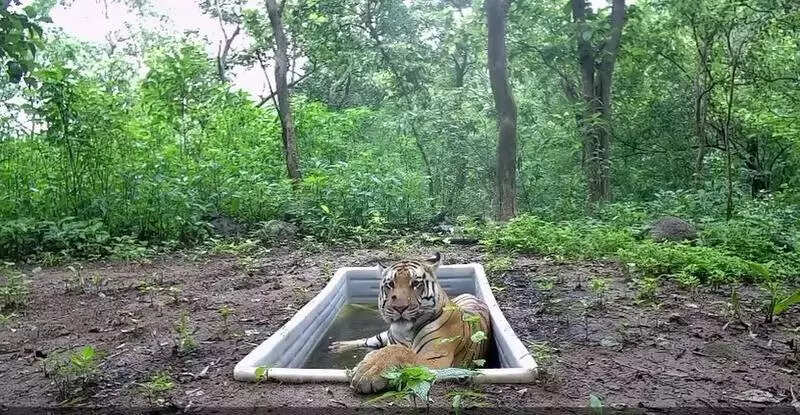
The lone tiger that carved out a 120 sq km territory in eastern Gujarat is proving to be a strictly wild hunter, sticking to forest prey and staying clear of human settlements. Scat analysis by forest officials shows the big cat’s menu is dominated by barking deer, with traces of nilgai and wild boar also in its diet, offering rare insight into how the animal survives in a human-dominated landscape without turning to livestock.Sources in the forest department said samples collected so far show no evidence of cattle or domestic animals in the tiger’s scat. “The research team from Vadodara found no sign of livestock kill. All indicators point to wild prey,” a senior officer said, underlining that the tiger deliberately avoided villages and grazing zones.Beyond the hunt, the animal itself is now the subject of a detailed scientific study. The forest department launched a structured monitoring programme to track its movement, feeding patterns and behaviour across the Ratanmahal landscape, where it roamed for the past 11 months. Field teams are analysing scat, documenting scratch marks, pugmarks and scent sprays, and mapping the tiger’s movement using geographical location data to build a full ecological profile.Sandeep Kumar, chief conservator of forest, Vadodara Circle, said the study aims to understand both diet and territory use. “Scat analysis will help identify prey species, while field signs will allow us to map movement patterns and territorial behaviour. So far, the tiger stayed away from human habitation and did not enter any village,” he said.The exercise already yielded unexpected insights into conservation. Camera traps and video surveillance set up for the tiger recorded rattlesnakes, flying squirrels and pangolins, species rarely documented in the region. The pangolin sightings are especially significant, challenging the long-held assumption that the species in Gujarat is largely confined to the Gir landscape.Senior officials said the findings are reshaping how the Ratanmahal region is viewed ecologically. “This is no longer just about 1 tiger. The data reveals the wider biodiversity value of this entire forest belt,” a senior forest officer from Gandhinagar said, adding that a broader conservation proposal for the area is now under consideration.For now, the tiger continues to hunt silently, with barking deer, nilgai and wild boar marking its path, while forest officials monitor the animal, making it 1 of the state’s most closely studied wild residents.