
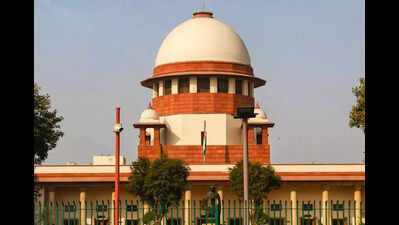
New Delhi: Supreme Court on Monday agreed to examine ways and means to protect Mumbai’s parks, gardens and maidans as an NGO said land mafia and builders are encouraging encroachments to gobble up these open spaces that serve as green lungs by misusing the policy for in-situ rehabilitation of slumdwellers.A bench of CJI Surya Kant and Justice Joymalya Bagchi said passing orders to protect non-encroached parks, maidans and gardens is easy, but it would be a complex issue to order removal of those who have been living in slums in such open areas for years. “Slumdwellers must have basic amenities in their houses. At the same time, if one person encroaches on an open area and it gets reserved for in-situ rehabilitation of slumdwellers, then it is a problem of different magnitude,” the CJI-led bench said and sought responses from the Maharashtra govt and BMC. Appearing for NGO Alliance for Governance and Renewal (NAGAR), senior advocate Shyam Divan said the petitioner had no objection to in-situ rehabilitation of slumdwellers, but it cannot be done on open spaces encroached upon. “They can be rehabilitated around the same area, sparing the open areas for common use of citizens,” he said. He said Development and Control Regulations (DCR), 1991, had specified that if 25% or more of an open space is encroached upon by slumdwellers, then that site is to be used for in-situ rehabilitation by building pukka houses for them. But DCR, 2034, issued by the Maharashtra govt in 2018, states that no minimum percentage of a plot area of 500sqm is required for in-situ rehabilitation of encroachers on the land, Divan said, adding that this is a clear invitation to land mafia and builders to encourage encroachment, and even if one hut is erected on such an open space, it would be reserved for in-situ rehabilitation. “Slum rehabilitation is virtually an industry in the city of Mumbai,” he said. Challenging the provision in DCR 2034, the petitioner said, “Perpetuating the illegality of encroachment by sanctioning construction leads to irreversible consequences. Areas lost to construction cannot be regained. Encroachers are forgiven and rewarded; private rights are created in favour of third parties (purchasers of the free sale component) of the redeveloped area (close to 50% of the reconstructed area or 33% of the total area). The loser is the larger public, which is forever deprived of that area, meant for public use and access.” The appeal before SC was drafted by senior advocate Madhvi Divan, who 24 years ago had drafted the first petition on this issue that was filed before Bombay high court. Both she and Shyam Divan presented the case before the CJI-led bench.