

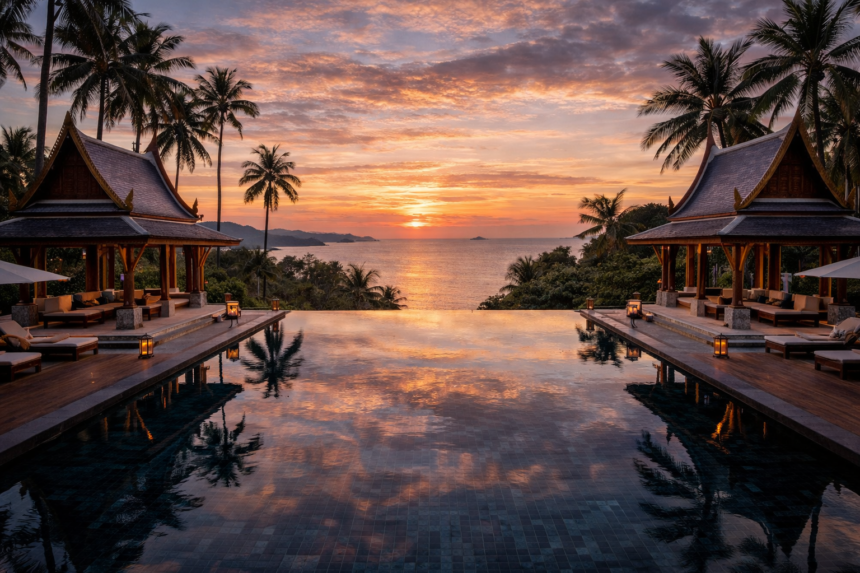
Aman Resorts : In a world saturated with opulent hotels vying for attention with grand chandeliers and extravagant displays, Aman Resorts stands apart with a whisper, not a shout. Drawing its name from the Sanskrit word for ‘peace’, Aman has, since its founding in 1988, pioneered a philosophy of quiet luxury that has reshaped the very definition of high-end hospitality. It is a brand that has cultivated not just customers, but devoted followers—affectionately termed “Amanjunkies”—who plan their lives and travels around the serene sanctuaries scattered across the globe. This is not merely a story of beautiful hotels; it is the story of a radical idea that intimacy, space, and profound respect for place could become the ultimate luxuries.
What began as founder Adrian Zecha’s personal quest for a holiday home in Phuket blossomed into a global empire of 36 properties in 20 countries, including 15 situated near or within UNESCO-protected sites. From the cliffside pavilions of Amanpuri to the soaring urban serenity of Aman Tokyo and the desert majesty of Amangiri, each property serves as a deeply personal portal to its destination. This guide delves into the soul of Aman, exploring the history, philosophy, iconic properties, and the unique service culture that inspires unparalleled loyalty. We will journey through its past, present, and ambitious future to understand why, for many, Aman is not just a place to stay, but a state of being.
The Genesis of Peace: Adrian Zecha’s Vision
The Aman story is inextricably linked to the vision of its founder, Adrian Zecha, a man who entered hospitality almost by accident. An Indonesian-born former journalist, Zecha’s early career at Time magazine and as the founder of Asia Magazine honed his sense of storytelling and cultural nuance. His foray into hotels began in the 1970s, assisting with land deals for Marriott before co-founding the Regent Hotels chain. After a successful exit from Regent, Zecha sought to build a private holiday home on a breathtaking headland in Phuket, Thailand.
The site, however, felt too extraordinary to keep to himself. Partnering with architect Ed Tuttle, Zecha’s vision evolved from a private villa into a small, 40-pavilion retreat. On January 1, 1988, Amanpuri (“place of peace”) opened its doors. It was a stark contrast to the era’s luxury norms. There was no grandiose lobby, no ostentatious decor. Instead, Tuttle drew inspiration from ancient Thai temple architecture, using local teak, stone, and expansive, contemplative sightlines that erased boundaries between indoors and out. The resort felt less like a hotel and more like a secluded village, a concept so novel it would become the brand’s blueprint.
Zecha’s founding philosophy was disarmingly simple yet revolutionary: to create sanctuaries that felt like a gracious private home, where a limited number of guests could experience discreet, impeccable service and a profound sense of calm. He believed in “less is more,” finding opulence off-putting and prioritizing space, simplicity, and sincerity over spectacle. This ethos attracted a discerning early clientele—not necessarily the ultra-wealthy seeking status, but thoughtful travelers, often upper-middle-class, who saved specifically for the unique, meaningful experience an Aman stay promised. They were the original Amanjunkies, drawn not by a logo, but by a feeling.
Architectural Philosophy: Building Harmony with Place
If service is Aman’s soul, then architecture is its silent, powerful body. The brand’s design mandate is unwavering: each property must be a sensitive and authentic response to its geography and cultural heritage. Aman does not impose a signature style; instead, it employs world-renowned architects to interpret the spirit of a place. The result is a portfolio where no two properties are alike, yet all share a common DNA of restraint, serenity, and space.
Key architects have become legends in the Aman narrative. Ed Tuttle defined the early aesthetic with Amanpuri, Amankila (Bali), and Amanjena (Marrakech), mastering a language of flowing pavilions and local materials. Kerry Hill brought a minimalist, modernist precision infused with local context, seen in the ryokan-inspired Aman Tokyo, the fortress-like Amangalla in Sri Lanka, and the breathtaking Amankora circuit in Bhutan. Jean-Michel Gathy of Denniston is known for his dramatic, experiential designs, from the theatrical Aman Venice housed in a 16th-century palazzo to the awe-inspiring Amanyangyun in Shanghai, a project that involved the monumental relocation and preservation of ancient camphor forests and Ming-era houses.
The architectural principles are consistent:
-
Low Density: Properties typically have fewer than 55 rooms, often far fewer, ensuring privacy and a sense of exclusive sanctuary.
-
Indoor-Outdoor Living: Walls dissolve into gardens, private pools merge with horizons, and courtyards invite the sky in.
-
Use of Indigenous Materials: Local stone, reclaimed wood, traditional thatch, and regional textiles root the buildings in their landscape.
-
Cultural Narrative: Design tells a story, whether through the Bedouin tent inspiration of Aman-i-Khás or the wood-and-paper aesthetic of Aman Kyoto.
This philosophy creates what industry experts call an “architecture of restraint,” which removes visual noise and allows the natural setting—be it a desert rock face, a Japanese forest, or the Andaman Sea—to become the starring amenity.
The Evolution of Ownership: From Founder’s Passion to Global Empire
Behind Aman’s serene facade lies a history of corporate turbulence that shaped its trajectory. Following Amanpuri’s success, Zecha rapidly expanded, opening Amandari in Bali (1989) and properties in France and Bora Bora by 1992. However, the need for capital led to outside investment. In 1998, a majority stake was sold to Colony Capital, a real estate fund, leading to Zecha’s first departure. After a settlement in 2000, he returned, overseeing a prolific period that saw launches in Cambodia, India, Bhutan, and the Caribbean.
In 2007, Indian real estate giant DLF acquired Aman for $400 million. The 2008 financial crisis strained DLF, leading to the 2014 sale of the brand for $358 million to a joint venture led by Russian real estate developer Vladislav Doronin. This sale triggered a fierce ownership dispute, briefly reinstating Zecha as CEO for 17 days in 2014 before a legal settlement in 2016 confirmed Doronin as the sole owner and chairman.
Doronin’s leadership marked a decisive new chapter. While committed to preserving Aman’s core ethos, he embarked on an aggressive, visionary expansion with a clear focus on monetizing the brand’s extraordinary equity. The strategy pivoted from exclusively remote retreats to include trophy urban properties and branded real estate. The 2014 opening of Aman Tokyo proved a masterstroke, translating Aman’s serenity into a sky-high urban ryokan and demonstrating massive demand. This was followed by the $1.3 billion transformation of New York’s Crown Building into Aman New York (2022), complete with a members-only Aman Club, signaling a move into ultra-luxury urban ecosystems.
Under Doronin, Aman Group has attracted significant investment, including a $900 million infusion from Saudi Arabia’s Public Investment Fund in 2022, valuing the company at approximately $3 billion. The pipeline is now global and multifaceted, including Aman Beverly Hills, Aman Miami Beach, and the highly anticipated Aman at Sea superyacht, Amangati, set to launch in 2027. This evolution from a collection of intimate resorts to a comprehensive global lifestyle brand represents the most significant shift in Aman’s history, balancing its peaceful heritage with ambitious growth.
The Cult of the Amanjunkie: Decoding Unparalleled Loyalty
Few brands in any industry inspire the fervent, personal devotion that Aman commands. The term “Amanjunkie” was coined to describe travelers who don’t merely prefer Aman—they structure global itineraries around its properties, seeking out new openings as pilgrimages. This loyalty stems from a uniquely crafted ecosystem of service, privacy, and experience that operates on a level beyond conventional luxury.
The Aman Service Ethos: Intuitive and Invisible
Service at Aman is legendary, often described as psychic and unobtrusive. It is built on the Japanese principle of omotenashi—the art of anticipating needs without being asked. Staff-to-guest ratios are exceptionally high, reportedly around 6:1 in some resorts. The goal is to make the guest feel both utterly cared for and completely private. Staff are trained to recognize returning guests by name, remember intricate preferences (which are kept in detailed guest profiles), and execute requests with a “culture of saying ‘yes'” to anything reasonable. Stories abound of staff sourcing impossibly specific ingredients, arranging utterly private cultural encounters, or creating magical, personalized moments that transcend a standard concierge service.
Privacy as the Ultimate Luxury
For Aman’s high-net-worth clientele, many of whom live in the public eye, the absolute discretion offered is a primary draw. Properties have minimal signage and discreet entrances. Staff are rigorously trained never to acknowledge who is on property. The small scale and expansive layouts ensure guests rarely encounter others unless they wish to. This creates a “bubble” of emotional safety and relaxation that is increasingly rare in the world.
Creating a Sense of “Home”
Despite its exclusivity, Aman cultivates a warm informality. The design avoids cold, corporate perfection, and staff are encouraged to be genuine and engaging. For regulars, returning to an Aman property can feel like coming to a second home where they are known and understood. This emotional resonance transforms a transaction into a relationship, making the substantial cost feel like an investment in a personal sanctuary rather than a hotel bill.
Iconic Properties: A Journey Through the Aman World
Aman’s portfolio is a map of the world’s most breathtaking and culturally rich destinations. Here, we explore some of its most iconic properties, categorized by experience.
Asian Pioneers & Spiritual Sanctuaries
-
Amanpuri, Phuket (1988): The genesis. Its tiered black-tiled pools descending through coconut palms to the sea remain an iconic image of tropical bliss.
-
Amankora, Bhutan (2004): A unique circuit of five lodges across the Himalayan kingdom, offering a profound journey through Bhutan’s culture and landscapes. It is often cited as one of the best ways to experience this remote nation.
-
Aman Tokyo (2014): The prototype for urban Aman. A serene, 30-floor oasis with a vast internal atrium and ryokan-inspired interiors, consistently ranked among Tokyo’s best hotels.
-
Amanoi, Vietnam (2013): Perched above Vinh Hy Bay, this property is a masterpiece of contemporary Vietnamese design set within a national park.
Desert & Wilderness Retreats
-
Amangiri, Utah (2009): A monument in the desert. Its concrete suites and pool are seamlessly carved into the dramatic rock formations of the American Southwest, offering a sublime connection to the raw landscape.
-
Aman-i-Khás, India (2003): A luxurious, ten-tent safari camp near Ranthambore National Park, evoking the romance of Mughal-era encampments.
Coastal & Island Havens
-
Amanpulo, Philippines (1993): Accessible only by private plane, this private island resort with its pristine beach and crystal-clear waters is the epitome of secluded paradise.
-
Amanyara, Turks & Caicos (2006): A minimalist pavilion-style resort centered around a massive reflecting pool, leading to a serene coastline of rocky coves and white sand.
Cultural & Urban Icons
-
Aman Venice (2013): Housed in two fully restored 16th-century palazzi on the Grand Canal, it offers a sumptuous, historically immersive experience with private gardens.
-
Aman New York (2022): Doronin’s urban masterpiece. This hotel and residence in the Crown Building features a stunning three-story spa, jazz club, and the exclusive Aman Club, redefining luxury in Manhattan.
Table: A Selection of Iconic Aman Properties at a Glance
| Property Name | Location | Key Feature | Experience Type |
|---|---|---|---|
| Amanpuri | Phuket, Thailand | Founding property; black-tiled infinity pools | Beach, Heritage |
| Amangiri | Utah, USA | Seamless desert architecture; monumental landscape | Desert, Wellness |
| Aman Tokyo | Tokyo, Japan | Urban ryokan with soaring atrium; central location | City, Cultural |
| Amankora | Bhutan | Five-lodge Himalayan circuit | Cultural, Trekking |
| Amanpulo | Pamalican Island, Philippines | Exclusive private island | Island, Seclusion |
The Wellness Paradigm: Aman’s Holistic Approach
Wellness is not an add-on at Aman; it is a foundational pillar integrated into the environment and experience. Aman Wellness encompasses everything from the design of serene spaces to deeply personalized, destination-inspired treatments and programs.
Many properties are located in regions with ancient healing traditions, which are respectfully incorporated. This could mean Ayurvedic rituals in India, traditional jamu herbal medicine in Indonesia, or forest bathing (shinrin-yoku) in Japan. The Aman Skincare line, launched in 2018, extends this philosophy, harnessing powerful natural ingredients from Aman destinations for use in spas and at home.
Flagship wellness destinations like Amangiri with its vast desert spa, or Amanemu (Japan) with its natural hot spring onsens, are destinations in themselves. The brand has also partnered with figures like tennis champion Novak Djokovic to offer specialized Detoxification Programs at select resorts. This holistic approach—treating wellness as a journey for body, mind, and spirit in harmony with nature—resonates deeply with modern luxury travelers seeking transformation, not just relaxation. For an external perspective on the evolution of luxury wellness travel, which Aman helped pioneer, Conde Nast Traveler offers insightful analysis on global trends.
Looking Ahead: Aman’s Future as a Global Lifestyle Brand
Under Vlad Doronin’s leadership, Aman is executing a bold strategy to evolve from a hotel group into a comprehensive luxury lifestyle platform. This expansion is happening across multiple verticals:
-
Urban Expansion: Following Tokyo and New York, major projects are underway in Beverly Hills, Miami Beach, and Bangkok, embedding the brand in key global cities.
-
Branded Residences: Selling ultra-luxury private homes adjacent to or integrated with Aman properties has become a major revenue stream, with record-breaking sales like the $135 million penthouse at Aman New York.
-
Aman at Sea (2027): The construction of the 183-meter superyacht Amangati marks the brand’s entry into ultra-luxury cruising, offering Aman’s sanctuary-like experience on the ocean with 47 suites.
-
The Janu Brand: Launched as Aman’s “spirited sibling,” Janu (Sanskrit for ‘soul’) aims for a more social, energetic, and slightly more accessible vibe while maintaining exceptional design and service.
-
Retail & Lifestyle: From The Essentials by Aman clothing line to fine fragrances and homewares, the brand is extending its aesthetic into products that allow the “Spirit of Aman” to be experienced daily.
This aggressive growth raises questions about brand dilution. Can the intimate, secluded ethos survive in bustling city centers and on a large superyacht? The company’s strategy appears to be one of symbiosis: using high-profile urban flagships as beacons to raise global awareness and drive demand for its classic resort properties, while maintaining rigorous standards for design, service, and scale. The financial validation from blue-chip investors suggests confidence in this model.
Conclusion: The Timeless Value of Peace
The journey of Aman Resorts is a fascinating study in the evolution of luxury. From Adrian Zecha’s simple desire for a peaceful retreat has grown a $3 billion empire that continues to set the standard for understated, experiential luxury. While its ownership, strategy, and portfolio have transformed dramatically, the core appeal—the promise of serenity, profound privacy, and a deeply authentic sense of place—remains potent.
For the Amanjunkie, the brand represents a sanctuary from the noise of the modern world. For the new luxury consumer, it offers authenticity and transformative experiences over mere opulence. As Aman sails into the future with superyachts, skyscrapers, and a sister brand, its greatest challenge will be safeguarding the intangible “Spirit of Aman”—that elusive feeling of peace and belonging that first captivated the world from a coconut grove in Phuket.
In an age of constant connectivity and curated social media personas, the luxury of being truly present, truly private, and truly at peace may be Aman’s most valuable and enduring offering. It is a lesson that the loudest statement is often made in a whisper, and that the ultimate luxury is not having more, but experiencing better. To understand the architectural principles that make such spaces so powerful, ArchDaily frequently features in-depth profiles on the architects like Kerry Hill and Ed Tuttle who shaped Aman’s aesthetic. Furthermore, the business strategy behind such brand evolution is complex; The Business of Fashion has covered the expansion of luxury hospitality brands into broader lifestyle empires, providing context for Aman’s own journey.