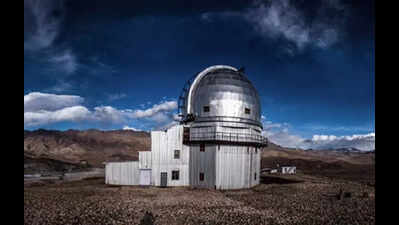
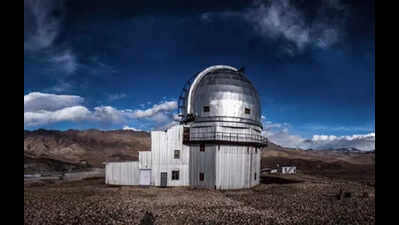
Pune/Bengaluru: India’s expanding contributions to astronomy research appear to have prompted a significant policy and funding push from the Centre, with Union finance minister Nirmala Sitharaman announcing support for four major projects in the Union Budget 2025–26. The initiatives — National Large Solar Telescope (NLST), National Large Optical-Infrared Telescope (NLOT), an upgrade of Himalayan Chandra Telescope (HCT), and COSMOS-2 planetarium — aim to strengthen both research capability and science outreach.In her Budget speech in Parliament on Sunday, Sitharaman said the Centre would upgrade or establish these facilities to “promote Astrophysics and Astronomy via immersive experiences”. While individual allocations have not been detailed, the Budget provides Rs 1,623.87 crore in assistance to autonomous bodies, including the Indian Institute of Astrophysics (IIA), Bengaluru. The IIA director, professor Annapurni Subramaniam, told TOI that the institute will implement the projects. Scientists from the Inter-University Centre for Astronomy and Astrophysics (IUCAA) and the National Centre for Radio Astrophysics (NCRA) said the announcement could substantially boost India’s ability to conduct frontline research domestically, reducing dependence on overseas observatories. They said improved access to world-class facilities could encourage students to pursue advanced research in India while attracting global collaborations and retaining young scientific talent.The NLST will be located near Pangong Lake in Ladakh, which IIA has identified as an ideal high-altitude site. “…this location is best suited for optical and near-IR observations. The site also provides significant periods of coronagraphic skies (high transparency). The laminar winds with mild gusts throughout the day provide periods of outstanding seeing.” The NLOT, as outlined by IIA, will be a larger 10-12 metre facility in Hanle, Ladakh. It will operate across optical and infrared wavelengths, enabling observations of distant galaxies, star-forming regions and exoplanets. Hanle has emerged India’s principal astronomy site due to its clear skies, low atmospheric moisture and minimal light pollution. HCT has operated here since 2000, supporting studies of variable stars, supernovae and active galaxies. The Budget proposes upgrading the HCT to extend its capabilities.COSMOS-2 will be built in Amaravati, Andhra Pradesh, as an education and outreach facility with digital projection systems and interactive exhibits. IIA recently signed a memorandum of understanding with the Andhra Pradesh government to implement this project.The institute is also close to completing COSMOS-1, an LED dome planetarium and research training centre in Mysuru. “This will be the world’s first independent 8K resolution LED dome planetarium, which is the next big leap in planetarium technology,” says IIA.Professor Raghunathan Srianand, director of IUCAA, said the concept of a National Large Optical and Infrared Telescope gained traction after India developed key technologies through its participation in the Thirty Meter Telescope (TMT) project. “The question is whether we can leverage that knowledge to build an indigenous telescope that is larger than what we currently have — our biggest telescope right now is about 10 metres,” he said. “This was discussed for some time, including during TMT-related discussions, and it’s possible that after this announcement, agencies like the department of science and technology (DST) or national research foundation (NRF) may ask institutions to submit more detailed reports.”Yashwant Gupta, centre director at NCRA, said, “It’s very good news that at the highest level in the government, there is recognition of the work happening in Indian astronomy. The HCT has been functional for almost 25 years and is ready for a major upgrade, while the next-generation large optical telescopes have been in discussion for a long time. These will nicely complement the GMRT, our world-class facility for radio astronomy.“