

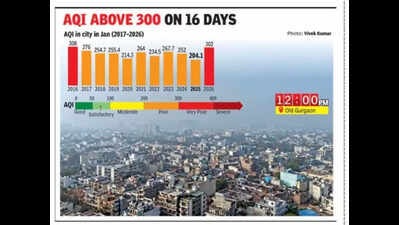
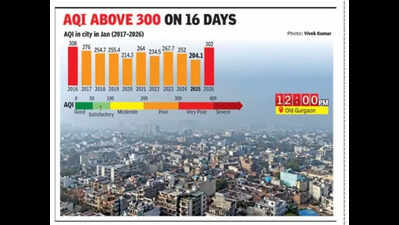
Gurgaon: The city has logged the worst Jan air in nine years — there were no ‘satisfactory’ and ‘good’ air days; just two ‘moderate’ days and the air quality index (AQI) breached 300 mark on 16 days of the month, one of which neared 400.The most polluted Jan in recent years offered virtually no respite, with most days stuck in the ‘poor’ or ‘very poor’ range in the city. The city recorded a monthly average AQI of 302, firmly in the very poor category. Average AQI for Jan 2016 was 308 and for Jan 2017, it was 276. This — the Jan average this year — surpassed the previous Jan peak of 263.9 in 2021 and marked a sharp deterioration from Jan 2025’s average of around 204, data compiled from daily readings between 2016 and 2025 shows.“The absence of ‘satisfactory’ air days indicates that this is no longer a winter season problem but a serious environmental crisis. It is necessary that immediate steps are taken to control emissions, along with more serious public health warnings and long-term air quality planning for urban areas,” critical care and pulmonology head at Gurgaon’s CK Birla Hospital Dr Kuldeep Kumar Grover told TOI.Prolonged polluted spells were observed through the middle and latter half of the month, when readings repeatedly hovered above 350. Jan averages over the years highlight how steep this year’s spike was. The city recorded about 255 in 2018, 255 in 2019, dipped to nearly 214 in 2020, rose to around 264 in 2021, fell to roughly 234 in 2022, climbed to about 268 in 2023, hovered near 252 in 2024, dropped to around 204 in 2025, before jumping to 302 this winter.For residents, the numbers mean nearly the entire month was spent breathing unhealthy air, wiping out improvements seen in recent years and pushing Jan pollution to its highest level in at least eight winters. The data underscores a deeper concern: without sustained action on transport emissions, dust control and regional coordination, extreme winter air is fast becoming the norm rather than the exception.Grover (CK Birla Hospital) added, “Jan’s air quality data from Gurgaon is serious and indicates a serious health warning. A monthly average AQI of 302 and several days around 350-400 indicates that the city breathed life-threatening air for several days without any chance of a recovery period. This poses an increase in the risk of respiratory infections, asthma attacks, heart attacks, strokes and chronic lung damage, particularly in children, the elderly, and those with pre-existing conditions.“According to experts, the surge reflects a familiar pattern of adverse winter meteorology layered over steady local emissions.A senior official from Haryana State Pollution Control Board said, “Suspended road dust continues to play a significant role. Construction activities and broken road surfaces worsen resuspension. Unless emission control is strengthened across sectors, winter pollution will remain stubborn.”Analysts from Centre for Research on Energy and Clean Air said low wind speeds, shallow mixing heights and temperature inversions trap pollutants close to the ground during north Indian winters. When this combines with emissions from vehicles, construction dust, waste burning and regional sources, pollution accumulates faster and clears more slowly.On several days, all monitoring stations in the city reported ‘poor’ to ‘very poor’ air simultaneously, with sharper spikes coinciding with calm wind conditions. Officials said suspended road dust and traffic emissions continue to be major contributors, especially along damaged stretches and active construction zones.Neighbouring NCR cities, including Delhi, also experienced sustained winter pollution, with large parts of the region spending most days in the ‘very poor’ category.