

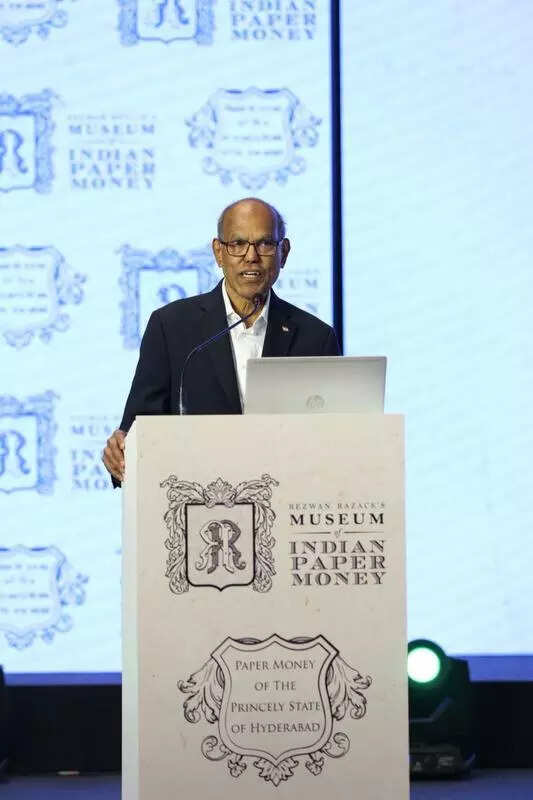
Reflecting on how money is being reshaped by technology, Subbarao said the country is once again at a moment of monetary disruption. “Today, we go into another transformation. Digital money… so many of the questions that we considered earlier are resurfacing today because money is being imagined and reimagined in a digital form,” he said. He pointed to cryptocurrencies as a sign of how radically the idea of money is changing. “In fact, cryptocurrencies are being issued by private entities,” he noted, posing a fundamental question: “Does the issue of money have to be a monopoly?”Tracing the origins of paper currency in India, Subbarao reminded the audience that disruption is nothing new. “Paper money was first introduced in this country in the mid-18th century in the Calcutta and Madras presidencies by a few banks. The introduction of those banknotes marked one of the most significant disruptions in India’s monetary history,” he said and explained the financial architecture that supported paper money. “The issuing banks typically kept a fraction of the value of currency as precious metal in reserves. That’s how we got a fractional reserve system, which continues even today,” he said.But beyond economics and policy, Subbarao underscored the emotional and historical value of currency. “To most policymakers, central bankers, and academics, currency notes are just money. In your community of note collectors, though, they are much more, as they tell stories,” he said.Echoing concerns about a paperless future, Razak, who has authored ‘Paper money of the princely state of Hyderabad’ spoke of the urgency of preserving this fading legacy.“In times to come, I think everything is going to be converted and all paper money is going to become history,” he said. “It is very important for us to save and restore, or note, this legacy. All of us should keep one note of each type in our collection, at least to tell the children that this is what we used to go to the grocery store with and buy. There are children born beyond 2016 who don’t know what Rs 2,000 or Rs 1,000 notes were like.” Adding a broader perspective to legacy and memory, Irfan Razack, managing director of Prestige Group, said what endures is not wealth, but impact.