


The story of America can be told through the lyrics of folk music – songs of the Great Depression, the civil rights era, and the social revolutions of the 1960s. As folk singer Pete Seeger put it in 1967, “A song isn’t a speech; a song is not an editorial. If a song tries to be an editorial or a speech, often it fails as a song. The best songs tell a story, paint a picture, and leave the conclusion up actually to the listener.”
It ain’t the banks
And it ain’t the taxes
It ain’t the payday loans and the high rent homes
And predatory fees and practices …
If you worked a little harder
Then you’d have a lot more
So the blame and the shame’s on you
For being so damn poor, yeah
From “The Poor”

CBS News
If it seems fitting right now to have a guy with six strings singing about the times, Welles said, “Every dog has its day!”
Well, it’s your own damn fault you’re so damn fat
Shame, shame, shame
All the food on the shelf was engineered for your health
So you’re gonna have to take the blame
From “Fat”
Welles can be soft-spoken in person, but behind the microphone he sings loud and clear. He takes aim at anyone he thinks takes advantage of working people – the “folks” in folk music.
There ain’t no “you” in UnitedHealth
There ain’t no “me” in the company
There ain’t no “us” in the private trust
There’s hardly “humans” in humanity
From “UnitedHealth”
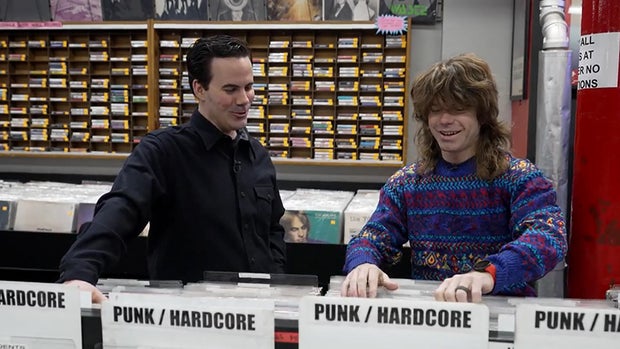
At a Greenwich Village record store last fall, Welles dug through his musical roots, and his mother’s influence: “She really liked Crosby, Stills and Nash, and she liked Fleetwood Mac,” he said. “She liked pretty, pretty music. But no one was really talking about Dylan. So, I suppose that was maybe the first solo space mission I flew, was to go and find, like, some hard folk music.”
CBS News
He was in New York to perform on CBS’ “The Late Show with Stephen Colbert,” where he chose a song that speaks to the unease some feel about our moment in history:
Join ICE,
Boy, ain’t it nice?
Join ICE
Take my advice
If you’re lackin’ control and authority,
Come with me and hunt down minorities
Join ICE
From “Join ICE”
Welles is up for four Grammy Awards Sunday, recognition that this troubadour from Ozark, Arkansas, never expected, especially considering his talents seemed to be more on the football field rather than the stage.
He wasn’t always comfortable with his voice, which his sister said sounds like burnt toast. “But burnt toast is still edible!” he laughed.
With that simple and direct “‘burnt toast” sound, Welles gets millions of views on social media.
War isn’t murder
Good men don’t die
Children don’t starve
And all women survive
War isn’t murder
That’s what they say
When you’re fighting the devil
Murder’s okay
From “War Isn’t Murder”
He tapes himself, alone in the Arkansas hills, with lyrics that can seem ripped from the headlines, as in “No Kings.” But he laughs when asked if he sees himself as a political figure: “A political … ? Wow! No!”
Those songs got their start in his spare bedroom-turned-studio, where he played for us a new one:
I knew a man, his only wish
To answer to no one, drink like a fish.
He worked real hard and he got it all.
There was plenty to drink, and no one to call.
If you look down the road, you’ll see the sun
And it makes time, as you take time,
Just to end where you’ve begun.
I’ve got peace like a river.
I’ve got time.
I don’t need a thing
That ain’t already mine.
From “Peace Like a River”
Asked what he’s trying to say in his songs, Welles replied, “I can’t tell you what it means. Like, it’s up to everybody. Nobody is going to paint anything and tell you, ‘This is what I mean when I painted this.’ You know, that’s no fun. That takes away your experience.”
Welles has been embraced by legends of folk and rock. He recently performed with John Fogerty, and late last year he went into the studio with Joan Baez, bridging generations and bringing in new audiences.
Joan Baez and Jesse Welles perform “Don’t Think Twice It’s Alright” at The Filmore in San Francisco:
For Jesse Welles, it is his way of keeping the spirit of American folk music alive. “I think it’s important that it doesn’t go away,” he said. “It’s something that you know has been going on, it’s been going on for centuries and centuries. You wake up one morning and you go, this is what I do. This is what I was supposed to do.”