

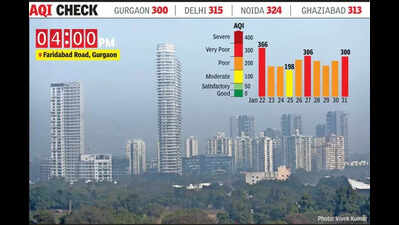
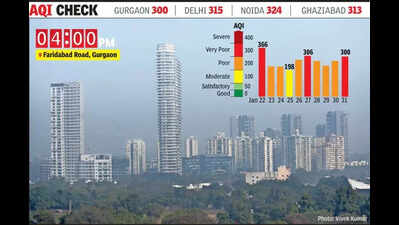
Gurgaon: The city’s air quality worsened on Saturday and remained just one point short of the ‘very poor’ category, with air quality index (AQI) rising to 300 from 268 a day earlier.Two of the four monitoring stations recorded ‘very poor’ air quality. Sector 51 recorded an AQI of 360, followed by Vikas Sadan at 333. The other two stations remained in the ‘poor’ category, with Teri Gram at 253 and Gwalpahari at 235. Forecasts indicate that air quality may deteriorate further in the coming days and slip into the ‘very poor’ category.According to system of air quality and weather forecasting and research (Safar), weather conditions on Sunday are expected to remain unfavourable for the dispersion of pollutants due to low wind speeds and limited ventilation. “A ventilation index below 6,000 m²/s and average wind speeds of less than 10kmph are not conducive to pollutant dispersion,” Safar said.The agency said surface winds are likely to be from the north, with calm conditions in the morning. Wind speeds may increase to about 5kmph during the day and reach around 8kmph in the afternoon before weakening again to about 5kmph in the evening and night.Safar also projected a maximum mixing depth of 1,150m and a ventilation index of 3,000 m²/s on Sunday. These conditions indicate limited vertical mixing and weak air movement, which can trap pollutants near the ground.Particulate pollution levels remained high across the city. PM2.5 concentrations exceeded safe limits at all monitoring stations. Sector 51 recorded 500 µg/m³, followed by Vikas Sadan at 463 µg/m³, Gwalpahari at 365 µg/m³, and Teri Gram at 348 µg/m³. The World Health Organisation’s 24-hour guideline for PM2.5 is 15 µg/m³.PM10 levels were also significantly above safe limits. Sector 51 recorded 500 µg/m³, Vikas Sadan 445 µg/m³, Gwalpahari 259 µg/m³, and Teri Gram 215 µg/m³. The WHO’s 24-hour guideline for PM10 is 45 µg/m³.Central Pollution Control Board’s annual permissible limits of 60 µg/m³ for PM2.5 and 100 µg/m³ for PM10 were breached at almost all monitoring stations.