


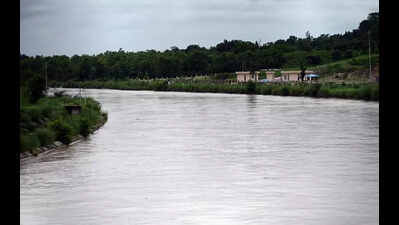
Chandigarh: The Punjab water resources dept has claimed that with the expansion of the state’s irrigation network, canal water is now being delivered to over 1,356 outlet locations after remaining dry for several decades.The dept’s latest comparative figures for 2024 and 2025 show a continued upward trend in water volume. The Sohelewala distributary, for example, has recorded moving from a nominal 1 Cusec in Kharif 2024 to an average of 23 Cs in Kharif 2025. Similarly, the Karamgarh distributary saw its average flow surge from 9 Cs in Kharif 2024 to 38 Cs in Kharif 2025, a 320% increase. The Nizamwah Distributary more than doubled its capacity, rising from 125 Cs in 2024 to 284 Cs in 2025.Besides the agricultural benefits, the canal water expansion aims to stabilise the state’s groundwater levels. With approximately 73% of Punjab’s irrigation currently dependent on tubewells, the shift towards surface water is intended to alleviate the strain on over-exploited aquifers.“Between FY 2022 and 2025, Rs 4,557 crore was spent on canal lining, repairs and watercourse restoration. Over 15,539 km of canals were cleaned, 18,349 watercourses were restored, and 1,356 locations received canal water after a long gap. The area under canal irrigation expanded from 2.23 million in 2022 to 4.78 million acres in 2025,” said an official. As per the data, 57 locations (serving 47 villages) received canal water for the first time in 2023 in their entire history as part of the restoration drive.Meanwhile, farmers note that the reliance on “Khal Restoration” and desilting requires continuous maintenance. Without regular investment, these newly functional watercourses—some of which were dormant for up to 35 years in districts like Fazilka and Amritsar—are prone to rapid siltation. Furthermore, the 2025 figures show uneven growth in some areas. While some distributaries more than doubled their capacity, others, such as the 2-R Distributary in the BML division, remained nearly static, with a mere 2% increase from 2024 to 2025. This disparity indicates that certain regions still face structural bottlenecks.In 2023, while over 17,000 watercourses were targeted for restoration, the actual delivery of water at the “tail-end” often depends on the head-regulator discharge and rainfall patterns. Farmers in some areas noted that while the water reaches their village, the pressure is not always sufficient to irrigate elevated fields, necessitating the use of diesel pumps.