

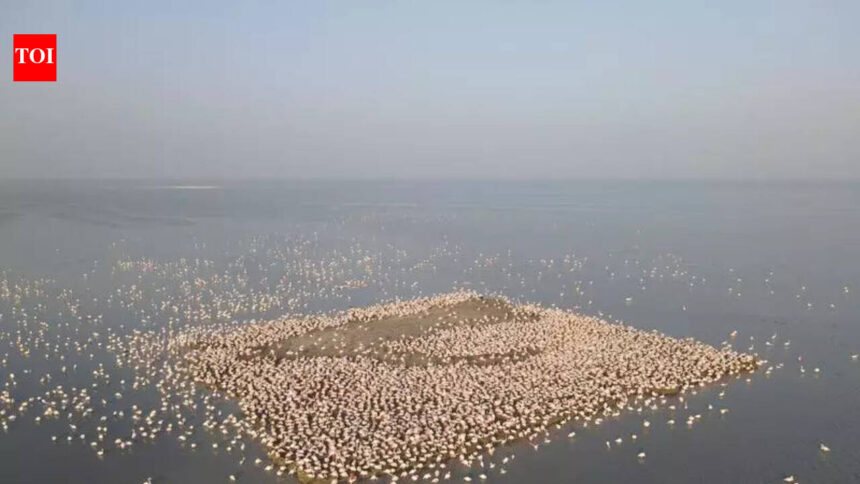
Ahmedabad: Gujarat’s annual waterbird census has documented the redrawn winter map of migration in Gujarat. The numbers are staggering: 6.42 lakh birds at Nalsarovar alone. Thol, too, has posted its best count of 74,400 birds since 2010. But amid this abundance of nearly 7.2 lakh birds, flamingos — once the visual signature of these two Ramsar-recognised wetlands — were largely absent.With just around 1,622 recorded across both wetlands, the iconic species has largely moved elsewhere. Ahmedabad’s loss is Kutch’s gain as large colonies are instead thriving in the Rann of Kutch, say experts.Foresters recorded the presence of 10 lakh flamingos in Nadabet wetland at the end of Jan. Improved breeding conditions there appear to have tipped the balance.Nalsarovar recorded a historic 6.42 lakh birds, the highest in its recorded history. Thol logged 74,000 birds, its strongest count in the past 15 years. Together, the two Ramsar-recognised wetlands and hosted remarkable diversity, with 270 species recorded at Nalsarovar and 205 at Thol.But for bird-watching enthusiasts, the dwindling number of flamingos caused heartbreak. Ornithologists pointed out that Nalsarovar, once reported flamingo congregations of over 25,000 during overall bird counts of 1.5 to 2 lakh. However, according to the current census, the combined count of flamingos at the two lakes stood at only around 1,622, with officials stating that Thol had virtually no flamingos this season.Aradhana Sahoo, chief conservator of forests, Nalsarovar, said: “The 6.42 lakh figure was the highest ever recorded at Nalsarovar. Gujarat had seen a strong migratory presence this year, with bird colonies reported in Nadabet in Kutch and other areas.”Experts tracking bird movements across western India said flamingos appear to have shifted their centre of activity to Kutch. Unseasonal rainfall helped retain water in parts of the Greater and Little Rann of Kutch, improving vegetation and feeding grounds — key factors for congregation and breeding.Uday Vohra, ornithologist and former forest officer associated with multiple census exercises, said large colonies were observed in both the Greater and Little Rann, indicating Kutch had emerged as the principal hub this season. He noted that flamingos may still arrive at Nalsarovar in the final leg of the season, which runs until April, but current concentrations are elsewhere. Observers also reported that flamingos were scarce at traditional sites such as Porbandar and Thane Creek near Mumbai, suggesting the birds are responding to a broader set of habitat cues and breeding opportunities concentrated in Kutch this year.Forest department interventions appear to have strengthened Kutch’s appeal. Ten artificial breeding platforms were created in 2020-21. Nesting was recorded in July 2021, but breeding failed due to low rainfall. After a good monsoon in 2022, nesting occurred across all platforms, with eggs laid in July 2022. Each platform, measuring 100x10x1m, prevented eggs from being washed away during heavy rain. If needed, water was supplemented through tankers. Subsequent enumeration reported 1.78 lakh greater flamingo chicks, 97,700 lesser flamingo chicks, and 82,900 chicks whose species could not be identified.“With Kutch offering better water availability, safer nesting sites and improved feeding grounds, flamingos are prioritising Kutch over inland wetlands this year,” said a senior forest official.Ornithologists also attributed the surge in overall bird numbers at Nalsarovar and Thol partly to the absence of tourism activity. Around 250 boatmen operated at Nalsarovar before boating was suspended following the Harni tragedy in Vadodara in Jan 2024. Experts said that the increase in numbers showed that minimal human interference in sensitive wetland habitats could directly lead to greater bird abundance, with undisturbed zones encouraging larger congregations and longer stays.